Kasteel
Plassenburg
🇩🇪 Duitsland · 12e eeuw
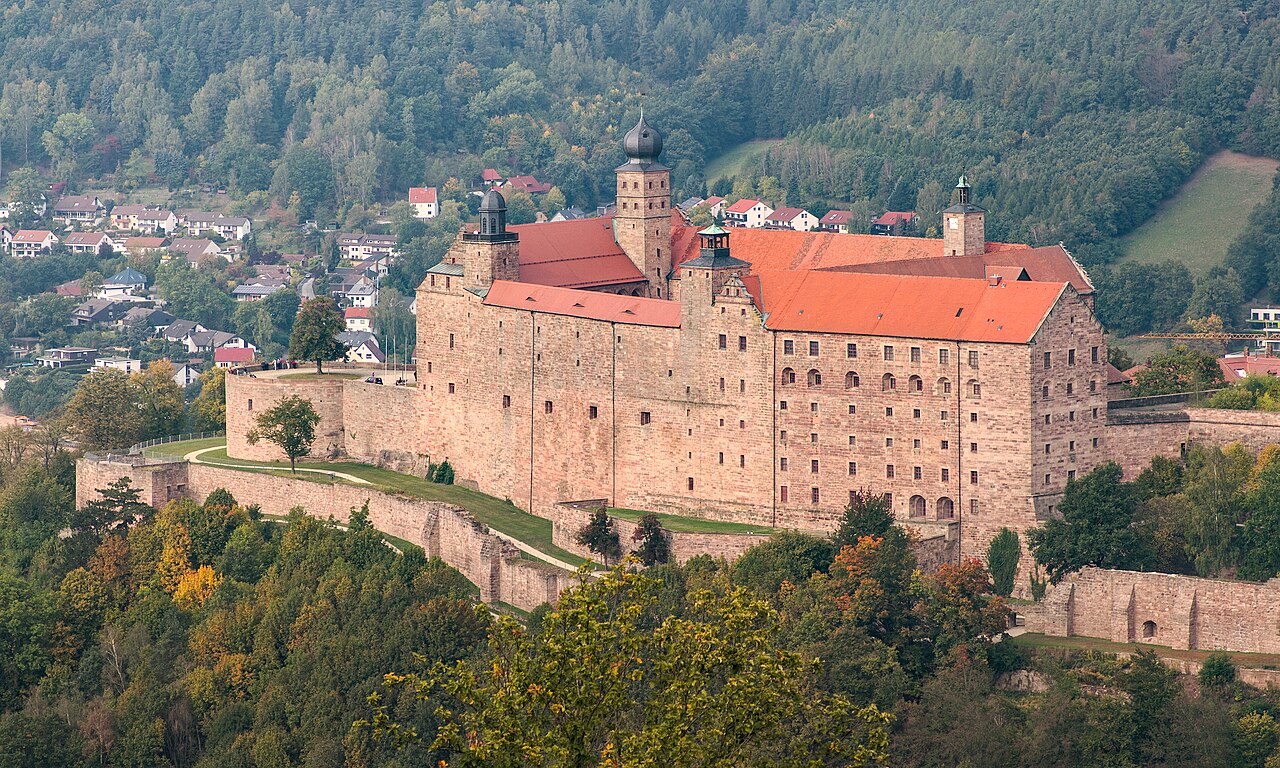
Plassenburg is een kasteel in de stad Kulmbach in Beieren. Het is een van de meest indrukwekkende kastelen van Duitsland en een symbool van de stad. Het werd voor het eerst vermeld in 1135. De familie Plassenberg was ministeriaal van de graven van Andechs (later de hertogen van Andechs-Meranien) en gebruikte de Plassenburg als hun zetel. Het huis Guttenberg, een prominente Frankische adellijke familie, voert zijn oorsprong terug tot 1149, met een Gundeloh v. Blassenberg (Plassenberg). De naam Guttenberg is afgeleid van Guttenberg en werd rond 1310 aangenomen door een Heinrich von Blassenberg. Vanaf 1340 regeerden de Hohenzollerns vanuit Plassenburg kasteel over hun gebieden in Franken, tot 1604. De Plassenburg was voor de Hohenzollerns zowel vesting als residentie.
Het werd in 1554 verwoest aan het einde van de Tweede Markgraafse Oorlog (1552-1554) van markgraaf Albrecht Alcibiades. De Plassenburg werd later door architect Caspar Vischer herbouwd tot een indrukwekkend bolwerk en een enorm paleis. In 1792 verkocht markgraaf Alexander de Plassenburg aan zijn neef, de koning van Pruisen. Een gecombineerd Beiers en Frans leger, onder bevel van Jérôme Bonaparte, broer van Napoleon, belegerde de Plassenburg in 1806. In 1810 werd Kulmbach Beiers, en het kasteel werd gebruikt als gevangenis en als militair hospitaal. Tijdens de Tweede Wereldoorlog gebruikte de Organisation Todt de Plassenburg als trainingskamp en herstellingsoord. Tegenwoordig is het een museum en een locatie voor culturele evenementen.
Het bevat een aanzienlijke collectie Pruisische militaire voorwerpen en portretten.
Machinaal vertaald uit “Plassenburg” op de Engelstalige Wikipedia, CC BY-SA 4.0.
Plassenburg staat op plaats 1.202 van 8.134 in de bekendheidsranglijst van deze atlas en op plaats 95 van de 505 die de atlas in Duitsland in kaart brengt. Gebouwd in 1135, en daarmee ouder dan 84% van de gedateerde bouwwerken in de atlas — een van de 564 bouwwerken in de atlas die uit de 12e eeuw stammen. De Wikipedia-artikelen erover werden de afgelopen 60 dagen 4.316 keer geopend, meer dan 83% van de atlas. Zie hoe dat zich verhoudt in de kastelenstatistiek.
Bekijk op de interactieve kastelenkaart →Veelgestelde vragen
Waar ligt Plassenburg?
Plassenburg ligt in Duitsland, op 50.108°, 11.464°.
Wanneer werd Plassenburg gebouwd?
De atlas dateert de stichting op 1135. Er kunnen eerdere bouwwerken hebben gestaan; dit is het oudste gedocumenteerde bouwjaar.
Hoe bekend is Plassenburg?
In de bekendheidsranglijst van deze atlas: plaats 1.202 van 8.134 wereldwijd, plaats 95 in Duitsland. Bekendheid combineert het aantal Wikipedia-taalversies met het aantal lezers.
Welk kasteel ligt het dichtst bij Plassenburg?
Waldsteinburg, ongeveer 28 km verderop.
Meer kastelen in Duitsland
- Burcht Stahleck Duitsland · 12e eeuw
- Kasteel Trausnitz Duitsland · 13e eeuw
- Marburger Schloss Duitsland · 12e eeuw
- Slot Blutenburg Duitsland · 15e eeuw
Meer kastelen
- Buonconsiglio Castle Italië · 13e eeuw
- Deal Castle Engeland · 16e eeuw
- Bolton Castle Engeland · 14e eeuw
- Duart Castle Schotland · 13e eeuw