 Germany · 16th century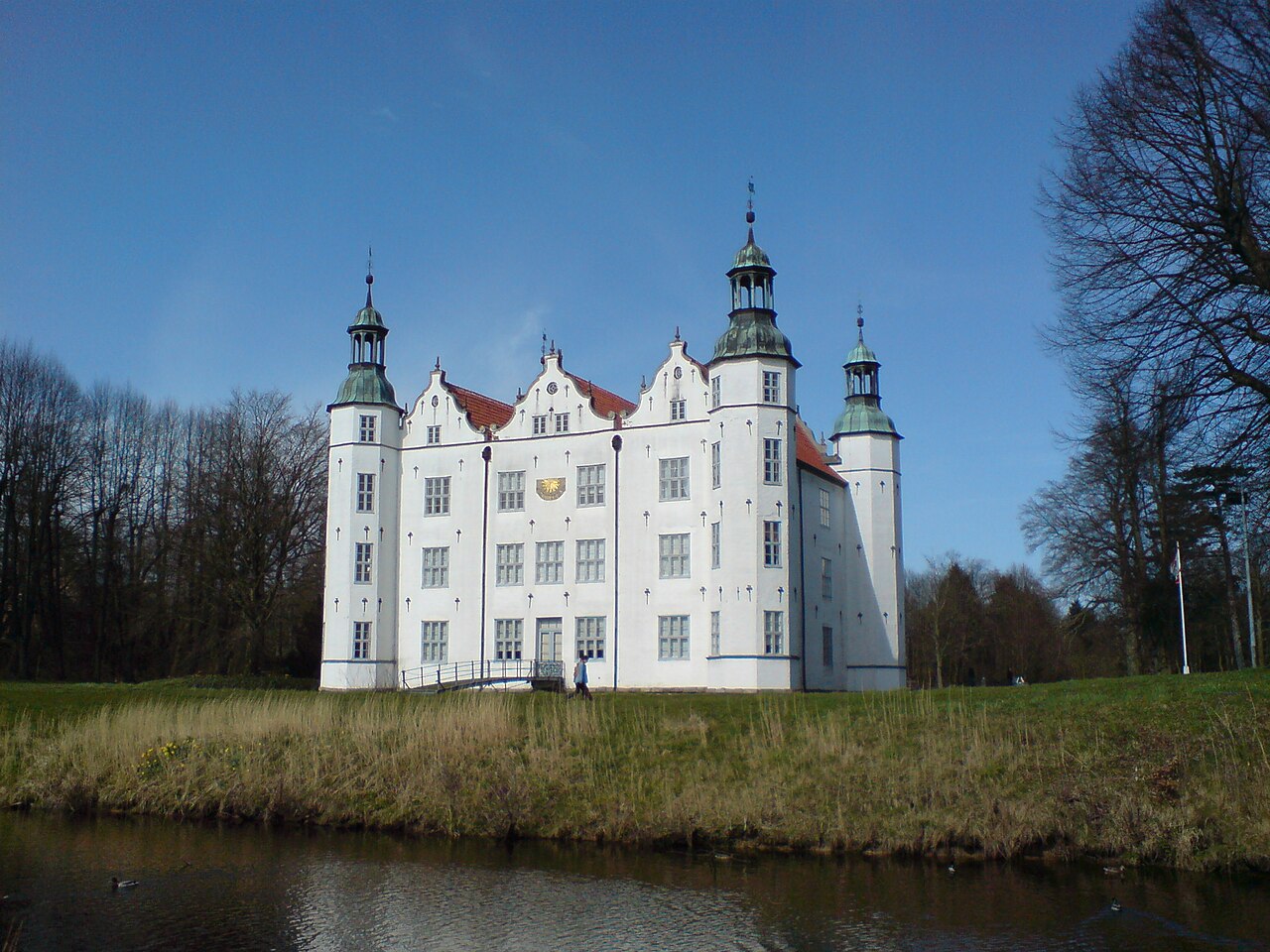
Schloss Ahrensburg (Ahrensburg Palace) is a former Herrenhaus (mansion) and is today referred to as a Schloss. It is located in Ahrensburg in southern Schleswig-Holstein, Germany, not far from the city of Hamburg.
In the 13th century, there was a mansion with a moat and defensive towers known as Burg Arnesvelde, about three kilometers south of today's Schloss Ahrensburg. In 1327, the fortified mansion was owned by the church. During the Reformation the property came into the hands of the Danish King Frederick II, and in March 1567 Arnesvelde was transferred to Daniel Rantzau as compensation for work done and debts the king had run up. After Rantzau's death in 1569 during the Siege of Varberg his brother Peter took over the mansion. He tore down parts of the castle and started building what was to become today's Schloss Ahrensburg.
The original structure on the island in the artificial pond/moat was built after 1585 at the initiative of Peter Rantzau, of the Rantzau family. Even at that time, the moat only served artistic rather than defensive purposes.
Ahrensburg was a representative of the short-lived Mehrfachhaus-type of Renaissance mansion, in which a rectangular building was doubled (Wahlstorf) or trebled (Ahrensburg, Schloss Glücksburg). As this type had architectural disadvantages it was soon replaced by others. The four corner turrets were not part of the original design but added only later during construction.
In 1594-96, the nearby chapel was built, together with some residential outbuildings which served as an infirmary for the old and sick.
Ahrensburg remained with the Rantzau family for seven generations. In 1759, they were forced to sell it, however. It was purchased by Heinrich Carl von Schimmelmann, a merchant from Hamburg. He transformed the local economy, the appearance of the nearby village and the interior of the castle, turning it into a late-Baroque court. He also removed the outbuildings (stables, coach house, etc.) from the castle's island and filled in the innermost of the two moats. It is likely that the use of white paint also dates to this period and that the castle previously featured unplastered brick walls with sandstone ornaments.
From 1759 to 1778, Ahrensburg served as Schimmelmann's summer residence and remained his family's main seat in the 19th century.
Text adapted from “Schloss Ahrensburg” on Wikipedia, CC BY-SA 4.0.
Ahrensburg Castle ranks #1,704 of 9,079 worldwide in the atlas's castle fame ranking, and #133 of the 711 mapped in Germany. Founded c. 1585, it is older than 33% of the atlas's dated landmarks — one of 891 atlas entries founded in the 16th century. Its Wikipedia articles were opened 2,662 times in the last 60 days, more than 75% of the atlas. 3 more atlas landmarks stand within 25 km. See how Germany compares in the castle statistics.
View on the interactive castle map →