 Scotland · 13th century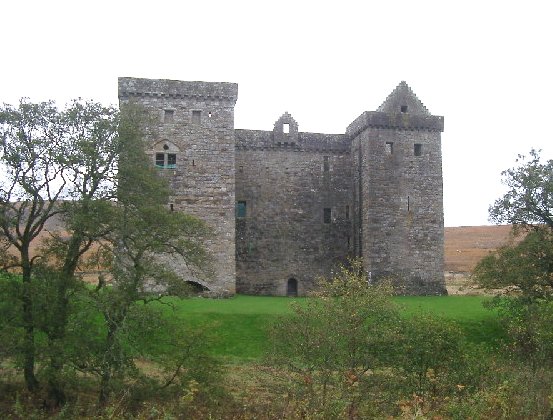
Hermitage Castle is a semi-ruined castle in the border region of Scotland. It stands in the remote valley of the Hermitage Water, part of Liddesdale in Roxburghshire. It is under the care of Historic Scotland. The castle has a reputation, both from its history and its appearance, as one of the most sinister and atmospheric castles in Scotland.
It is thought that the name derives from Old French: l'armitage – guardhouse. The castle was known as the guardhouse of the bloodiest valley in Britain, and the "Strength of Liddesdale".
Hermitage Castle was supposedly built by one Nicholas de Soulis around 1240, in a typical Norman Motte and Bailey pattern. It stayed in his family until approximately 1320 when his descendant, William de Soulis, forfeited it because of suspected witchcraft and the attempted regicide of King Robert I of Scotland. Legend has it that Soulis's tenantry, having suffered unbearable depredations, arrested him, and at the nearby Ninestane Rig (a megalithic circle), had him encased in lead sheet and boiled to death. In actuality, he died, a prisoner, in Dumbarton Castle.
In 1338, the then incumbent, Englishman Sir Ralph de Neville was besieged by Sir William Douglas, The Knight of Liddesdale, known as the "Flower of Chivalry". It was here that Douglas imprisoned and starved to death Sir Alexander Ramsay of Dalhousie. his competitor for royal favour.
After the Battle of Neville's Cross and Liddesdale's capture by the English, the castle fell into the hands of the English for a time and was given to the care of William Dacre, 2nd Baron Dacre. Upon Liddesdale's death, brought about by a near kinsman, William Douglas, 1st Earl of Douglas, the castle was given to the then baron but later 1st Earl of Douglas. He enabled the construction of most of the present building, possibly with the help of John Lewin, master mason at Durham Cathedral. The castle remained in the hands of the Black Douglases until 1455. The Black Douglas line had so incensed the King that James Douglas, 9th Earl of Douglas was forfeited, never to return to Scotland, and the beneficences that they had enjoyed passed to the Red Douglas line, including Hermitage Castle.
King James IV was suspicious of the then Earl of Angus, Archibald, Bell the Cat and his relationship with Henry VII of England, and ordered him to relinquish The Hermitage to the Crown.
Text adapted from “Hermitage Castle” on Wikipedia, CC BY-SA 4.0.
Hermitage Castle ranks #1,155 of 9,079 worldwide in the atlas's castle fame ranking, and #37 of the 226 mapped in Scotland. Founded 1240, it is older than 72% of the atlas's dated landmarks — one of 1080 atlas entries founded in the 13th century. Its Wikipedia articles were opened 6,165 times in the last 60 days, more than 89% of the atlas. 3 more atlas landmarks stand within 25 km. The nearest day-trip guide is Newcastle upon Tyne, 81 km away. See how Scotland compares in the castle statistics.
View on the interactive castle map →