Ruin
Aizpute Castle
🇱🇻 Latvia · 13th century
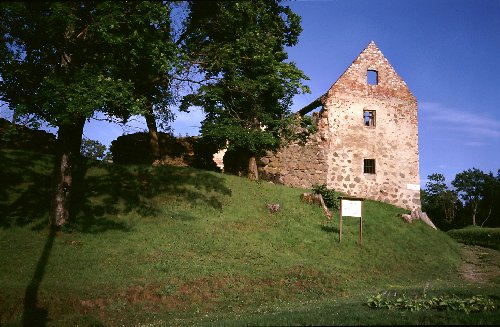
Aizpute Castle (German: Ordensburg Hasenpoth) is a Livonian Order castle in the town of Aizpute in the historical region of Courland, in western Latvia. It was heavily damaged during the Second Northern War (1655–1660). Since 1998, the castle ruins are a Latvian historical monument.
The place located on a military road between Kuldiga (German: Goldingen) and Liepāja (German: Libau), was first mentioned as German: Asenputten in papers documenting division of Kurland in 1253 and was at that time probably the site of a Curonian Wallburg. Hasenpoth, former Hanseatic city was the seat of the Order and the seat of the Kurland cathedral chapter.
The construction of the Ordensburg, located on the left bank of the Tebra River, begun in 1249 under Order Master Dietrich von Grüningen and served to secure the southern part of the army road from Riga to Goldingen. It was built as a regular Order Castle with a forepart, a corner tower and wooden buildings in the yard. For 1341 Hasenpoth is called as belonging to the Commandery Goldingen and is in 1397 and 1430 explicitly referred to as the castle of the Order. Castle Hasenpoth gained importance as a border castle between religious and episcopal areas, the bishop maintained a castle here, so that these castles were referred to as Bishop Hasenpoth and Order Hasenpoth. In 15th century outside of the castle's walls was built new eastern block. The Order used it until Order collapse after Treaty of Vilnius (1561).
During the Duchy of Courland and Semigallia, the castle was restored and from that time the entrance gate retains plaster with rich and decorative decoration in sgraffito technique. During Second Northern War (1655–1660), the castle was devastated by the Swedish troops. In 1665 Jacob Kettler rebuilt castle and it garrison was reinforced with cannon team. In 1682 the castle became the property of von Michael Friedrich Nold.
At this time castle lost it character of fortification and was rebuilt as a residential building still protected by castle walls. Gradually it importance as a residential building was also lost and it remained only partially occupied.
In the second half of 18th century a new manor house was built near the castle mill pond on the other side. A mill, an alcohol brewery and a farmhouse were also built near the pond.
Text adapted from “Aizpute Castle” on Wikipedia, CC BY-SA 4.0.
Aizpute Castle ranks #5,235 of 8,134 worldwide in the atlas's castle fame ranking, and #31 of the 45 mapped in Latvia. Founded c. 1201, it is older than 77% of the atlas's dated landmarks — one of 861 atlas entries founded in the 13th century. See how Latvia compares in the castle statistics.
View on the interactive castle map →Frequently asked questions
Where is Aizpute Castle?
Aizpute Castle stands in Latvia, at 56.72077°, 21.59568°.
When was Aizpute Castle built?
The atlas dates its founding to c. 1201. Earlier structures may have stood on the site; this is the earliest documented founding year.
How famous is Aizpute Castle?
In this atlas's fame ranking: #5,235 of 8,134 worldwide, and #31 in Latvia. Fame here combines how many Wikipedia language editions cover a landmark with how many people read them.
What is the nearest castle to Aizpute Castle?
Embūte Castle, about 28 km away.
More castles in Latvia
- Šlokenbeka Castle Latvia · 16th century
- Gaujiena Castle Latvia · 13th century
- Burtnieki Castle Latvia · 14th century
- Krustpils Castle Latvia
More ruins
- Ostrovica Fortress (Croatia) Croatia · 12th century
- Cesargrad Croatia · 13th century
- Minat al-Qal'a Israel · 10th century
- Pettingen Castle Luxembourg · 10th century