 United Arab Emirates · 18th century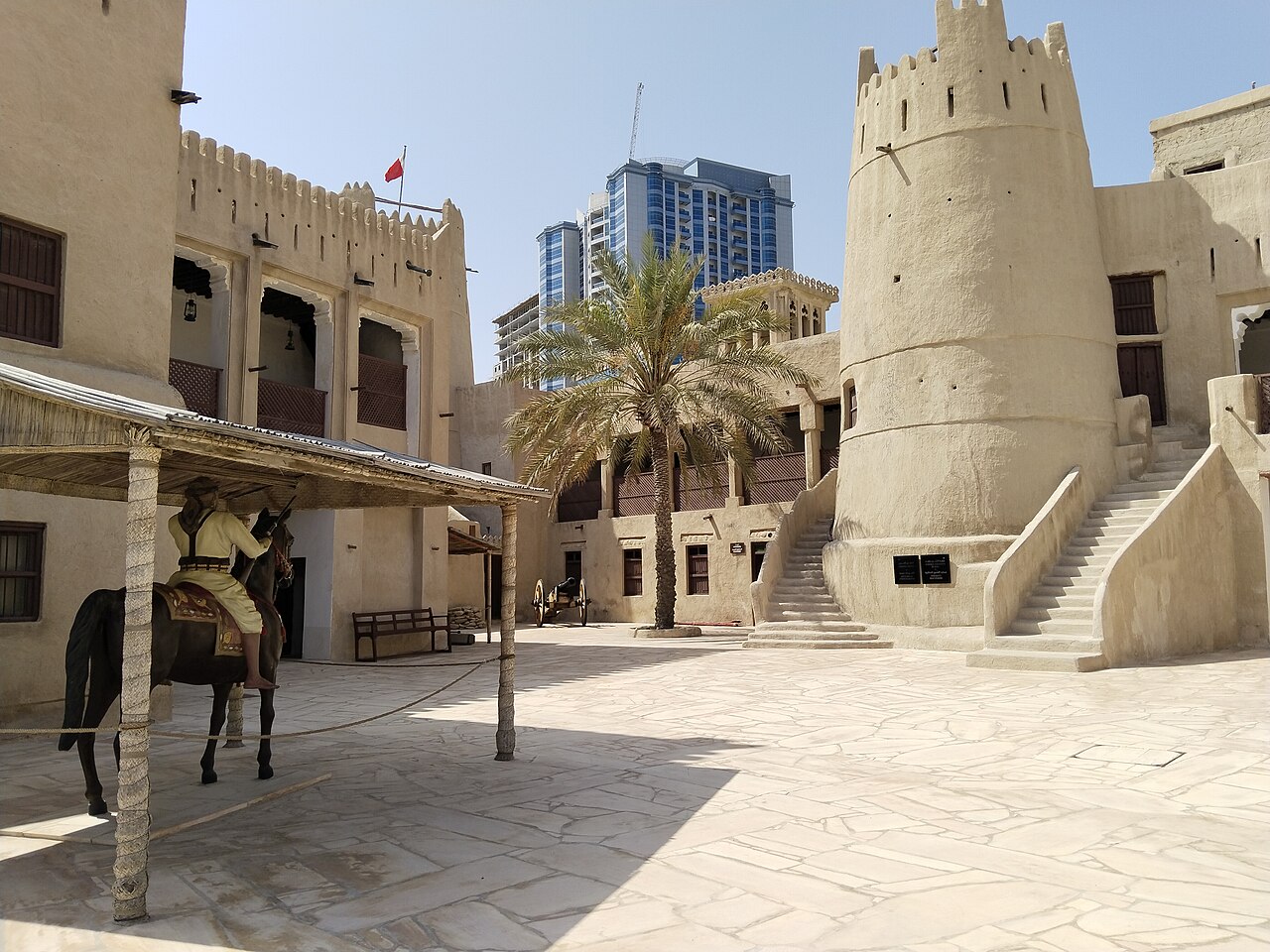
Ajman Fort is a double-storey traditional rock, coral and mudbrick fortification in the centre of the city of Ajman in the United Arab Emirates (UAE). Its construction is thought to date back to the late 18th century and it is claimed the fort's barjeel, or wind tower, is the oldest such structure in the UAE.
Ajman Fort has been central to the history of the city and emirate of Ajman and its rulers for over 200 years. The establishment of Ajman as an independent emirate under Al Nuaimi rule took place when Sheikh Rashid bin Humaid Al Nuaimi and fifty followers took effective control of the coastal settlement of Ajman in a short conflict. The consolidation of that establishment did not take place until 1816 or 1817, when Ajman Fort finally fell to Rashid and his followers. Rashid was duly recognised as the Ruler of Ajman by the Ruler of Sharjah, Sheikh Saqr bin Sultan Al Qasimi, who had previously claimed Ajman under his sphere of influence or suzerainty.
Having fallen to an invasion from Al Heera in 1820, in 1821, Ajman Fort again fell briefly to a force of Darawisha Bedouin, who were removed by the action of Saqr bin Sultan of Sharjah.
Rashid bin Humaid's rule saw the bombardment of Ajman and its fort from the sea by British forces in the course of the 1819 punitive expedition mounted by the British against the Qawasim. This led to Rashid bin Humaid becoming a signatory to the General Maritime Treaty of 1820. The fort was completely destroyed in the action.
The peaceful accession of Rashid's son, Humaid bin Rashid Al Nuaimi, as Ruler of Ajman in 1838 was not to last long however, and in 1841 Humaid's brother Abdelaziz bin Rashid Al Nuaimi took possession of Ajman fort and declared himself Ruler. In this he made a powerful enemy, as Humaid had married a daughter of Sultan bin Saqr Al Qasimi, who now sought his restoration. In 1848, Abdelaziz bin Rashid was killed during an armed conflict with Ajman's secessionist neighbouring town of Hamriyah. On Abdelaziz' death, Humaid, who was also wounded in the conflict, became Ruler once again.
On 15 June 1920, Abdulrahman bin Muhammad Al Shamsi, the headman of another secessionist neighbour of Ajman's, Al Heera, seized Ajman Fort and declared himself ruler in place of the-then Ruler of Ajman, Humaid bin Abdulaziz Al Nuaimi.
Text adapted from “Ajman Fort” on Wikipedia, CC BY-SA 4.0.
Ajman Fort ranks #8,286 of 9,079 worldwide in the atlas's castle fame ranking, and #13 of the 19 mapped in United Arab Emirates. Founded c. 1775, it is older than 14% of the atlas's dated landmarks — one of 696 atlas entries founded in the 18th century. 2 more atlas landmarks stand within 25 km. The nearest day-trip guide is Sharjah, 52 km away. See how United Arab Emirates compares in the castle statistics.
View on the interactive castle map →