Ruin
Akagi Castle
🇯🇵 Japan · 16th century
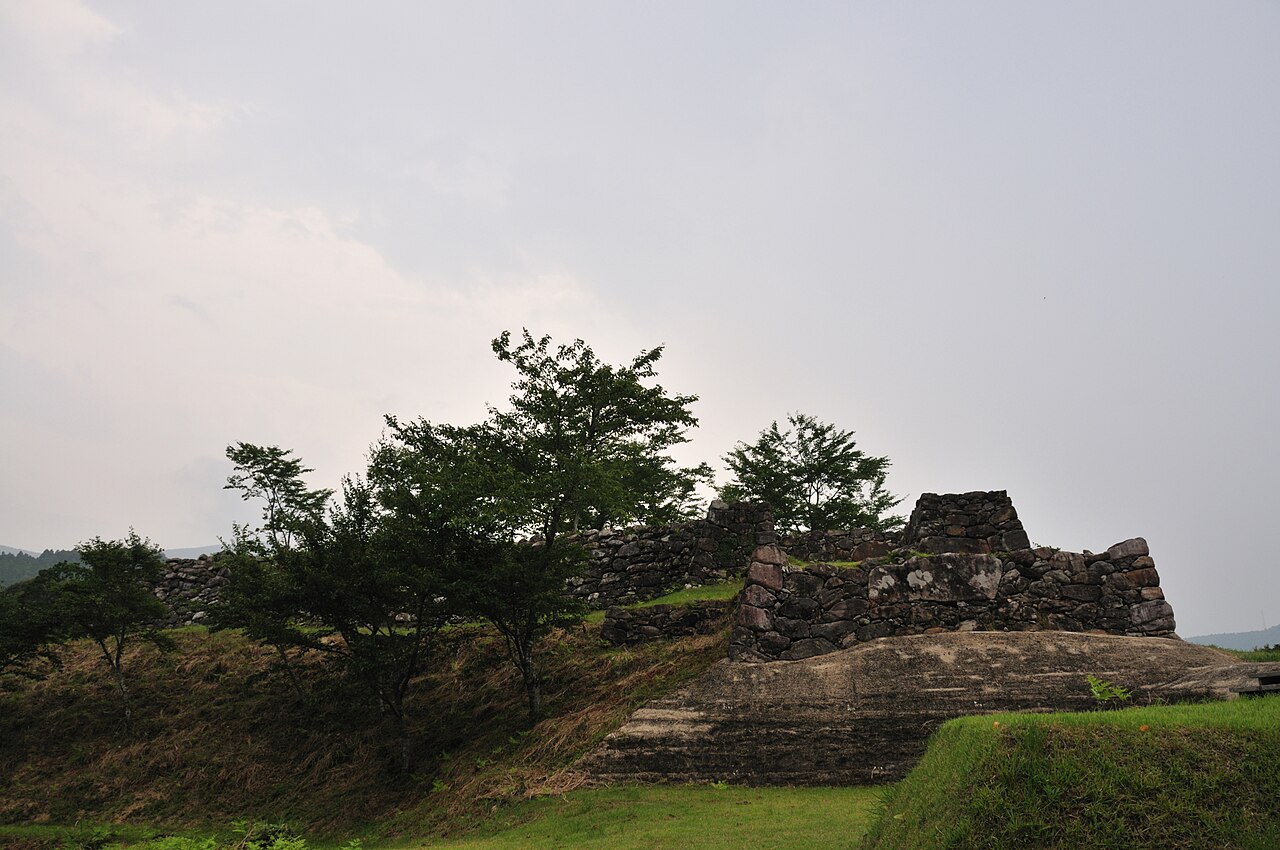
Akagi Castle (赤木城, Akagi-jō) was a Sengoku period hirayama-style Japanese castle located in the Kiwa neighborhood of the city of Kumano, Mie prefecture. Its ruins have been protected as a National Historic Site since 1989.
Akagi Castle is located in the hills of former Muro District of Kii Province in the western part of the city of Kumano, at an elevation of 230 meters, with a relative height of 30-40 meters above its surroundings. The area is a small basin surrounded by the Kii Mountains on an ancient route connecting the Ise Shrine with the Kumano Shrines. The castle was originally constructed by Tōdō Takatora to suppress a local rebellion around 1589 and consists of a series of three curved embankments surrounding the inner bailey at the top of the hill. This arrangement is the typical format used by Sengoku period and previous mountain notifications; however, the castle also incorporated more modern developments, such as stone walls and fortified gateways.
From the Nanboku-chō period, the southern Kii Peninsula was the location of constant conflict between many petty warlords. Toyotomi Hideyoshi invaded the region in 1585 and assigned it to the control of his brother Toyotomi Hidenaga, who attempted to rule from Wakayama Castle. Hidenaga attempted to conduct a survey of the territory the following year, which was immediately opposed by all local warlords who rose in revolt. This was known as the "Kitayama Ikki" and involved thousands of local inhabitants. The rebels were quickly defeated by Hidenaga's forces; however, Hidenaga refused the surrender of the rebel remnants and ordered his army to resume the campaign the following spring, showing no mercy, but his plans to completely crush the rebels was postponed when most of his forces were called away for Hideyoshi's invasion of Kyūshū.
Hidenaga ordered Tōdō Takatora to construct Akagi Castle as a base of operations, and in May 1589, beheaded a large number of rebellious farmers at Tabirako Pass. It later was revealed that the purpose of the survey was to enable Hidenaga's general Yoshikawa Heisuke to fell over 20,000 trees from Kumano, which were then sold in Osaka for great profit. An outraged Hideyoshi ordered Yoshikawa's execution, and Hidenaga fell from favor. However, Hideyoshi realized the value of Kumano timber, and Akagi Castle continued to be a center for the exploitation of this resource.
Text adapted from “Akagi Castle” on Wikipedia, CC BY-SA 4.0.
Akagi Castle ranks #5,311 of 8,134 worldwide in the atlas's castle fame ranking, and #255 of the 297 mapped in Japan. Founded 1589, it is older than 35% of the atlas's dated landmarks — one of 755 atlas entries founded in the 16th century. 1 more atlas landmarks stand within 25 km. The nearest day-trip guide is Wakayama, 81 km away. It is one of the 71 landmarks on the atlas's regional map of Kansai. See how Japan compares in the castle statistics.
View on the interactive castle map →Frequently asked questions
Where is Akagi Castle?
Akagi Castle stands in Japan, at 33.89611°, 135.95167°.
When was Akagi Castle built?
The atlas dates its founding to 1589. Earlier structures may have stood on the site; this is the earliest documented founding year.
How famous is Akagi Castle?
In this atlas's fame ranking: #5,311 of 8,134 worldwide, and #255 in Japan. Fame here combines how many Wikipedia language editions cover a landmark with how many people read them.
What is the nearest castle to Akagi Castle?
Shingū Castle, about 19 km away.
More castles in Japan
- Hamada Castle Japan · 17th century
- Nagurumi Castle Japan · 15th century
- Tsurugaoka Castle Japan · 13th century
- Suwahara Castle Japan · 16th century
More ruins
- Yatsushiro Castle Japan · 17th century
- Noshima Castle Japan
- Šaunštejn Castle Czech Republic · 14th century
- Kastelburg Germany · 13th century