 Japan · 16th century
Suwahara Castle ranks #5,143 of 9,040 worldwide in the atlas's castle fame ranking, and #235 of the 295 mapped in Japan. Founded 1573, it is older than 34% of the atlas's dated landmarks, one of 887 atlas entries founded in the 16th century. Its Wikipedia articles were opened 1,349 times in the last 60 days, more than 59% of the atlas. 3 more atlas landmarks stand within 25 km. The nearest day-trip guide is Okazaki, 88 km away. See how Japan compares in the castle statistics.
Suwahara Castle (諏訪原城, Suwahara-jō) was a Sengoku period yamashiro-style Japanese castle located in the Kanaya neighborhood of the city of Shimada, Shizuoka prefecture, Japan. The ruins have been protected as a National Historic Site since 1975.
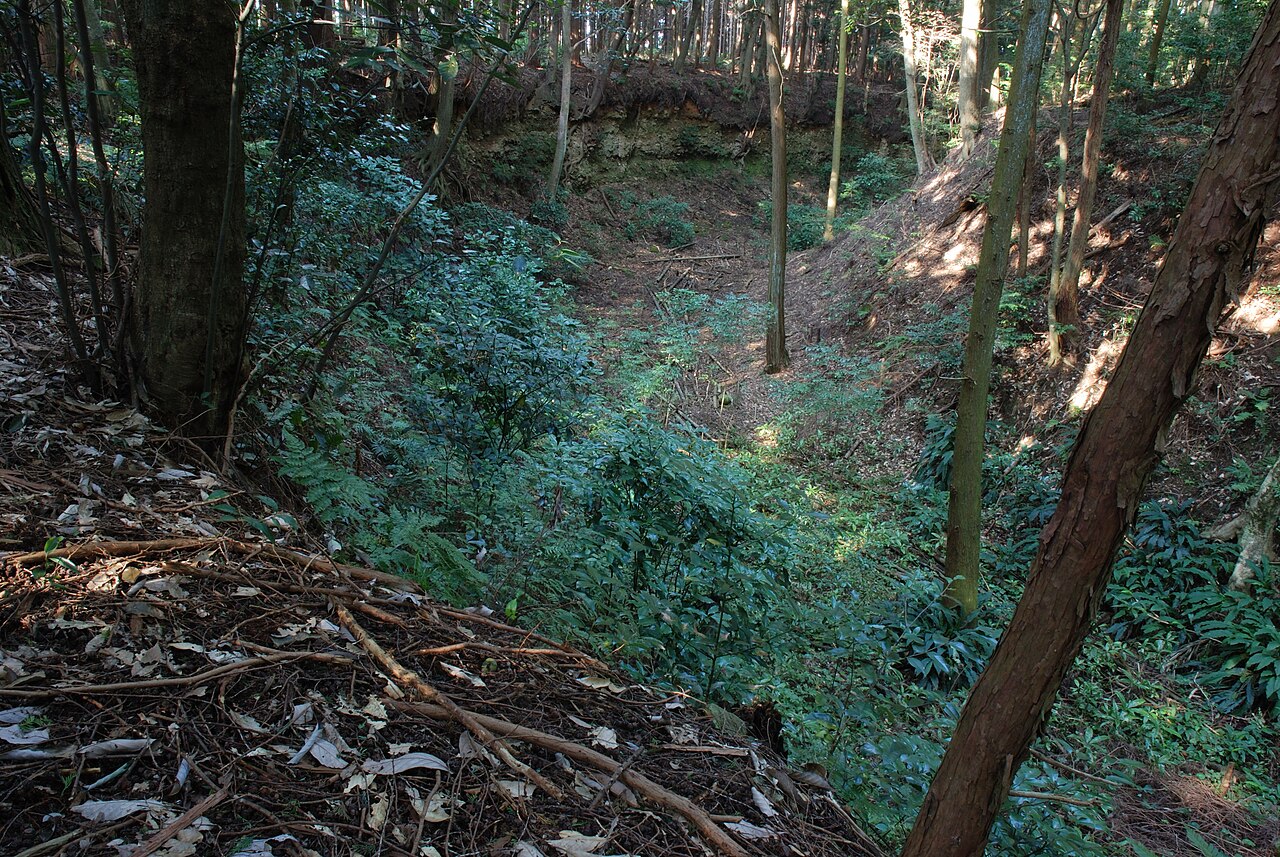
Suwahara Castle is located at the edge of cliff in the northern part of the Makinohara Plateau, commanding the location where the Ōi River crosses the Tōkaidō highway. It has an elevation of about 200 meters. At the time the castle was constructed, the river was closer to the cliff face, so that the castle was strategically important for controlling both the highway and the river. The inner bailey of the castle is a square-shaped area, 100 meters on a side, which is backed against a steep cliff. Two enclosures spread in concentric circles from the inner bailey, each protected by a moat and wall. The second bailey is approximately 100 meters long by 80 meters die, and the third bailey is approximately 200 meters long by 80 meters wide.
In the middle of both the second and third bailey is a large semi-circular fort, called an "Umadashi", which is a construct unique to Takeda clan designs. Each "umadashi" is a 40 meter semi-circular wall, protected by a dry moat, with a gate on either end, from which the defenders could protect the flanks of the wall, the gates, and to stage counterattacks. total size of the castle was about 300 meter long and 200 meter wide.
Following the death of the warlord Takeda Shingen, his son Takeda Katsuyori attempted to pursue his father's legacy by pursuing a highly aggressive policy against Mikawa-based Tokugawa Ieyasu. As part of this campaign, Katsuyori ordered his general Baba Nobuharu to construct a castle at this location in 1573 in order the facilitate the Takeda invasion of Tōtōmi Province and capture of Takatenjin Castle. It was named after a Suwa shrine brought to this site by the Takeda clan from Shinano Province, as the Suwa kami were the tutelary kami of the Takeda.
In 1575, following their victory at the Battle of Nagashino, the Tokugawa swept through Tōtōmi Province, and overran Suwahara Castle. The castle was renamed Makino Castle and used as the Tokugawa base of operations against the Takeda in the Siege of Takatenjin Castle in 1581. After Tokugawa clan was relocated to the Kantō region by Toyotomi Hideyoshi in 1590, Suwahara Castle was abandoned.
Text adapted from “Suwahara Castle” on Wikipedia, CC BY-SA 4.0.
View on the interactive castle map →