 Turkey · 13th century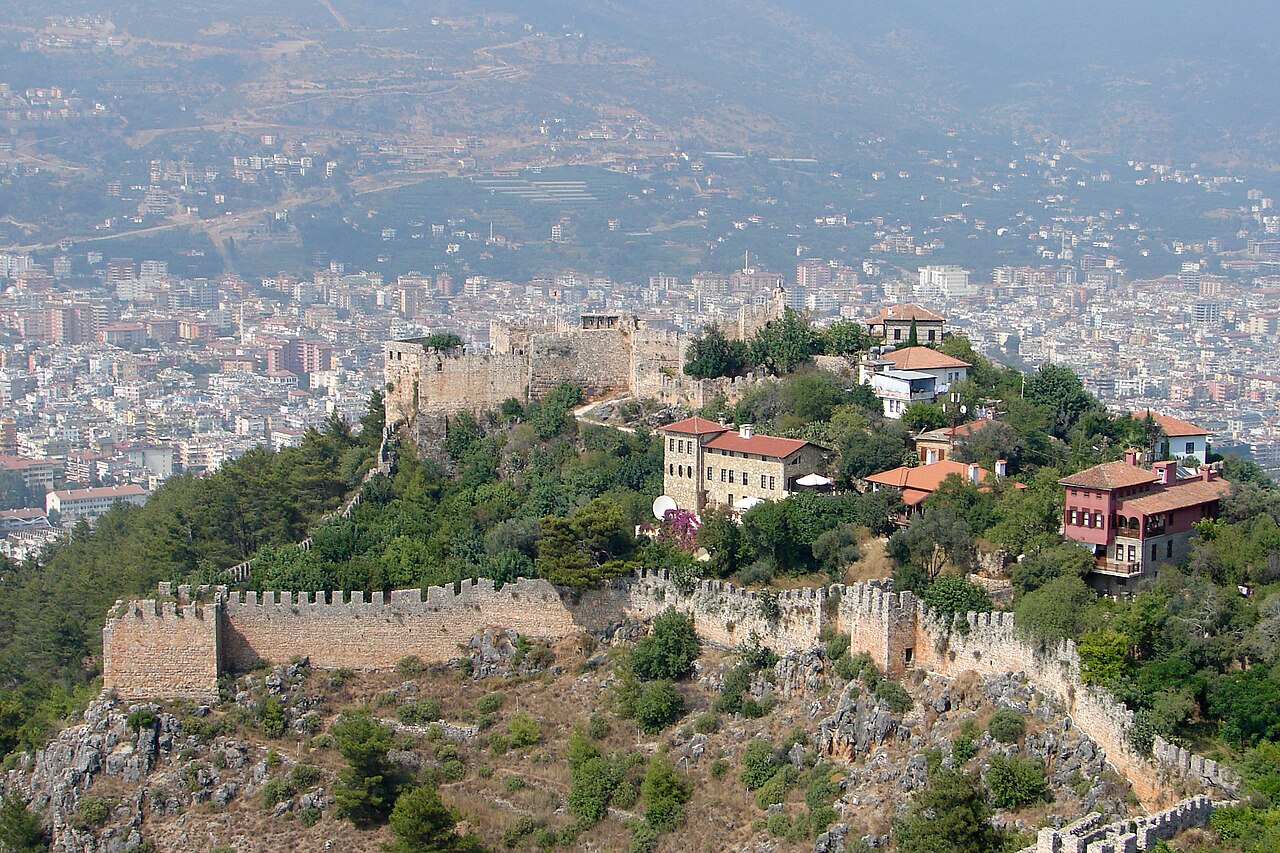
Alanya Castle (Alanya Kalesi) is a medieval castle in the southern Turkish city of Alanya.
Most of the castle was built in the 13th century under the Seljuq Sultanate of Rûm following the city's conquest in 1220 by Alaeddin Keykubad I, as part of a building campaign that included the Kızıl Kule.
The castle was built on the remnants of earlier Byzantine era and Roman era fortifications. After the area was pacified under the Ottoman Empire, the castle ceased to be purely defensive, and numerous villas were built inside the walls during the 19th century. Today the building is an open-air museum.
The castle is located 250 metres (820 ft) high on a rocky peninsula jutting into the Mediterranean Sea, which protects it from three sides and the entire castle complex covers approximately 10 hectares.
The wall which surrounds the castle is 6.5 kilometres (4.0 mi) long and includes 140 towers. 400 different cisterns were built to serve the castle. In 2009, city officials filed to include Alanya Castle and Tersane as UNESCO World Heritage Sites, and they were named to the 2009 Tentative List.
Text adapted from “Alanya Castle” on Wikipedia, CC BY-SA 4.0.
Alanya Castle ranks #584 of 9,079 worldwide in the atlas's castle fame ranking, and #17 of the 129 mapped in Turkey. Founded c. 1250, it is older than 67% of the atlas's dated landmarks — one of 1080 atlas entries founded in the 13th century. Its Wikipedia articles were opened 9,654 times in the last 60 days, more than 93% of the atlas. 1 more atlas landmarks stand within 25 km. See how Turkey compares in the castle statistics.
View on the interactive castle map →