 Germany · 13th century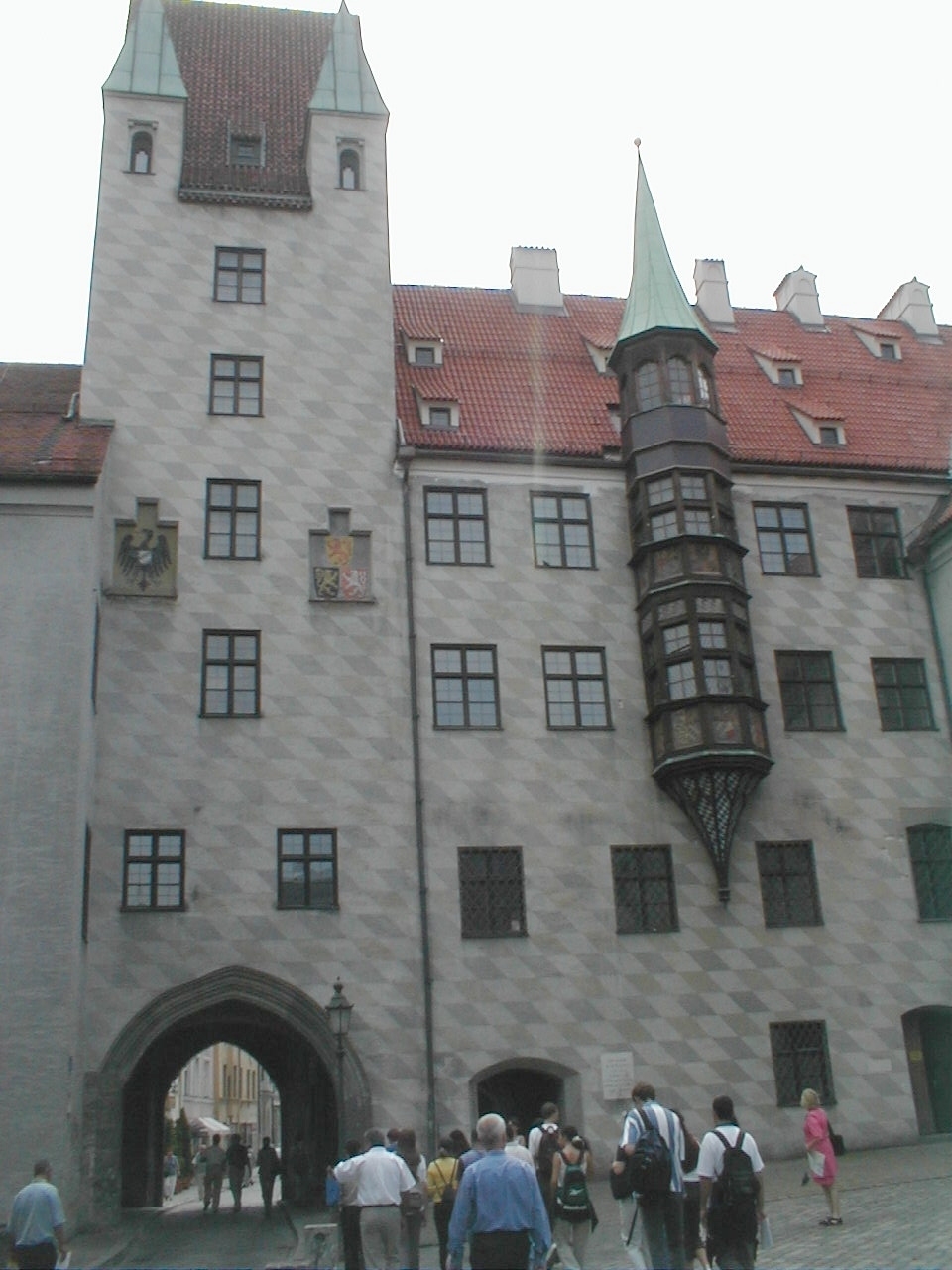
The Alter Hof (Old Court) in the center of Munich is the former imperial residence of Louis IV, Holy Roman Emperor and consists of five wings: Burgstock, Zwingerstock, Lorenzistock, Pfisterstock and Brunnenstock. Like most of the old town, it was rebuilt after being destroyed in World War II.
Archeological excavations have shown that a castle already existed there in the 12th century. After the first partition of Bavaria in 1255, the Alte Hof became the residence of Louis II, Duke of Bavaria in the then very northeastern part of the city. The castle was the first permanent imperial residence in the Holy Roman Empire under his son Louis IV, Holy Roman Emperor. The St. Lorenz Chapel at the north side, which was demolished later in the 19th century, once housed the regalia of the House of Wittelsbach.
After some uprisings the castle became too unsafe, and in the course of an extension of the town, together with the construction of a new double-ring of town walls, the Wittelsbach dukes once again chose the very northeastern corner as the construction site for a replacement ducal residence. Consequently, as it was newly erected, the castle was called "Neuveste", new fortress. Over the course of centuries, the Neuveste would eventually develop into what is nowadays the Munich Residenz. When Duke Sigismund lived in the Alter Hof at the end of the fifteenth century and made further structural alterations to it, including painting in the courtyard with lozenge-shaped decoration, the actual residence was already the Neuveste.
In the first half of the 16th century, Duke William IV finally transferred the residence permanently to the Neuveste. Thus from the 16th century onwards, the Alter Hof was only seat of several governmental departments including the stewardship.
In 1591–92, the Pfisterstock was built with decorative gables typical of the Renaissance; it was attributed to Wilhelm Egkl. In the first half of the 17th century, a building for the brewhouse and the brewhouse office, which had been known as the Brunnenstock since the end of the 18th century, was built. This was then replaced by Georg Friedrich Ziebland in 1831/32 by a new building on the old foundations for the Steering Commission. At the beginning of the 19th century, St.Lorenz chapel was broken off. The tower was also removed but later rebuilt.
Text adapted from “Alter Hof” on Wikipedia, CC BY-SA 4.0.
Alter Hof ranks #1,740 of 9,079 worldwide in the atlas's castle fame ranking, and #135 of the 711 mapped in Germany. Founded 1253, it is older than 67% of the atlas's dated landmarks — one of 1080 atlas entries founded in the 13th century. Its Wikipedia articles were opened 3,489 times in the last 60 days, more than 81% of the atlas. 12 more atlas landmarks stand within 25 km. The nearest day-trip guide is Munich, 1 km away. See how Germany compares in the castle statistics.
View on the interactive castle map →