 Switzerland · 10th century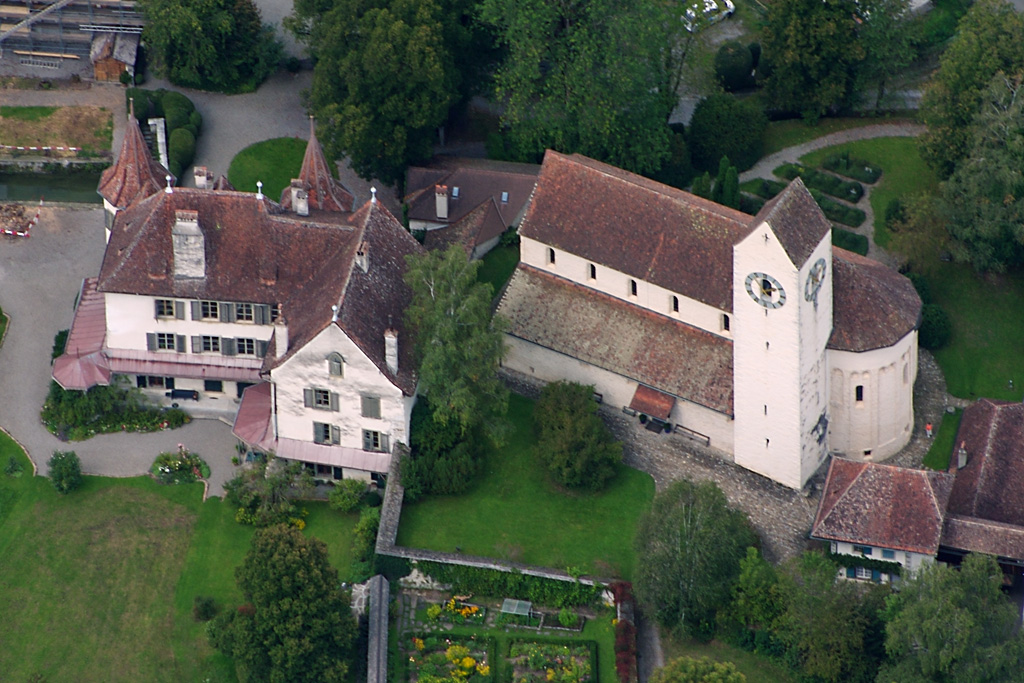
Amsoldingen Castle (German: Schloss Amsoldingen) is a castle in the municipality of Amsoldingen in the canton of Bern in Switzerland. The castle and associated former collegiate church of St. Mauritius are a Swiss heritage site of national significance.
Amsoldingen Castle and the neighboring was built in the 10th century. The castle was built as the residence of the wealthy provost of the collegiate church of Amsoldingen. However, the provost and church gradually became impoverished and in 1484 ownership of the castle was given to St. Vincent's cathedral in Bern. The college of canons in Bern sold the castle and surrounding lands in 1496 to the wealthy merchant Barthlome May. In 1536, Barthlome's grandson, Sulpitius May, sold the castle, after which it passed through a number of owners.
By the end of the 17th century it was owned by the engineer and surveyor Samuel Bodmer. Between 1711 and 1724, Bodmer lived in the castle as he designed the flood control system around Thun Lake and the Aare River to protect the villages and farm land from floods. During the 18th and early 19th century the castle was owned by the Luternau family who built the parks around the castle. It was sold in 1815 to Ludwig Zeerleder, who then sold it to Alfred de Rougemont von Bonstetten, who later sold it to Beat Ludwig Tscharner von Erlach. Under von Erlach the castle was rebuilt in a neo-Gothic style in 1846.
The first church on the site was built in the early Romanesque style in the 6th century. Like the castle, the former collegiate church of St. Mauritius was built in the 10th century. The Ottonian three-aisle church was built from stone scavenged from the ruins of Aventicum on the foundations of the earlier church. According to tradition, the stift or donation that supported the church was made in the 10th century by the King of Burgundy Rudolph II. It was one of the twelve churches that he founded around Lake Thun. Around 1210, the 10th century church was modified with the construction of the crypt and renovation of the south aisle.
The church is first mentioned in a record in 1228. Around 1300, the interior of the church was covered with murals including the still visible painting of Saint Christopher on the north wall. The southern side apse was demolished and a Romanesque bell tower was added between 1345 and 1486.
Text adapted from “Amsoldingen Castle” on Wikipedia, CC BY-SA 4.0.
Amsoldingen Castle ranks #7,228 of 9,079 worldwide in the atlas's castle fame ranking, and #136 of the 213 mapped in Switzerland. Founded c. 950, it is older than 92% of the atlas's dated landmarks — one of 193 atlas entries founded in the 10th century. 19 more atlas landmarks stand within 25 km. The nearest day-trip guide is Bern, 27 km away. See how Switzerland compares in the castle statistics.
View on the interactive castle map →