 Germany · 12th century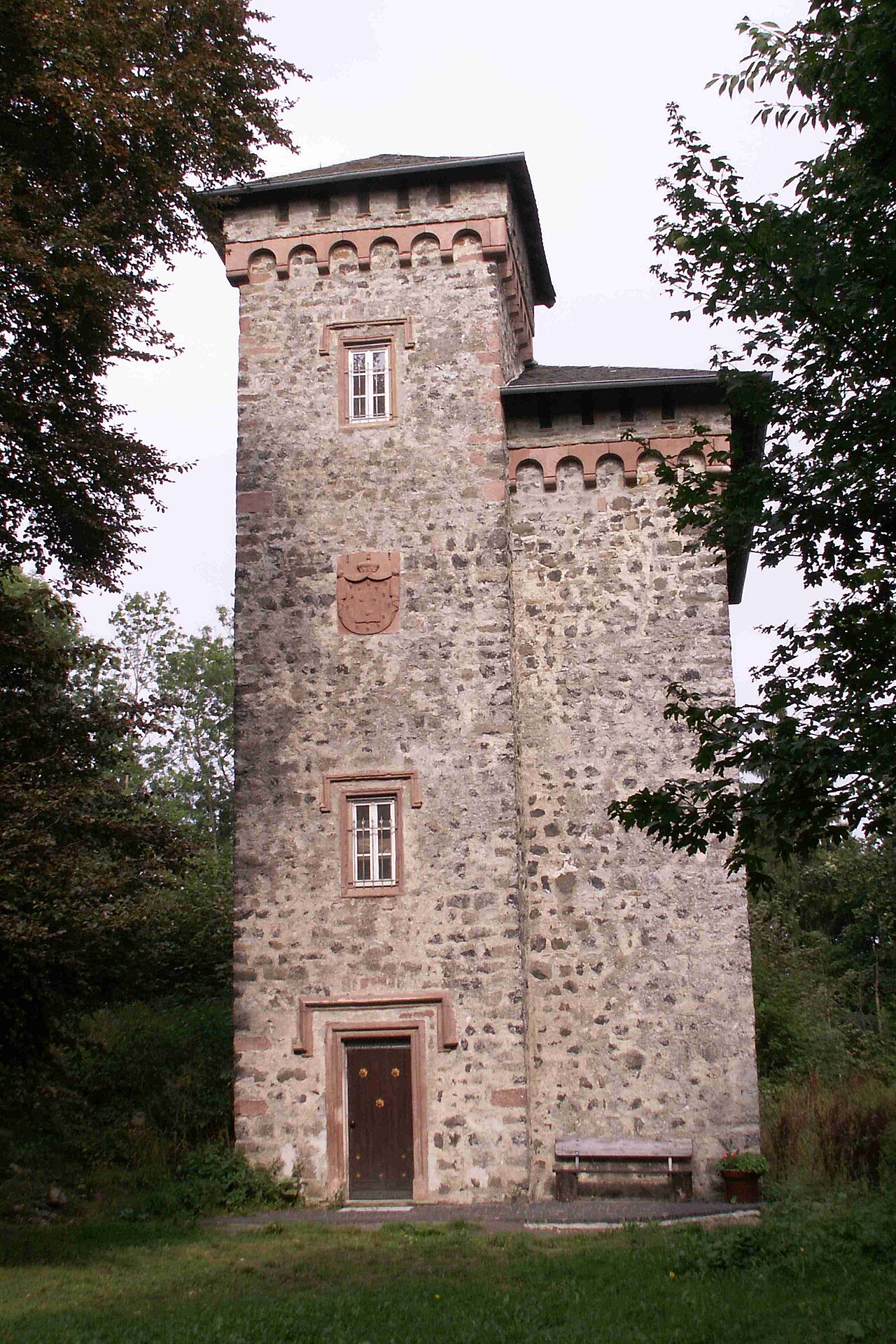
Aremberg Castle (German: Burg Aremberg) is a ruined mediaeval hill castle on the Aremberg in the Ahr Hills in the Eifel region in Germany. The ruins lie near Aremberg in the county of Ahrweiler in the German state of Rhineland-Palatinate.
The castle ruins lie on the thickly wooded mountain of Aremberg (623.8 m above sea level (NHN)) one of the largest Tertiary volcanoes in the Eifel, in the vicinity of the settlement of Aremberg. The village itself is on the western mountainside, below the summit dome.
The castle is first mentioned in 1166, then under the name of Arberg. In the 12th century, a castle was built on the mountain because it was a good strategic location.
Aremberg Castle was the centre of the imperially immediate Barony of Arenberg, whose family still flourishes today in Belgium and South America and possesses considerable wealth. Although the lordship was very small in area, numerous family members managed to exert great influence at the court in Vienna, so that the family rose from counts to princes and ultimately to dukes. The (sparse) remains of the Aremberg castle that survive today barely hint at this former glory. The main residences of the dukes were in the Southern Netherlands, Arenberg castle in Heverlee and the famous Enghien Gardens.
From 1564 onwards, the castle was fundamentally renovated and expanded by the Jülich fortress architect (presumably Johann I.) von Pasqualini. In 1642, it was besieged by Hessian troops under Major General Rosen. The capture of the fortification was prevented by the relief of Spanish troops under Count Ernst von Isenburg.
As a loyal partisan of the Habsburg emperor, the Arenbergs achieved a continuous elevation in rank from Imperial Count (1549) to sovereign ducal status (1644). The early modern fortification construction on the Aremberg should also be seen in this context. This expansion was initiated, designed (1642/3) and directed by the Capuchin friar Antoine of Arenberg (1593–1669), an uncle of the first duke, Philippe François of Arenberg. Father Antoine was the fabricien (master builder) of the Flemish provincial order, where he built the Capuchin monasteries of Tervuren and Brussels. In 1660, Father Mansuet from Neufchâteau took over as construction supervisor, assisted by Lieutenant Billaut. By 1674, the construction of the fortress was considered complete.
Text adapted from “Aremberg Castle” on Wikipedia, CC BY-SA 4.0.
Aremberg Castle ranks #7,307 of 9,079 worldwide in the atlas's castle fame ranking, and #657 of the 711 mapped in Germany. Founded 1166, it is older than 79% of the atlas's dated landmarks — one of 756 atlas entries founded in the 12th century. 10 more atlas landmarks stand within 25 km. The nearest day-trip guide is Koblenz, 56 km away. It is one of the 51 landmarks on the atlas's regional map of the Moselle. See how Germany compares in the castle statistics.
View on the interactive castle map →