 Germany · 12th century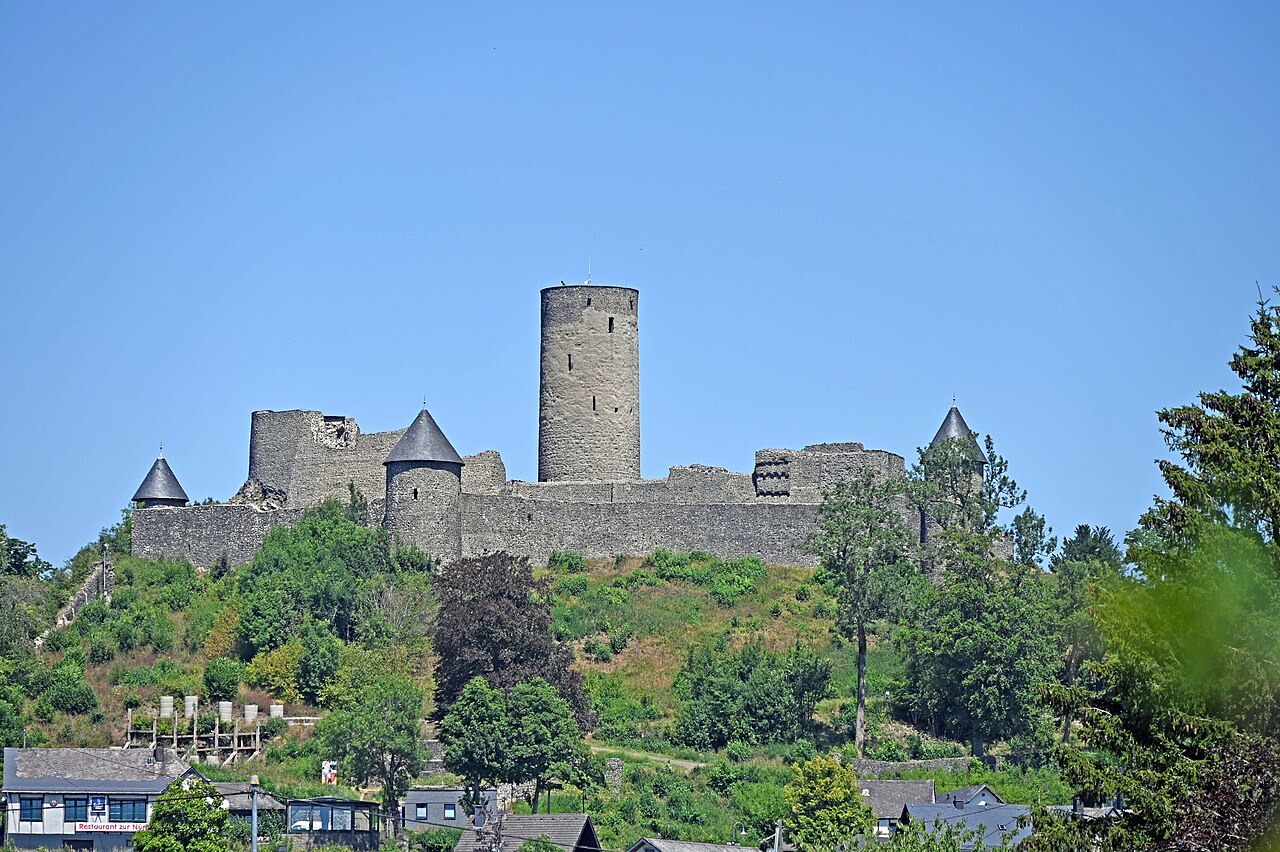
The Nürburg is a ruined hilltop castle in the German Eifel Mountains near the village of Nürburg south of Adenau in the district of Ahrweiler in the state of Rhineland-Palatinate. It stands within the famous North Loop, or Nordschleife, of the Nürburgring racing course at an altitude of 678 m (2,224 ft) on a volcanic basalt cone. It may be visited for a fee.
The site was first mentioned in the records in 1166 as Noureberg or Mons Nore, but it is probable that it was already used as a signal station in Roman times to protect the important Roman road that ran through the Eifel.
The actual instigator of the Nürburg was Count Ulrich, who is named in a document from 1169, although his father, Dietrich I of Are, had already started the construction of a refuge castle on the mountain. Ulrich's descendants called themselves the lords of Nürburg and Are and were vassals (Lehnsmänner) of the bishops of Cologne and the Hohenstaufen emperor.
In 1290, ownership of the castle was transferred to the Electorate of Cologne, because there were no more descendants of the lords of Nürburg. The archbishopric appointed a bailiff (Amtmann), who from then on was to represent their interests.
The construction of the castle was carried out in three stages. After the construction of the rectangular inner ward or kernburg, the zwinger walls were built between 1340 and 1369 under the bailiff, Johann von Schleiden, as a second defensive ring. In the 15th century a third wall was erected to protect the hitherto freely-accessible castellan's buildings that have not survived.
As early as the 16th century the castle fell into a very poor condition, a situation which the officiating bailiffs complained about. As a result, restoration work was carried out several times.
In 1633, during the Thirty Years' War, the Nürburg was captured by the Swedes under General Baudissin, who plundered and damaged it. In 1674, Imperial troops occupied the castle.
In 1689, French soldiers finally destroyed the place. The surviving keep, or bergfried, was initially used as a prison, but was no longer fit for that purpose after 1752. The castle was abandoned and used as a stone quarry.
In 1818 Prussia had the bergfried restored because, with its height of 678 m above sea level (NN), it would be able to act as a trigonometric point. In the course of this work the outer ward was demolished.
Text adapted from “Nürburg Castle” on Wikipedia, CC BY-SA 4.0.
Nürburg Castle ranks #1,965 of 9,079 worldwide in the atlas's castle fame ranking, and #154 of the 711 mapped in Germany. Founded 1166, it is older than 79% of the atlas's dated landmarks — one of 756 atlas entries founded in the 12th century. Its Wikipedia articles were opened 4,663 times in the last 60 days, more than 85% of the atlas. 10 more atlas landmarks stand within 25 km. The nearest day-trip guide is Koblenz, 46 km away. It is one of the 51 landmarks on the atlas's regional map of the Moselle. See how Germany compares in the castle statistics.
View on the interactive castle map →