 Russia · 16th century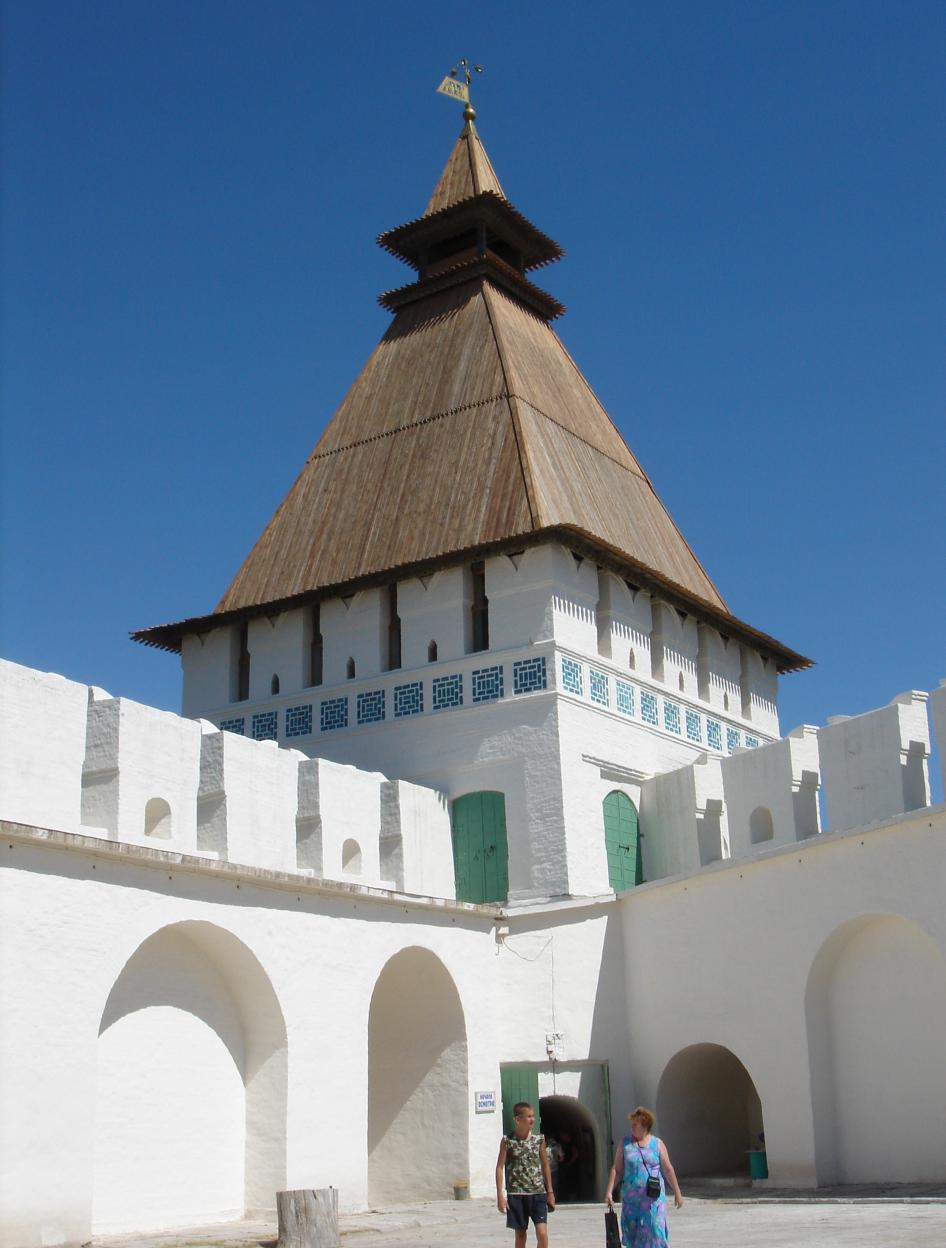
Astrakhan Kremlin (Russian: Астраханский кремль, romanized: Astrakhanskiy kreml) is a fortress in Astrakhan, Russia. It is located on a hill on an island in the Volga Delta, between the Volga, the Kutum, and the Tsarev.
For centuries, the Astrakhan Kremlin was an inapproachable stronghold on the south-eastern border of Russia. A series of historical events are related to the fortress: the Crimean Turkish hiking on the lower Volga in the 16th century, the Time of Troubles in Russia and the peasant uprising led by Stenka Razin in the 17th century, the transformation during the reign of Tsar Peter the Great, revolt of archers in 1705–1706, development of the Caspian navy in the 18th century, the reinforcement of the country's borders and entry into a part of Russian territories of the Caucasus and Central Asia.
In 1552, Tsar Ivan IV conquered the Kazan Khanate. Four years later, Russian troops took Astrakhan. With the incorporation of the Middle and Lower Volga regions, the Moscow state gained access to the Caspian Sea.
The first construction of the Kremlin began in 1587–1588 under the guidance of I.G. Vorodkov, a sapper and a lector of Discharge Order. He laid the first wooden fortress with powerful solid walls and towers. The construction site was chosen on the highest hill, known as “Rabbit” or “Zayachii” in Russian. It was the ideal location for a fortress, as the hill is surrounded by the Volga River to the west and north, and by lakes and marshes to the south and east.
During the reign of Tsar Ivan IV and Boris Godunov, the wooden fortress was rebuilt into a stone one. To construct the Kremlin walls and towers, state-appointed master builders were sent from Moscow to Astrakhan. The chiefs responsible for the construction and planning of the stone fortress were Mikhail Ivanovich Veliyaminov, Grigorii Ovcin and lecturer Dei Gubastii. To achieve the best results, they used old but very strong Tatar plinths, brought from the ruins of Golden Horde cities. The stone citadel was built in the style of the Moscow Kremlin.
The walls of the Astrakhan Kremlin were equipped with prongs the slots of which allowed to fire from handguns against enemies. At the top tier, there were machicolations (Russian: варницы) —holes through which boiled water or hot tar could be poured on attackers.
Text adapted from “Astrakhan Kremlin” on Wikipedia, CC BY-SA 4.0.
Astrakhan Kremlin ranks #1,441 of 9,079 worldwide in the atlas's castle fame ranking, and #52 of the 146 mapped in Russia. Founded 1582, it is older than 34% of the atlas's dated landmarks — one of 891 atlas entries founded in the 16th century. Its Wikipedia articles were opened 3,719 times in the last 60 days, more than 82% of the atlas. See how Russia compares in the castle statistics.
View on the interactive castle map →