Castle
Baronial palace of Archi
🇮🇹 Italy · 11th century
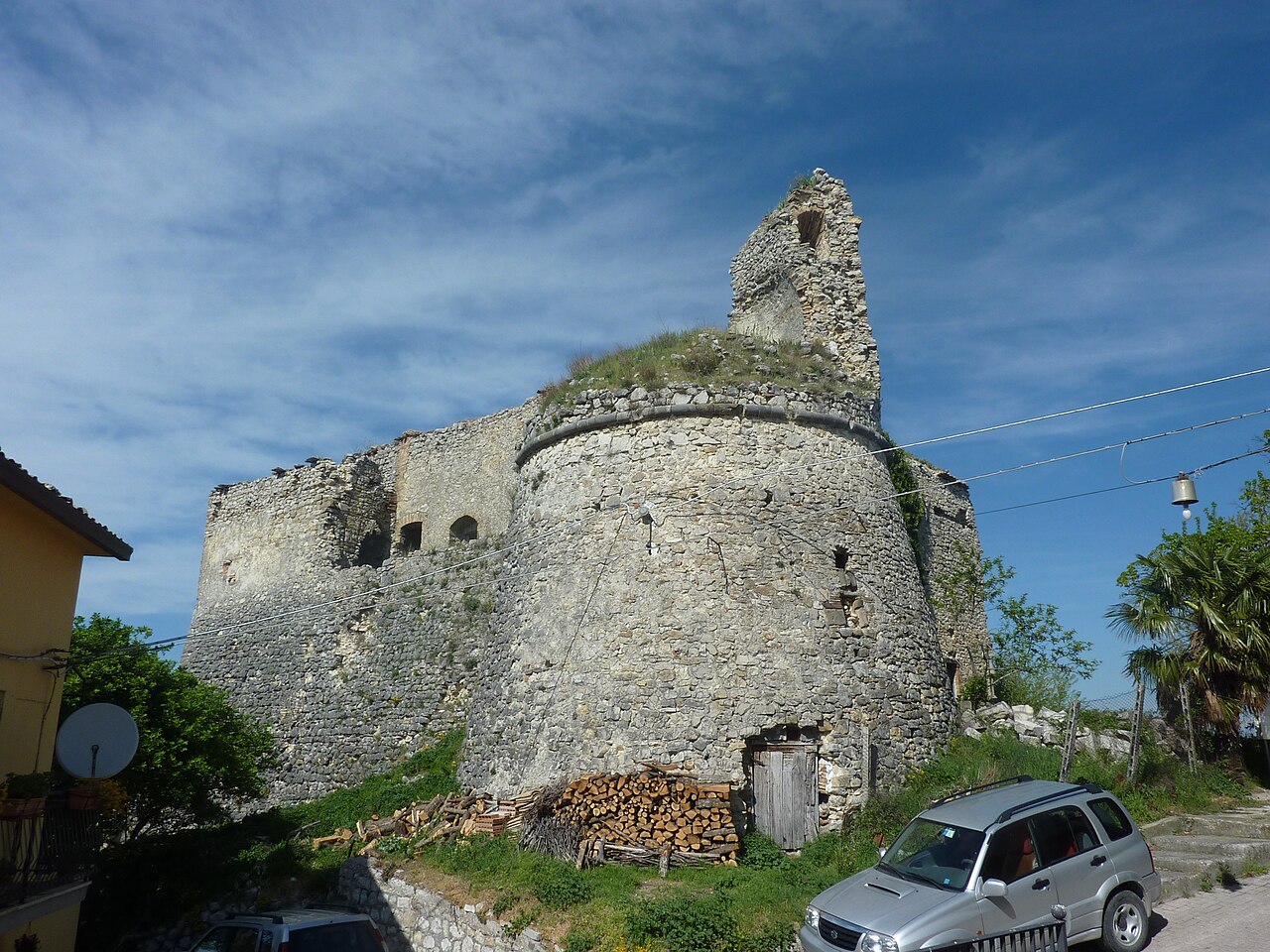
Palazzo baronale (Italian for Baronial Palace) is a fortified palace in Archi, Province of Chieti (Abruzzo).
The first mention of the castle dates back to the 11th century, when the settlement of Fara Adami was documented, located along the Sangro river and governed by the gastald Raniero and a priest named Adamo. However, the first official document confirming its existence in 1075 is the Catalogus Baronum, compiled by King Roger II of Sicily.
In the 15th century, Archi was a fief of the Caldora family, with the castle subsequently being owned by Jacopo, Antonio, and his son Restaino Caldora.
After various vicissitudes of feudal lords, in 1559, Archi and its castle passed to Martino di Segua. Several notarial documents attest that Martino repeatedly restored some wings of the castle. The work was carried out by master Antonio Malerba. However, in 1563, Martino had to auction the castle to pay off his debts.
Documents from the 17th century report that in 1644, Giovanni Battista Marino was involved in legal issues to inherit the castle.
It then belonged to various feudal lords, the last of whom were the Aldimari of Bomba, who held it until the abolition of feudalism in 1806.
Lastly, it was acquired by the Lannutti family, who lived there until the German seizure in 1943. The Nazis used the castle as a military outpost overlooking the Val di Sangro to monitor the arrival of Allied troops from Perano. Shortly before their retreat to the Alto Sangro mountains, the Nazis damaged and mined the castle, reducing it to its current ruinous state.
The original layout was quadrangular, with two main towers on the sloped walls, located at the southwest and southeast corners. The first tower had a circular plan, still partly visible, with a diameter of 7.5m, and the other was square, with a circular base. The north side featured a bastioned earthwork, which completely collapsed due to the destruction caused by the Nazis; it is now occupied by the municipal radio-TV antenna. The chemin de ronde was supported by a truncated-conical masonry wall, while the northeast side was reinforced by a cylindrical structure. The facades on the east and west sides were fortified with original buildings against the curtain wall, enhancing the fortification on the landslide-prone hill and creating a sort of double wall defense against assaults.
Text adapted from “Palazzo baronale” on Wikipedia, CC BY-SA 4.0.
Baronial palace of Archi ranks #7,501 of 8,764 worldwide in the atlas's castle fame ranking, and #507 of the 528 mapped in Italy. Founded c. 1050, it is older than 90% of the atlas's dated landmarks — one of 344 atlas entries founded in the 11th century. 7 more atlas landmarks stand within 25 km. The nearest day-trip guide is Avezzano, 79 km away. See how Italy compares in the castle statistics.
View on the interactive castle map →Frequently asked questions
Where is Baronial palace of Archi?
Baronial palace of Archi stands in Italy, at 42.09145°, 14.38097°.
When was Baronial palace of Archi built?
The atlas dates its founding to c. 1050. Earlier structures may have stood on the site; this is the earliest documented founding year.
How famous is Baronial palace of Archi?
In this atlas's fame ranking: #7,501 of 8,764 worldwide, and #507 in Italy. Fame here combines how many Wikipedia language editions cover a landmark with how many people read them.
What is the nearest castle to Baronial palace of Archi?
Castello di Roccascalegna, about 7 km away.
More castles in Italy
- Castello Nipozzano Italy
- Castello Rondolino Italy
- Castello Visconteo (Binasco) Italy · 14th century
- Castello di Montegufoni Italy · 11th century
More castles
- Castello di Proh Italy · 15th century
- Castello di Strambino Italy
- Castle of Serravalle Italy · 12th century
- Castle of Soncino Italy · 15th century