 Norway · 16th century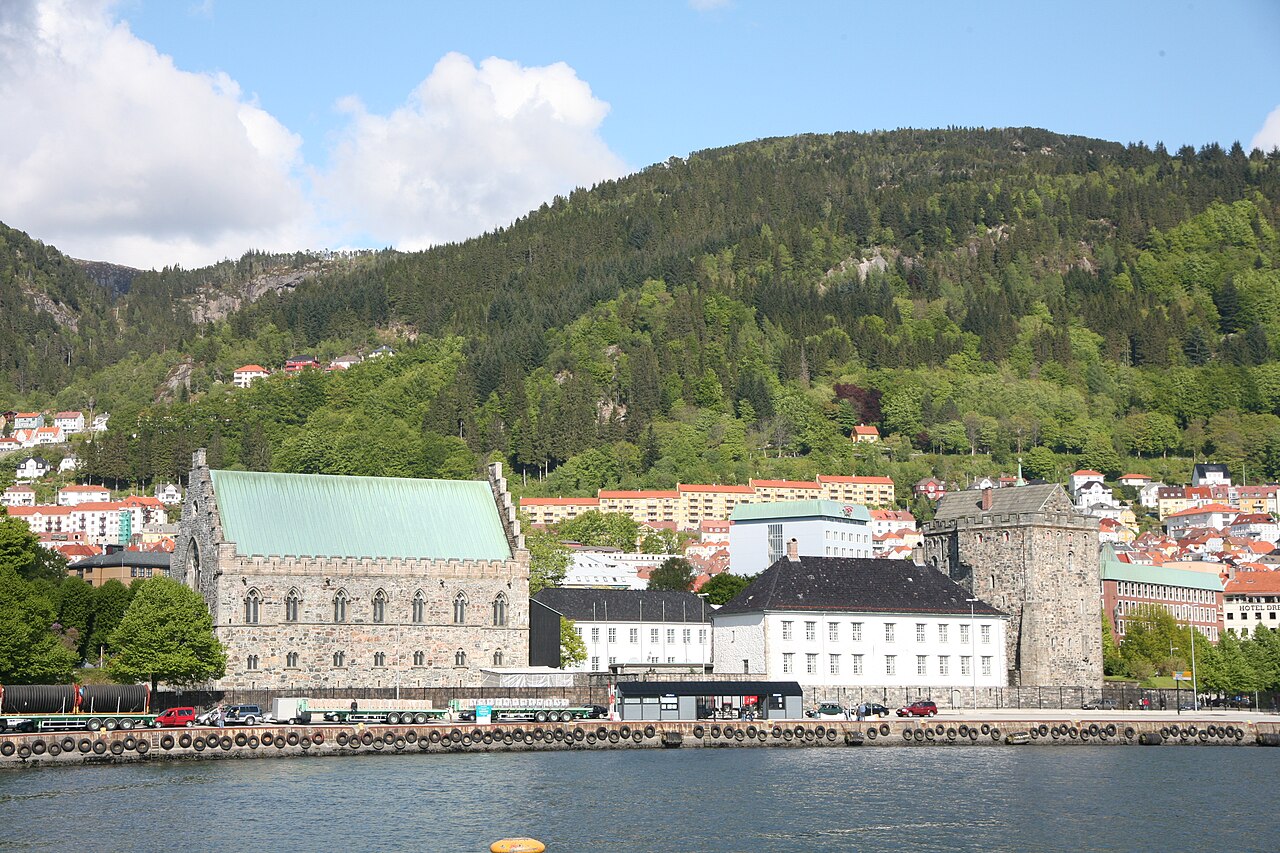
Bergenhus fortress (Norwegian: Bergenhus festning) is a fortress located in Bergen, Norway. Located at the entrance of Bergen harbour, the castle is one of the oldest and best preserved stone fortifications in Norway.
The fortress contains buildings dating as early as the 1240s, as well as later constructions built as recently as World War II. The extent of the enclosed area of today dates from the early 19th century. In medieval times, the area of the present-day Bergenhus Fortress was known as Holmen and contained the royal residence in Bergen, as well as a cathedral, several churches, the bishop's residence, and a Dominican monastery. Excavations have revealed foundations of buildings believed to date back to before 1100, which might have been erected by King Olav Kyrre. In the 13th century, until 1299, Bergen was the capital of Norway and Holmen was thus the main seat of Norway's rulers. It was first enclosed by stone walls in the 1240s.
Of the medieval buildings, a medieval hall and a defensive tower remain. The royal hall, today known as Haakon's Hall, was built around 1260. The defensive tower, was built around 1270 and contained a royal apartment on the top floor. In the 1560s, it was incorporated into a larger structure, which is today known as the Rosenkrantz Tower.
In the Middle Ages, several churches, including Bergen's cathedral Christ Church (Kristkirken på Holmen i Bergen), were situated on the premises. These were torn down between 1526 and 1531, as the area of Holmen was converted into a purely military fortification under Danish rule. From around this time, the name Bergenhus came into use. Building work on Christ Church probably started around 1100. It contained the shrine of Saint Sunniva, the patron saint of Bergen. In the 12th and 13th centuries it was the site of several royal coronations and weddings. It was also the burial site of at least six kings, as well as other members of the royal family. The site of its altar is today marked by a memorial stone.
In the 19th century, the fortress lost its function as a defensive fortification, but it was retained by the military as an administrative base. After restoration in the 1890s, and again after destruction sustained during World War II, Bergenhus is today again used as a concert venue and as a feast hall for public events.
Text adapted from “Bergenhus Fortress” on Wikipedia, CC BY-SA 4.0.
Bergenhus Fortress ranks #915 of 9,079 worldwide in the atlas's castle fame ranking, and #4 of the 26 mapped in Norway. Founded 1514, it is older than 42% of the atlas's dated landmarks — one of 891 atlas entries founded in the 16th century. Its Wikipedia articles were opened 8,743 times in the last 60 days, more than 93% of the atlas. 4 more atlas landmarks stand within 25 km. See how Norway compares in the castle statistics.
View on the interactive castle map →