 Norway · 18th century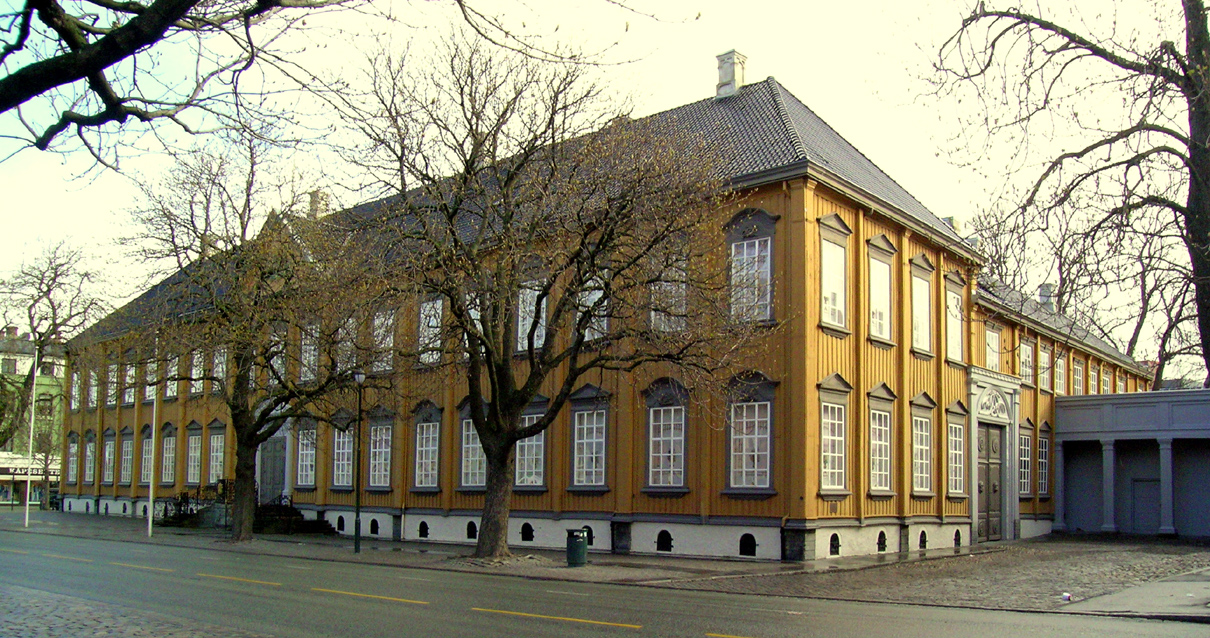
Stiftsgården is the royal residence in Trondheim, Norway. It is centrally situated on the city’s most important thoroughfare, Munkegaten. At 140 rooms constituting 4000 m² (43000 ft²), it is one of the largest wooden buildings in Northern Europe, and it has been used by royalty and their guests since 1800.
The palace was built in 1774–1778 for Cecilie Christine Schøller (1720–1786), the wealthy widow of Stie Tønsberg Schøller (1700–1769), chamberlain and merchant in Trondheim. Through her mother she was descended from some of the most prominent noble families in Denmark. From her father, the army commander in chief of central Norway, she inherited a large property in the city centre. When she inherited her husband's large fortune, she commenced the construction of the largest private townhouse in Trondheim. In 1777 she was given the title of a privy counselor. She is a representative of the cultural and commercial growth that Trondheim experienced in the late 18th century, and of the city's strong women in that period.
She often traveled abroad and seldom used the palace herself before she died in Copenhagen in 1786. The palace was constructed on the grounds of the former residence of her father, General Johan Friderich Frølich (1681–1757).
During her absence abroad, her son-in-law General Georg Frederik von Krogh (1732-1818) resided in the building. After her death, it was inherited by his son, Mrs. Schøller's grandson, and the General remained in residence there until it was sold to the state in 1800 for 10,000 rigsdaler. It was then used by the governor of the region, as law courts, and as a royal residence when the royal family visited Trondheim. The building also had several other functions; it housed the Bank of Norway in the period 1816–1819. In 1906 the palace became exclusively the royal residence in Trondheim.
Prominent guests resided there when in Trondheim. Thus, this location has been the place of residence in Trondheim for the Norwegian royal family since 1804. The first royal persons ever to visit the present building were Crown Prince Frederik of Denmark-Norway, Prince Carl and Prince Frederick of Hesse, who were the guests of General von Krogh in 1788.
Text adapted from “Stiftsgården” on Wikipedia, CC BY-SA 4.0.
Stiftsgården ranks #1,609 of 9,079 worldwide in the atlas's castle fame ranking, and #7 of the 26 mapped in Norway. Founded 1778, it is older than 14% of the atlas's dated landmarks — one of 696 atlas entries founded in the 18th century. Its Wikipedia articles were opened 2,954 times in the last 60 days, more than 77% of the atlas. 4 more atlas landmarks stand within 25 km. See how Norway compares in the castle statistics.
View on the interactive castle map →