Ruin
Bhongir Fort
🇮🇳 India · 7th century
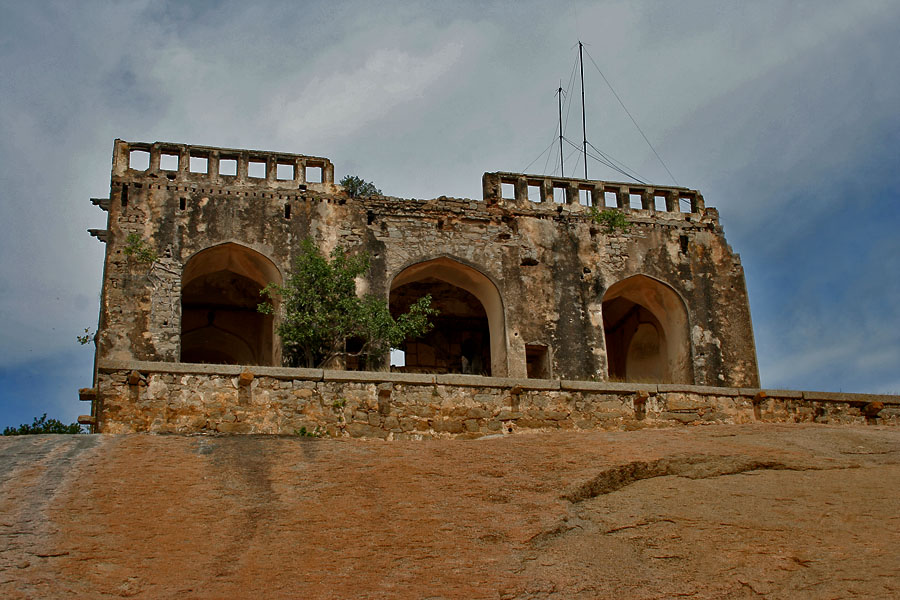
Bhongir Fort, also known as Bhuvanagiri Fort is a fort located in the heart of Bhongir a town in Yadadri Bhuvanagiri district, Telangana, India. It is located on a huge rock at a commanding height. 47 km from Hyderabad.
Bhuvanagiri Fort is in Yadadri-Bhuvanagiri District it was built in the 10th century on an isolated monolithic rock by the Western Chalukya ruler Tribhuvanamalla Vikramaditya VI and was thus named after him as Tribhuvanagiri.This name gradually became Bhuvanagiri and subsequently Bhongir.
At the foot of the fortified rocks 609.6 meters above the sea levels stands the town of Bhuvanagiri, the fort was considered practically impregnable by invading armies. The fort is associated with the rule of Queen Rudramadevi and her grandson Prataparudra II Bhuvanagiri Fort is one of the most prominent places in the Yadadri Bhuvanagiri District.
In the 10th century the cities of Bhuvanagiri Durgam and Bhuvanagiri existed. As king of the Chalukya dynasty, Rajayagiri was looking for a fort on the Mallanna Gutta. Impressed by the beauty of the mountain, King Rajagiri built a khilla (Quila) at the fort. When King Inamuliku gave Bonaiyah, who had shown a wonderful place he gently rejected them and requested that his name and the name of his wife Giramma built together. Legend has it that the city the king built on their names is today cultured in Bhuvanagiri.
Bhuvanagiri fort was long time ruled by Qutub Shahi. Later, when the Mughals invaded Golconda in 1687, they came to power. Sarvai Papanna who was born in Telangana to a common kalu Geetha family won the Orugallu in 1708 and later took over Bhuvanagiri.
Bhuvanagiri fort is an ancient monument built on a monolithic rock fortress, about 47 km from the city of Hyderabad. The hill is 184.5m high from road level it is one of the highest mountains in Deccan plateau. The mountain is an oval monolithic mountain and from the south it looks like a tortoise and a sleeping elephant from the western side travelling on the NH163. Bhuvanagiri fort is said to have been built during the reign of Mugla Vikramaditya, the 6th triangular dynasty of the western Chalukya dynasty. It is named after him as the Bhuvanagiri fort.
The hill has southbound and south-eastern passageways. The current route starts from the southwest. Bhuvanagiri Fort is the first steel gateway. It is said that the Nizam built it at his own expense.
Text adapted from “Bhongir Fort” on Wikipedia, CC BY-SA 4.0.
Bhongir Fort ranks #4,204 of 8,134 worldwide in the atlas's castle fame ranking, and #146 of the 179 mapped in India. Founded 609, it is older than 96% of the atlas's dated landmarks — one of 31 atlas entries founded in the 7th century. Its Wikipedia articles were opened 2,525 times in the last 60 days, more than 72% of the atlas. See how India compares in the castle statistics.
View on the interactive castle map →Frequently asked questions
Where is Bhongir Fort?
Bhongir Fort stands in India, at 17.51643°, 78.89254°.
When was Bhongir Fort built?
The atlas dates its founding to 609. Earlier structures may have stood on the site; this is the earliest documented founding year.
How famous is Bhongir Fort?
In this atlas's fame ranking: #4,204 of 8,134 worldwide, and #146 in India. Fame here combines how many Wikipedia language editions cover a landmark with how many people read them.
What is the nearest castle to Bhongir Fort?
King Kothi Palace, about 46 km away.
More castles in India
- Hadsar India
- Galna Fort India
- Thirumayam Fort India · 17th century
- Fort Anjediva India · 16th century
More ruins
- Burgruine Rothenthurn Austria
- Urasoe Castle Japan
- Kakunodate Castle Japan
- Castle of Carrazeda (ruins) Portugal