 India
India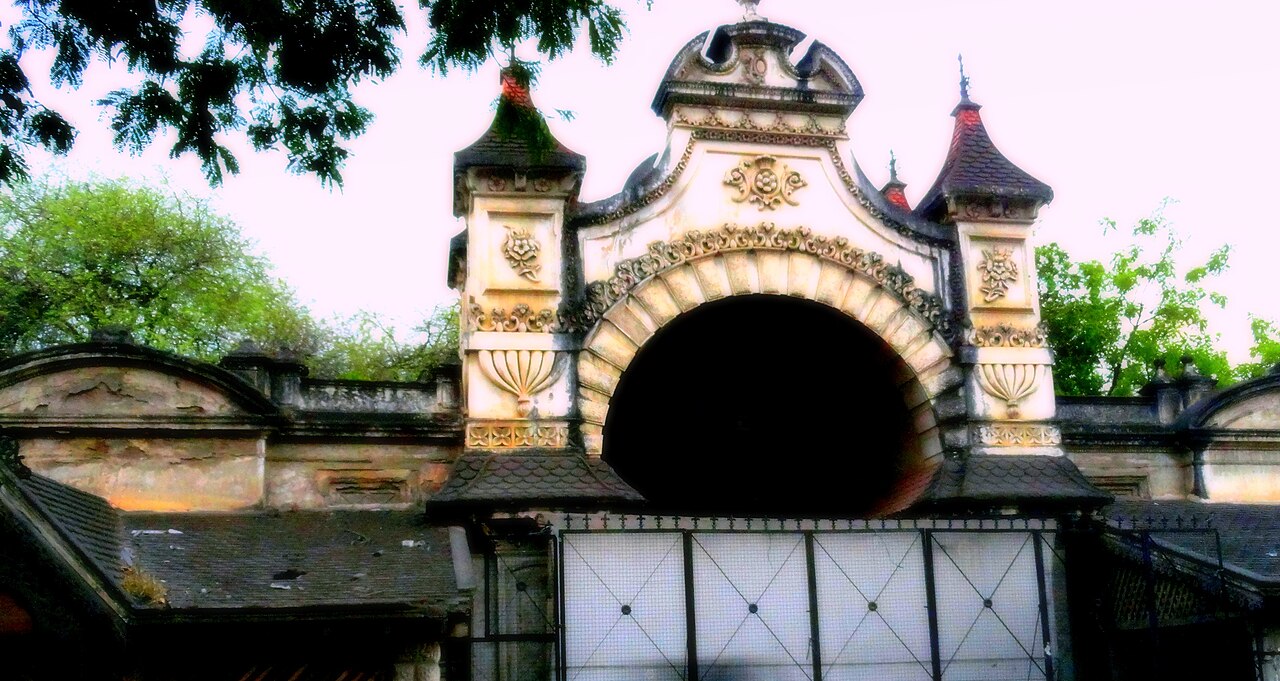
King Kothi Palace or Nazri Bagh Palace is a royal palace in Hyderabad, Telangana, India. It was the palace where the erstwhile ruler of Hyderabad State, Sir Mir Osman Ali Khan, the seventh Nizam, lived. It was a palace bought by his father Mahboob Ali Pasha, who had a penchant for buying ostentatious homes.
Initially, this grand palace was owned by a noble, Kamal Khan who had his initials 'KK' imprinted on all the furniture, doors, crockery, windows and even on the iron grilles of the palace. Mahboob Ali Pasha was keen to possess the palace but the bold engravings of the initials made him a little wary. To his relief, a courtier came up with an excellent solution. He suggested that since a large house in Urdu is called "Kothi" and since it would be the King's Palace, it could be renamed as "King Kothi" justifying the initials. The Nizam was pleased and went ahead and bought the palace. Thus the name King Kothi came into existence.
The palace was constructed by Kamal Khan, and sold to the Nizam once he expressed his desire for the palace. The young Nizam moved in when he was only 13. After his accession to the throne in 1911, he continued to stay at the palace and did not move to Chowmahalla Palace where his father lived.
In the sprawling palace, various kinds of expensive items were stored in steel trunks, fastened with English-made padlocks. The palace has three main buildings, divided into two groups. It also has a huge library used by the last Nizam.
The eastern half, now occupied by a state government hospital, was used by the Nizam for official and ceremonial purposes. The western half, which is now walled, has the main residential buildings known as Nazri Bagh or Mubarak Mansion and still belongs to the Nizam’s private estate.
The main entrance to Nazri Bagh always had a curtain draped across it, so it has come to be known as the purdah gate. When Nizam ventured out of the palace, the purdah was lifted to indicate the king was not home. The gate was guarded by Maisaram Regiment, police and Sarf-e-Khas Army bearing lances. The Nizam lived here until his death in 1967.
The palace is marked by large arched entrances and columns, intricate woodwork on canopied windows, and a large portico at the entrance.
Text adapted from “King Kothi Palace” on Wikipedia, CC BY-SA 4.0.
King Kothi Palace ranks #2,075 of 9,035 worldwide in the atlas's castle fame ranking, and #78 of the 223 mapped in India. Its Wikipedia articles were opened 3,819 times in the last 60 days, more than 82% of the atlas. 3 more atlas landmarks stand within 25 km. See how India compares in the castle statistics.
View on the interactive castle map →