 Sweden · 11th century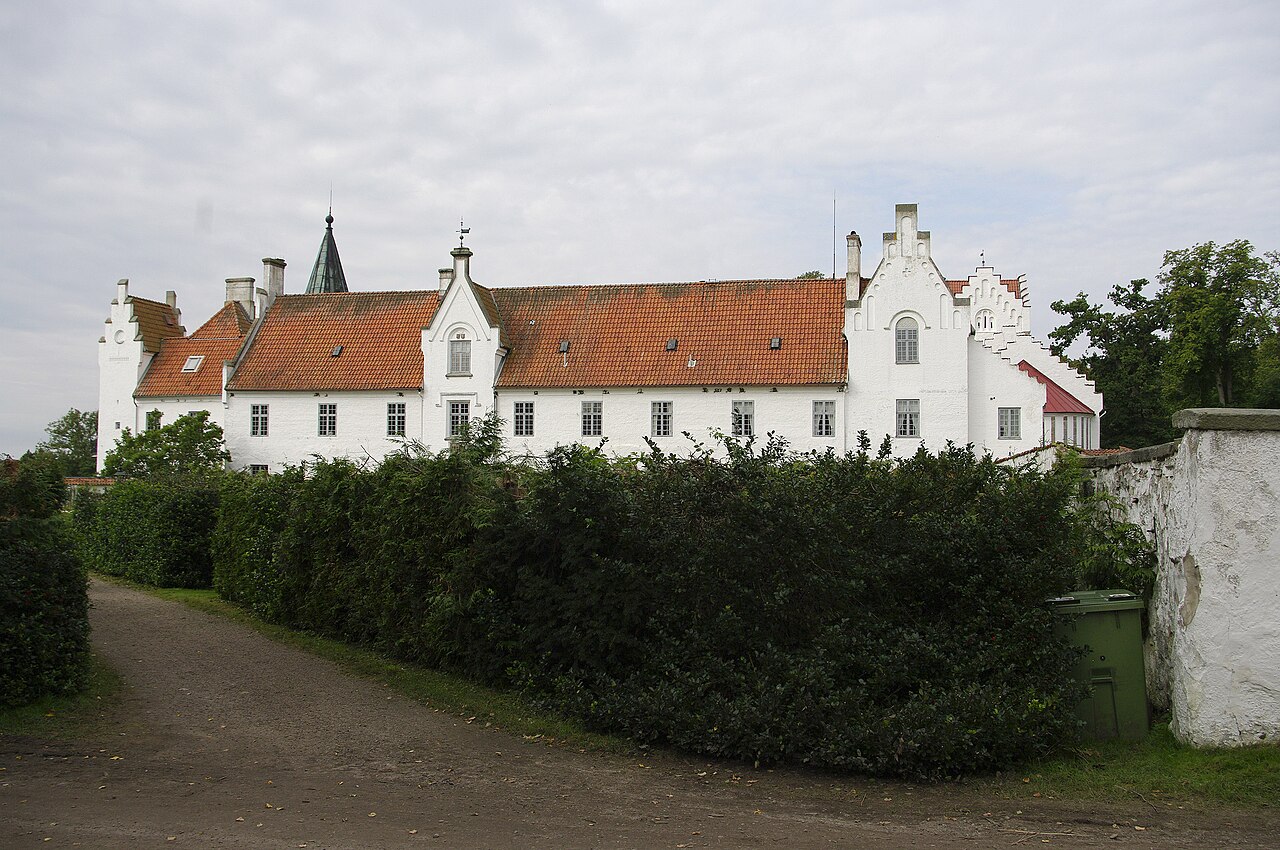
Bosjökloster (English: Bosjö Abbey) is a castle located on the shore of Lake Ringsjön in Höör Municipality, Scania, Sweden.
It was originally a nunnery, founded in 1080 by the Benedictine Order. The oldest preserved document that mentions Bosjö Abbey was written by Pope Lucius III in 1181, when he confirmed its privileges. The abbey was transformed into a castle in the 16th century, and only parts of the original building remains. During the Danish Reformation in the 16th century, the nunnery was closed down and the estate became Danish crown property. It was subsequently donated to Torbern Bille, the former archbishop of the Diocese of Lund under the condition that he took care of the remaining nuns. In 1560 King Frederick II of Denmark gave the estate as a barter to the widowed Scanian noble woman Thale Ulfstand. Her initials and the year 1569 are carved into the large oak doors of the entrance and are still visible.
The castle passed to the Beck family through marriage in 1629, but when Jochum Beck (1602-1682) lost the family fortune, it was sold to Corfitz Ulfeldt (1606–1664) to repay his debts. Ulfeldt was a Danish aristocrat famous for having switched sides. When he showed up at the peace negotiations at the Treaty of Roskilde proceedings to negotiate on behalf of Sweden, he was convicted of treason by a Danish court. Soon thereafter, he was also convicted of treason by a Swedish court, and was forced into exile. His wife Leonora Christina (1621-1698), daughter of King Christian IV, was captured in his place by the Danish authorities and was imprisoned in the Blue Tower in Copenhagen for 22 years.
Bosjökloster Castle was sequestered by the Swedish state and fell into disrepair. After a lawsuit in 1735, Bosjökloster was returned to the Beck family, who renovated the castle. They sold it in 1908 to Count Philip Bonde, whose family still owns Bosjökloster.
The composer Hilding Rosenberg (1892–1985) was born in the gardener's residence just south of the church tower.
Text adapted from “Bosjökloster” on Wikipedia, CC BY-SA 4.0.
Bosjökloster ranks #2,210 of 9,079 worldwide in the atlas's castle fame ranking, and #51 of the 209 mapped in Sweden. Founded 1080, it is older than 87% of the atlas's dated landmarks — one of 436 atlas entries founded in the 11th century. Its Wikipedia articles were opened 2,345 times in the last 60 days, more than 73% of the atlas. 9 more atlas landmarks stand within 25 km. The nearest day-trip guide is Kristianstad, 41 km away. See how Sweden compares in the castle statistics.
View on the interactive castle map →