Castle
Castillo de Alarcón
🇪🇸 Spain
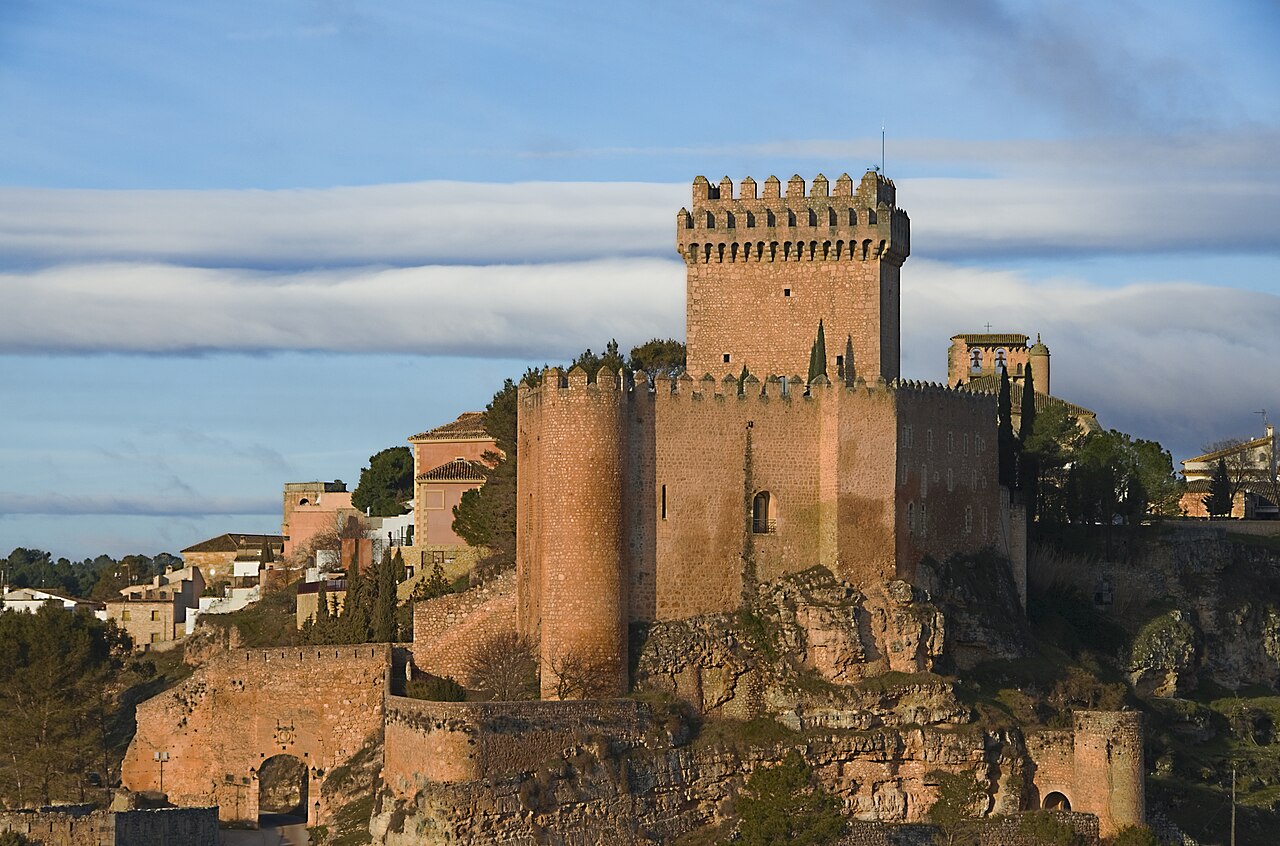
The Castle of Alarcón forms part of the fortifications built around the town of Alarcón in Cuenca, Spain. The fortress is composed of a walled enclosure, which houses the heart of the population and the castle proper, and of five exterior towers, separate and strategically placed.
Of Arab origin, the fortress was first under the jurisdiction of the Emirate of Córdoba. Following the collapse of the emirate's successor state, the Caliphate of Córdoba, and the formation of the taifa kingdoms, the town submitted to the Taifa of Toledo. During its time under Muslim power, the castle served as a defensive stronghold in the midst of internal conflicts. In 1184, Fernán Martínez de Ceballos, military captain under Alfonso VIII of Castile, besieged the fortress for nine months before finally capturing it in the name of his king. He was rewarded with the privilege of taking the name of the town as his surname, which he did, calling himself Martínez de Alarcón and thus establishing a new lineage.
From then on, the Castle of Alarcón received much attention from the successive kings of Castile, who expanded and reinforced it while providing it with its own charter (fuero) and granting it lordship over extensive neighboring territories. Spanish historian Andrés Marcos Burriel writes that its domain comprised 63 villages, including Albacete, La Roda, Villarrobledo, Castillo de Garcimuñoz, Belmonte and many others. All of this was placed under the protection of the Military Order of Santiago by Alfonso VIII. In 1212, the town council of Alarcón sent troops to support the king's army in the decisive Battle of Las Navas de Tolosa.
At the start of the 14th century, Ferdinand IV of Castile gave lordship of Alarcón and its castle to Juan Manuel, Prince of Villena. Only a provisional measure in 1297, the appointment was confirmed on March 23, 1305. It was at Alarcón that the prince wrote some of his literary works. After his death, the lordship passed to his son Fernando Manuel de Villena and then to his granddaughter Blanca. It was later recovered by King Peter of Castile and returned to the royal heritage. Henry II of Castile then gave it to Alfonso I of Aragon, whom he named Marquis of Villena in 1372, but Henry III took it back for the Crown in 1395. Finally, in the 15th century, Alarcón was given to Juan Pacheco, Marquis of Villena, on May 23, 1446.
Text adapted from “Castle of Alarcón” on Wikipedia, CC BY-SA 4.0.
Castillo de Alarcón ranks #5,428 of 8,134 worldwide in the atlas's castle fame ranking, and #250 of the 602 mapped in Spain. See how Spain compares in the castle statistics.
View on the interactive castle map →Frequently asked questions
Where is Castillo de Alarcón?
Castillo de Alarcón stands in Spain, at 39.54654°, -2.08307°.
How famous is Castillo de Alarcón?
In this atlas's fame ranking: #5,428 of 8,134 worldwide, and #250 in Spain. Fame here combines how many Wikipedia language editions cover a landmark with how many people read them.
What is the nearest castle to Castillo de Alarcón?
Castillo de Belmonte, about 53 km away.
More castles in Spain
- Castillo de Mombeltrán Spain · 15th century
- Castle of Monasterio de Rodilla Spain · 11th century
- Vila Vella (Tossa de Mar) Spain
- Castle of Puebla de Sanabria Spain
More castles
- Reinbek Castle Germany · 16th century
- Greifenstein Castle (Hesse) Germany
- Willibaldsburg Germany · 11th century
- Schloss Hämelschenburg Germany · 16th century