 Portugal · 12th century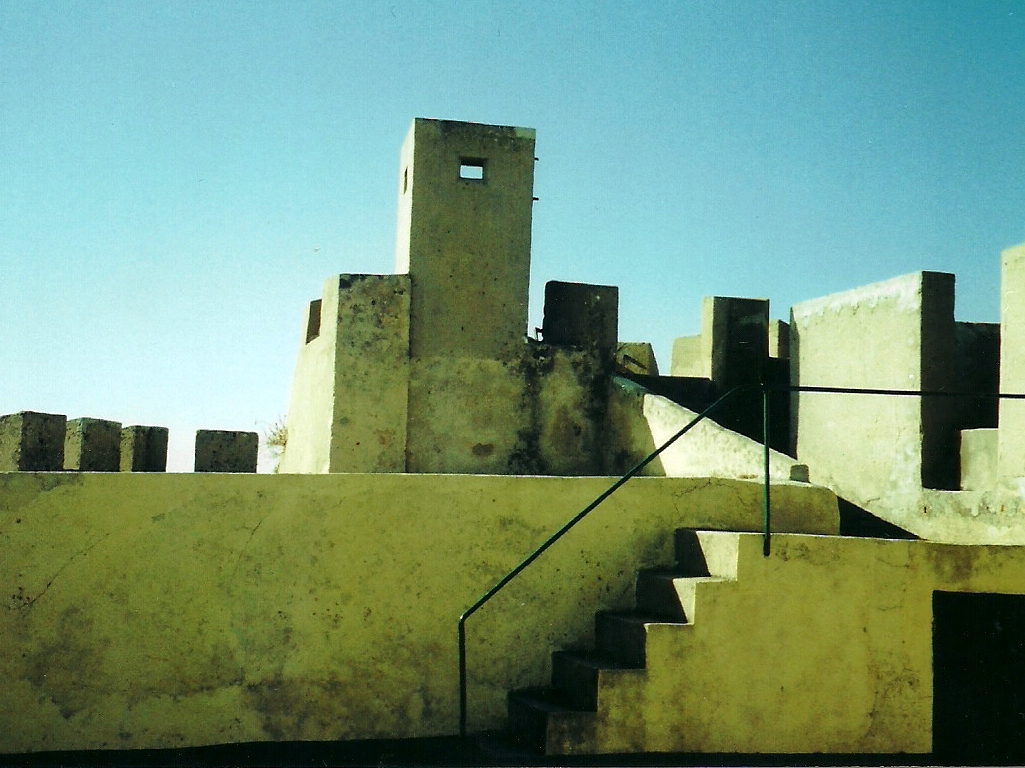
The Castle of Almada (Portuguese: Castelo de Almada) is a medieval castle located in the civil parish of Almada, Cova da Piedade, Pragal e Cacilhas, in the municipality of Almada, Portuguese Setúbal.
The castle was founded in a strategic position, on a site settled by Muslim forces during the Iberian occupation, referred to as al-Madan (which means gold mine or silver mine), suggesting that the site was built on mineral extraction in the region or epoch, and referred to in the Geografia Nubiense of Muhammad al-Idrisi (dating to the 12th century.
During the Portuguese Reconquista of Lisbon (around 1147), Almada was assaulted and conquered by the combined forces of King D. Afonso and a crusader army. Following its conquest, the settlement's defenses were reinforced and expanded following the foral (charter) issued of 1170.
King D. Sancho I signed a new foral in 1190. During this period, Almohad forces under the command of caliph Abū Yūssuf Yaʿqūb bin Yūssuf al-Manṣūr following their conquest of the Algarve, advanced to the north, expelling Portuguese forces from citadels in Alcácer do Sal and Palmela, and destroyed the defensive lines in Almada (1191). The Portuguese monarch reconquered the fortifications in 1195, and began the construction of a castle on the site. It was only following the battle of Navas de Tolosa (1212), when Christian forces registered a decisive victory over Muslim forces in the Iberian peninsula, that the lost territories were recaptured from the Tagus to Évora.
On 24 February 1255, King D. Afonso III (1248-1279) reconfirmed to the Order of Santiago, in the person of Master Paio Peres Correia and his commander, the control of the castles first donated by D. Sancho I, and later confirmed by Afonso II (1211-1223), namely Alcácer do Sal, Almadar do Sal, Almada, Arruda and Palmela.
The castle was expanded and reinforced during the reign of King D. Dinis I and, later, under the direction of King Ferdinand (1367-1383).
During the succession crisis of 1383-1385, when the city of Lisbon was under siege (1384), Almada was encircled by forces loyal to Castile, by Condestável D. Nuno Álvares Pereira who was unsuccessful in liberating the region.
During the reign of King D. Manuel I (1495-1521) a tower was constructed on the south wall of the castle fortifications.
Text adapted from “Castle of Almada” on Wikipedia, CC BY-SA 4.0.
Castle of Almada ranks #7,829 of 9,079 worldwide in the atlas's castle fame ranking, and #170 of the 212 mapped in Portugal. Founded c. 1150, it is older than 80% of the atlas's dated landmarks — one of 756 atlas entries founded in the 12th century. 22 more atlas landmarks stand within 25 km. The nearest day-trip guide is Lisbon, 3 km away. See how Portugal compares in the castle statistics.
View on the interactive castle map →