 Italy · 11th century
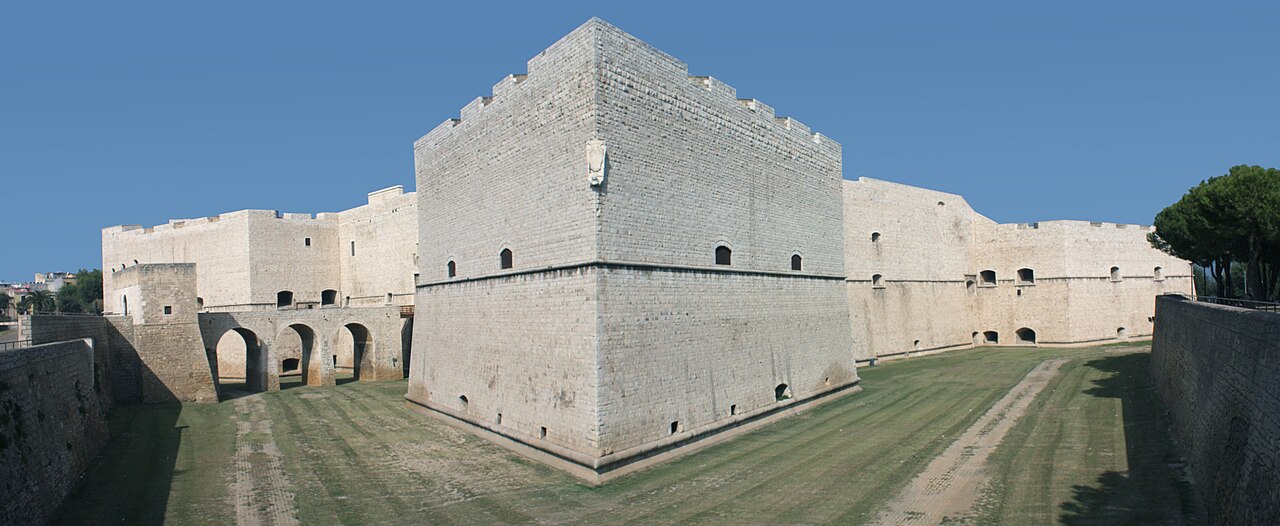
The castle of Barletta is the architectural result of various stratifications due to the succession of different ruling dynasties from the 11th century to the 18th century. Once a fortress for defensive purposes, surrounded by the sea that occupied the moat all around the castle and insulated it from potential enemy attacks, it constitutes a strategic point in city life as well as an important urban core. It is home to the Municipal Library, the Civic Museum and a conference and exhibition hall.
Among the works preserved, in addition to an alleged limestone bust of Frederick II of Swabia, dating back to the 13th century, the Sarcophagus of the Apostles, the first stone high relief to bear witness to Christianity in Barletta, dating from the period between the 3rd and 4th centuries, is located here.
Text adapted from “Castle of Barletta” on Wikipedia, CC BY-SA 4.0.
Castle of Barletta ranks #3,159 of 9,035 worldwide in the atlas's castle fame ranking, and #245 of the 555 mapped in Italy. Founded c. 1050, it is older than 89% of the atlas's dated landmarks, one of 439 atlas entries founded in the 11th century. Its Wikipedia articles were opened 1,596 times in the last 60 days, more than 64% of the atlas. 1 more atlas landmarks stand within 25 km. See how Italy compares in the castle statistics.
View on the interactive castle map →