 Italy · 11th century
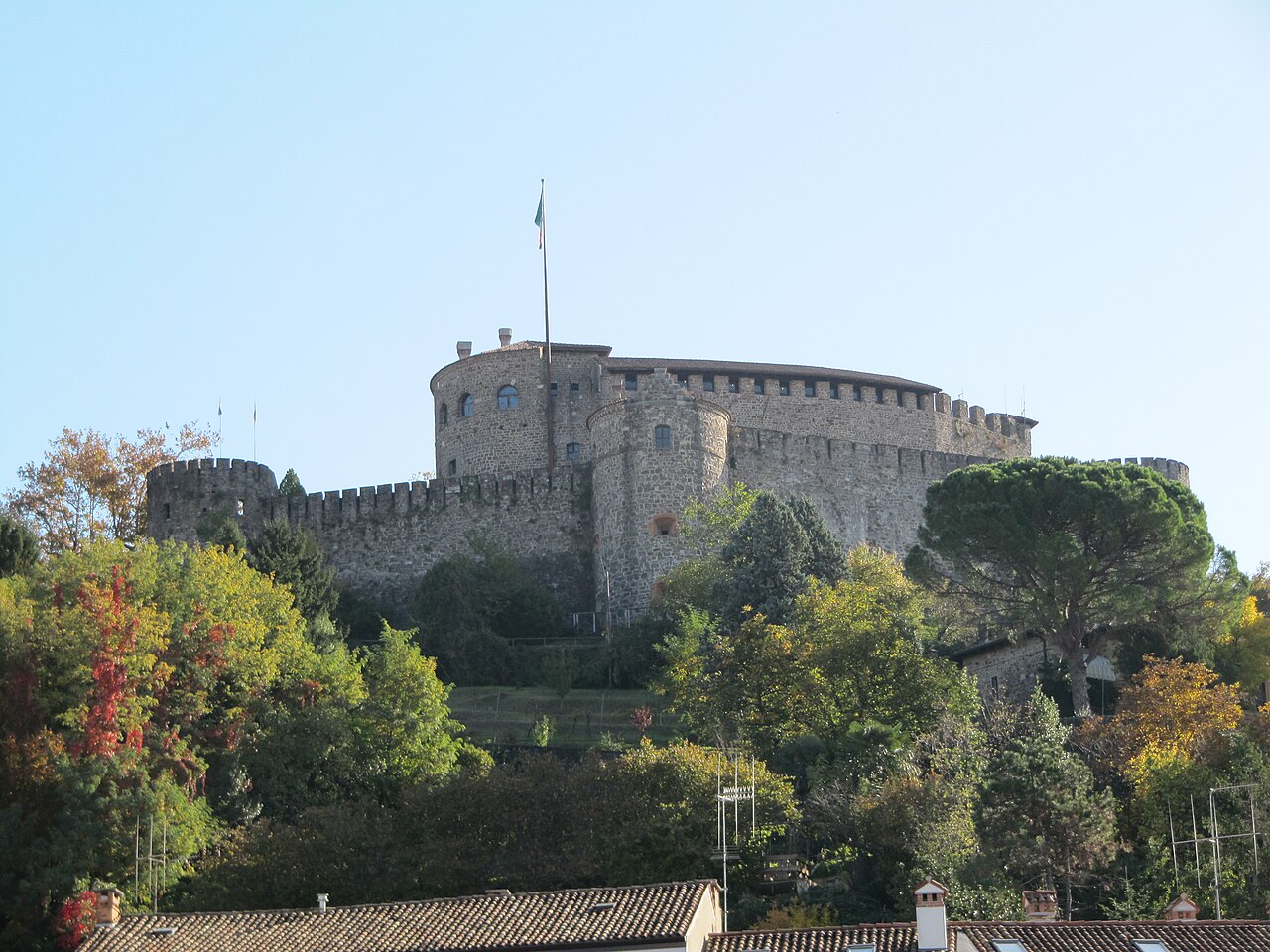
Castle of Gorizia ranks #4,309 of 9,040 worldwide in the atlas's castle fame ranking, and #321 of the 555 mapped in Italy. Founded c. 1050, it is older than 89% of the atlas's dated landmarks, one of 439 atlas entries founded in the 11th century. Its Wikipedia articles were opened 1,362 times in the last 60 days, more than 59% of the atlas. 3 more atlas landmarks stand within 25 km. The nearest day-trip guide is Udine, 33 km away. See how Italy compares in the castle statistics.
Gorizia Castle is an Italian fortification dating to the 11th century on the hill which dominates the city of Gorizia, Italy, from which it takes its name. The medieval House of Gorizia was named after the castle.
The construction of Gorizia Castle can be dated to around 1146, where, for the first time, the title of Count of Gorizia appears, given to Henry IV of Spanheim, which presumes the presence of a fortification at the site. Already in the next generation, it passed to the counts in the Puster Valley, related to the Spanheims, who thereafter took the title of Counts of Gorizia, testifying to the importance of the castle at the time.
It is likely that an initial series of defensive structures such as a small motte-and-bailey fort with a moat and a palisade which had preceded the construction of a stone tower or keep, which was further expanded during the 13th century, with the addition of a mansion and a two-storey building. During the same period there was certainly a hamlet outside of the palisade, also outfitted with a defensive barrier and composed of houses mandatorily built in masonry, an enforcement given to the residents together with the duty of defending the castle in case of attack.
The first representation of the castle dates back to 1307, imprinted on the seal allowed to the city by Albert II. Although the figure is very stylized, the keep can be clearly seen. It is likely that around 1350, the castle had similar appearance to that of Bruck in Lienz.
At Leonhard's death, the last count of Gorizia, in the spring of 1500, the County with Gorizia Castle became properties of Maximilian I of Habsburg, emperor of the Holy Roman Empire. Although having reinforced its defences, the castle and the region was lost in 1508, when it was seized by the Republic of Venice after Maximilian's unsuccessful attack on the Republic of Venice in the Battle of Cadore. The Republic claimed the County of Gorizia as an alleged fief of the Patriarchate of Aquileia.
Under the Republic of Venice, the castle had further fortification works to make it more appropriate to the Renaissance warfare, which incorporated the use of firearms. Among the various changes made, the 11th-century keep was demolished. However, Venice only managed to occupy the territory for thirteen months, until June 1509.
Text adapted from “Gorizia Castle” on Wikipedia, CC BY-SA 4.0.
View on the interactive castle map →