Castle
Castle Sinclair Girnigoe
SCT Scotland · 15th century
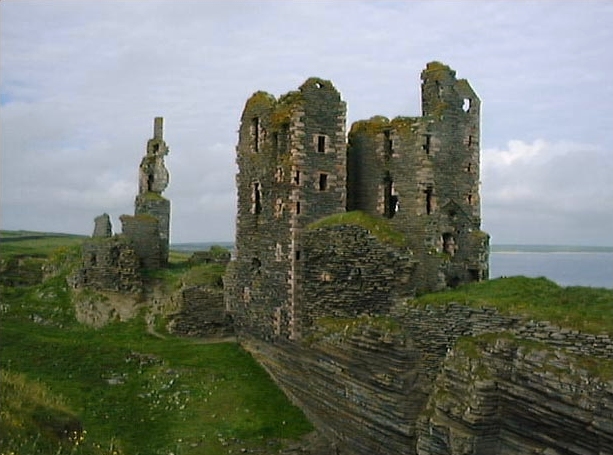
Castle Sinclair Girnigoe is located about 3 miles north of Wick on the east coast of Caithness, Scotland. It is considered to be one of the earliest seats of Clan Sinclair. It comprises the ruins of two castles: the 15th-century Castle Girnigoe; and the early 17th-century Castle Sinclair. They are designated as a scheduled monument.
The earlier Castle Girnigoe was built by William Sinclair, 2nd Earl of Caithness, probably sometime between 1476 and 1496, but certainly before his death at the Battle of Flodden in 1513. There is some evidence to suggest that the castle was built on the foundations of an earlier fortalice.
Olave Sinclair, the foud of Shetland, was brought to Girnigoe in May 1573, paralysed after a stroke. In 1577, George Sinclair, 4th Earl of Caithness, imprisoned his own son John Sinclair, Master of Caithness, in Castle Girnigoe, on suspicion of rebelling against his rule. He was held there for seven years, after which his father fed him a diet of salted beef, with nothing to drink, so that he eventually died insane from thirst. The rebel Earl of Bothwell was at Girnigoe in December 1594.
Expansion occurred in 1606 when Castle Sinclair was built, comprising a gatehouse and other buildings, along with a curtain wall. These were connected to the earlier castle by a drawbridge over a ravine. The same year George Sinclair, 5th Earl of Caithness, requested the Scottish Parliament to change the name to Castle Sinclair, but because the names Castle Sinclair and Castle Girnigoe were both written down in 1700, both names have been in use since.
Robert Sinclair describes Girnigoe as "an adapted 5-storey L-plan crow-stepped gabled tower house, which sat upon a rocky promontory jutting out into Sinclair Bay. Of interest is the secret chamber in the vaulted ceiling of the kitchen."
In 1672, George Sinclair, 6th Earl of Caithness, was in heavy debt to his fourth cousin, John Campbell of Glenorchy, and transferred the castle to Campbell as payment. When Sinclair died four years later with no heir, Campbell claimed the title Earl of Caithness and married Sinclair's widow. However, Sinclair's first cousin, George Sinclair of Keiss, challenged Campbell's title. This resulted in the Battle of Altimarlach in which Campbell defeated Sinclair in 1680.
Text adapted from “Castle Sinclair Girnigoe” on Wikipedia, CC BY-SA 4.0.
Castle Sinclair Girnigoe ranks #2,696 of 8,134 worldwide in the atlas's castle fame ranking, and #92 of the 168 mapped in Scotland. Founded 1476, it is older than 47% of the atlas's dated landmarks — one of 455 atlas entries founded in the 15th century. Its Wikipedia articles were opened 4,467 times in the last 60 days, more than 83% of the atlas. 2 more atlas landmarks stand within 25 km. It is one of the 57 landmarks on the atlas's regional map of the Scottish Highlands. See how Scotland compares in the castle statistics.
View on the interactive castle map →Frequently asked questions
Where is Castle Sinclair Girnigoe?
Castle Sinclair Girnigoe stands in Scotland, at 58.47801°, -3.06808°.
When was Castle Sinclair Girnigoe built?
The atlas dates its founding to 1476. Earlier structures may have stood on the site; this is the earliest documented founding year.
How famous is Castle Sinclair Girnigoe?
In this atlas's fame ranking: #2,696 of 8,134 worldwide, and #92 in Scotland. Fame here combines how many Wikipedia language editions cover a landmark with how many people read them.
What is the nearest castle to Castle Sinclair Girnigoe?
Ackergill Tower, about 3 km away.
More castles in Scotland
- Abergeldie Castle Scotland · 16th century
- Ardencaple Castle Scotland · 12th century
- Fort Charlotte (Shetland) Scotland · 17th century
- Brahan Castle Scotland · 17th century
More castles
- St Catherine's Castle England · 16th century
- Castle of Doña Blanca Spain
- Barxell Castle Spain · 13th century
- Sandgate Castle England · 16th century