 France · 16th century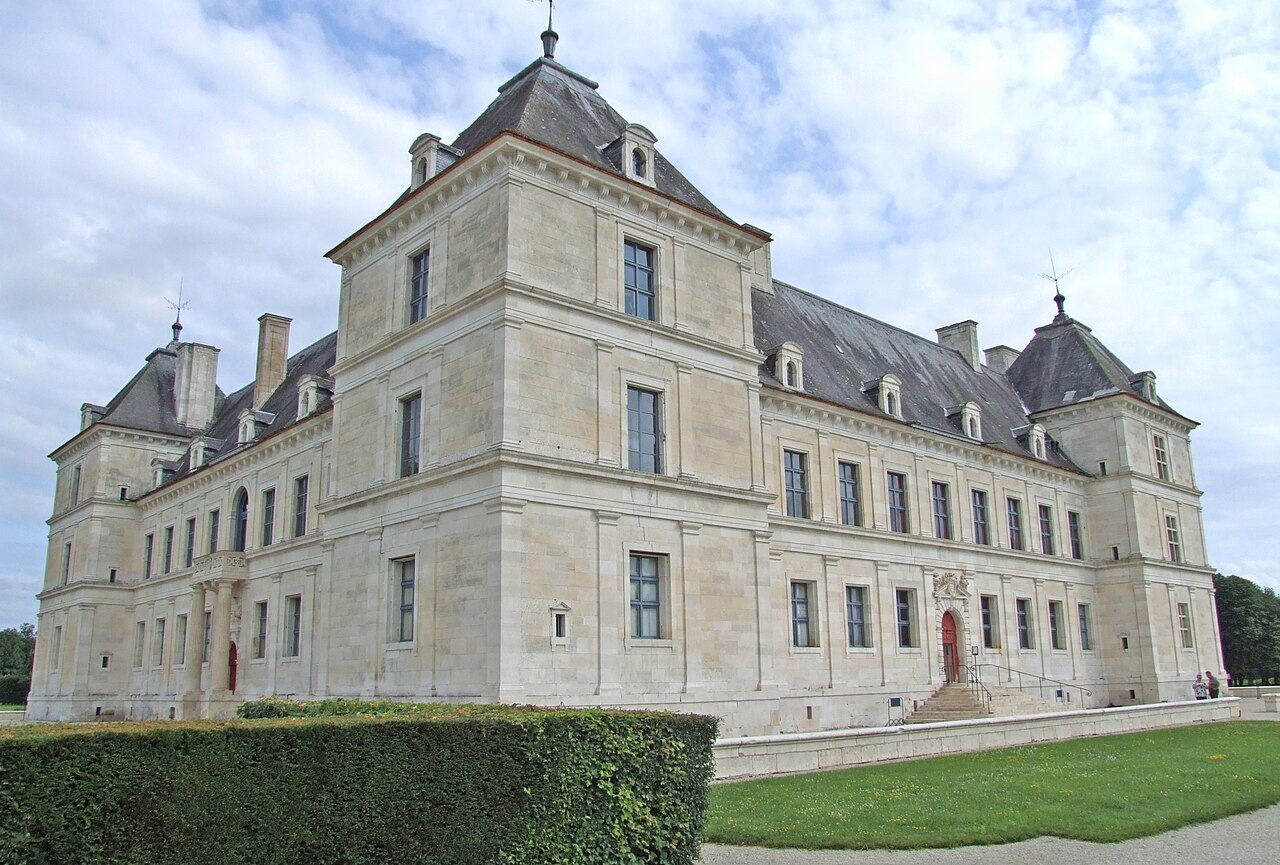
Château d'Ancy-le-Franc is a Renaissance-style château of the 16th century located in the town of Ancy-le-Franc in the department of Yonne, in France.
The site was originally occupied by a 12th-century fort, which survived until the end of the sixteenth century.
Construction of the existing château began in 1544, at the request of Antoine III de Clermont, brother-in-law of Diane de Poitiers and son of Anne de Husson, countess of Tonnerre. The design of the building is traditionally attributed to the Italian architect Sebastiano Serlio, who had been invited to France by King Francis I. Following Serlio's death in 1554 at Fontainebleau, architect Pierre Lescot, took over the work, respecting the original plans of Serlio. The interior design is the work of Francesco Primaticcio, who was working at Château de Fontainebleau at the time.
Antoine de Clermont died in 1578 and his grandson Charles-Henri de Clermont, completed the interior. Fully completed, the château was now able to host prestigious guests such as Henry III (brief visit), Henri IV in 1591, Louis XIII in 1631 and Louis XIV in 1674.
In 1683, the Clermont-Tonnerre family was forced to sell the land of Ancy-le-Franc and the château to François-Michel Le Tellier, minister of Louis XIV. The following year, Louvois acquired the entire County of Tonnerre, (including the Château de Maulnes). Following this, he employed well-known landscape architect André Le Nôtre for creating pathways and gardens within the grounds.
After the French Revolution, the family managed to regain possession of the château. He restored the grounds as well as the interior of the château to its former glory.
In 1844, Ancy-le-Franc was sold to Louis Aimé Gaspard de Clermont-Tonnerre, a descendant of Antoine III of Clermont. It then passed between various hands, including those of the princes of Merode.
The château is currently owned by a private company, Société Paris Investir SAS, which undertook its restoration, and recognition as a national historical monument.
The architecture of the château is the result of a mixture of French and Italian styles, a consequence of compromise between the French owner and Italian architect.
The château is built on a rectangular central plan. Four houses form a square and are each flanked by projecting pavilion walls. This plan is based on plans called "pi" widely used in France at that time.
Text adapted from “Château d'Ancy-le-Franc” on Wikipedia, CC BY-SA 4.0.
Château d'Ancy-le-Franc ranks #1,853 of 9,079 worldwide in the atlas's castle fame ranking, and #142 of the 793 mapped in France. Founded 1544, it is older than 40% of the atlas's dated landmarks — one of 891 atlas entries founded in the 16th century. Its Wikipedia articles were opened 2,211 times in the last 60 days, more than 72% of the atlas. 3 more atlas landmarks stand within 25 km. See how France compares in the castle statistics.
View on the interactive castle map →