 Germany · 15th century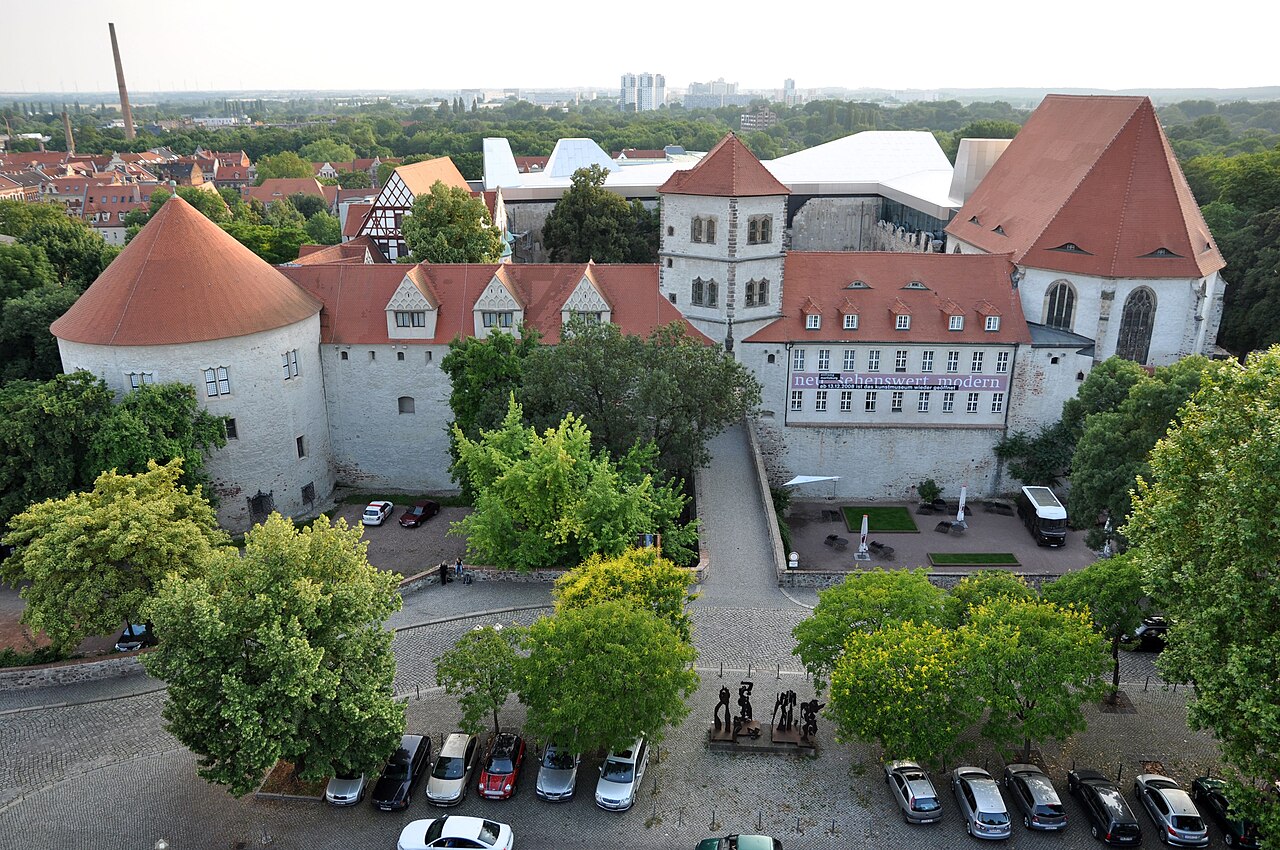
The Moritzburg (German pronunciation: [ˈmoːʁɪtsˌbʊʁk]) is a fortified castle in Halle (Saale), Germany. The cornerstone of what would later become the residence of the Archbishops of Magdeburg was laid in 1484; the castle was built in the style of the Early Renaissance.
Since the end of the 19th century, it has housed an arts museum which is recognised as being of national importance.
The history of the Moritzburg is closely connected to that of Halle. In 968, when the Archbishopric of Magdeburg was established by Otto I, Holy Roman Emperor, he granted the archbishop his Giebichenstein Castle near Halle. Already in the 13th century, powerful aristocrats could buy privileges, reduce the influence of the sovereign, the Archbishop of Magdeburg, on the town. Thus, Halle had practically reached a state of political autonomy in 1263. The same happened with Magdeburg and when the archbishops finally left Magdeburg, after a series of conflicts with the ever more powerful city council, Giebichenstein Castle became their principal residence in 1382.
In the 15th century a group of the important guilds formed an opposition and demanded representation in the city council, which was until then dominated by the urban aristocrats. In 1479, the opposition conspired with the sovereign and opened the gates of the city for the Archbishop's troops. After sparse resistance, Archbishop Ernest II. of Saxony, who was only 14 years of age at the time, moved into the town. As a consequence, the town lost its earlier gained freedoms and it was determined ein festes Schloss zu erbauen, um die Stadt besser in Gehorsam, Unterwürfigkeit und Ruhe zu erhalten: to build a castle in order to gain better control over the town and keep it obedient and quiet.
Construction began promptly with first surveying in April 1479. The search for an adequate location, however, proved difficult due to poor soil conditions. A location was finally found, incorporating the city wall, on the site of the former Jewish settlement northwest of the city.
Archbishop Ernest personally laid the cornerstone of his new residence on May 25, 1484 in a ceremonial procession and named the castle Moritzburg after Saint Maurice, the Patron Saint of the country.
Text adapted from “Moritzburg (Halle)” on Wikipedia, CC BY-SA 4.0.
Moritzburg ranks #1,749 of 9,079 worldwide in the atlas's castle fame ranking, and #136 of the 711 mapped in Germany. Founded 1484, it is older than 44% of the atlas's dated landmarks — one of 554 atlas entries founded in the 15th century. Its Wikipedia articles were opened 2,473 times in the last 60 days, more than 74% of the atlas. 2 more atlas landmarks stand within 25 km. See how Germany compares in the castle statistics.
View on the interactive castle map →