 France · 17th century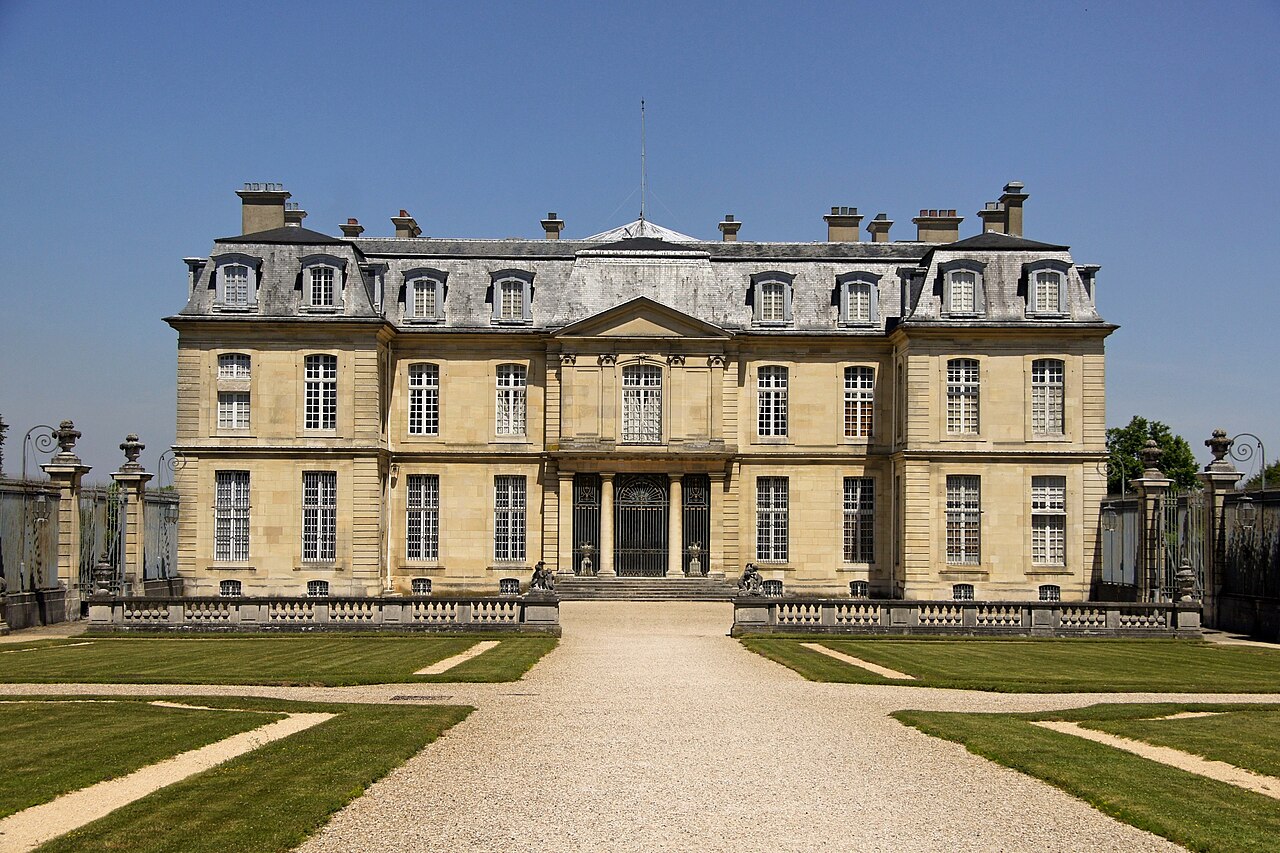
The Château de Champs-sur-Marne (French pronunciation: [ʃato d(ə) ʃɑ̃ syʁ maʁn]) is a neoclassical château in Champs-sur-Marne, France. It was built in its present form for the treasurer Charles Renouard de la Touane in 1699 by Pierre Bullet, architecte du roi. After the first proprietor's bankruptcy, another financier, Paul Poisson de Bourvalais, took up the project. Jean-Baptiste Bullet de Chamblain, the son of Pierre Bullet, finished Champs in 1706.
Ten years later, Paul Poisson was in the Bastille on charges of embezzlement and the château was seized by the Crown. In 1718, it was sold to the princesse de Conti, natural daughter of King Louis XIV and his first official mistress, Louise de La Vallière. That same year, however, the princess cancelled a debt by deeding Champs to her first cousin, the duc de La Vallière. When the duke died in 1739, he left the château to his son and heir, the famous bibliophile, Louis César de La Baume Le Blanc. The new duc de La Vallière was later to become a trusted friend of King Louis XV and his mistress, Madame de Pompadour.
Around 1750, the duke added a beautiful rococo salon chinois (Chinese salon) to the château with wall paintings by noted artist Christophe Huet. At the château, Louis César entertained many of the famous writers of the day, including Diderot, Voltaire, d'Alembert and François-Augustin de Paradis de Moncrif, with whom he also corresponded regularly.
After the construction of a magnificent new château at Montrouge around 1750, however, the duke gradually abandoned the Château de Champs-sur-Marne. Eventually, he tried to sell the domain, but he could not find a buyer and was forced to rent it out. Between July 1757 and January 1759, he leased the estate to Madame de Pompadour for 12,000 livres per year. The marquise spent 200,000 livres in less than eighteen months to renovate the château.
Text adapted from “Château de Champs-sur-Marne” on Wikipedia, CC BY-SA 4.0.
Château de Champs-sur-Marne ranks #2,374 of 9,079 worldwide in the atlas's castle fame ranking, and #188 of the 793 mapped in France. Founded 1699, it is older than 22% of the atlas's dated landmarks — one of 721 atlas entries founded in the 17th century. Its Wikipedia articles were opened 3,727 times in the last 60 days, more than 82% of the atlas. 30 more atlas landmarks stand within 25 km. The nearest day-trip guide is Paris, 18 km away. See how France compares in the castle statistics.
View on the interactive castle map →