Ruin
Château de Ham
🇫🇷 France · 11th century
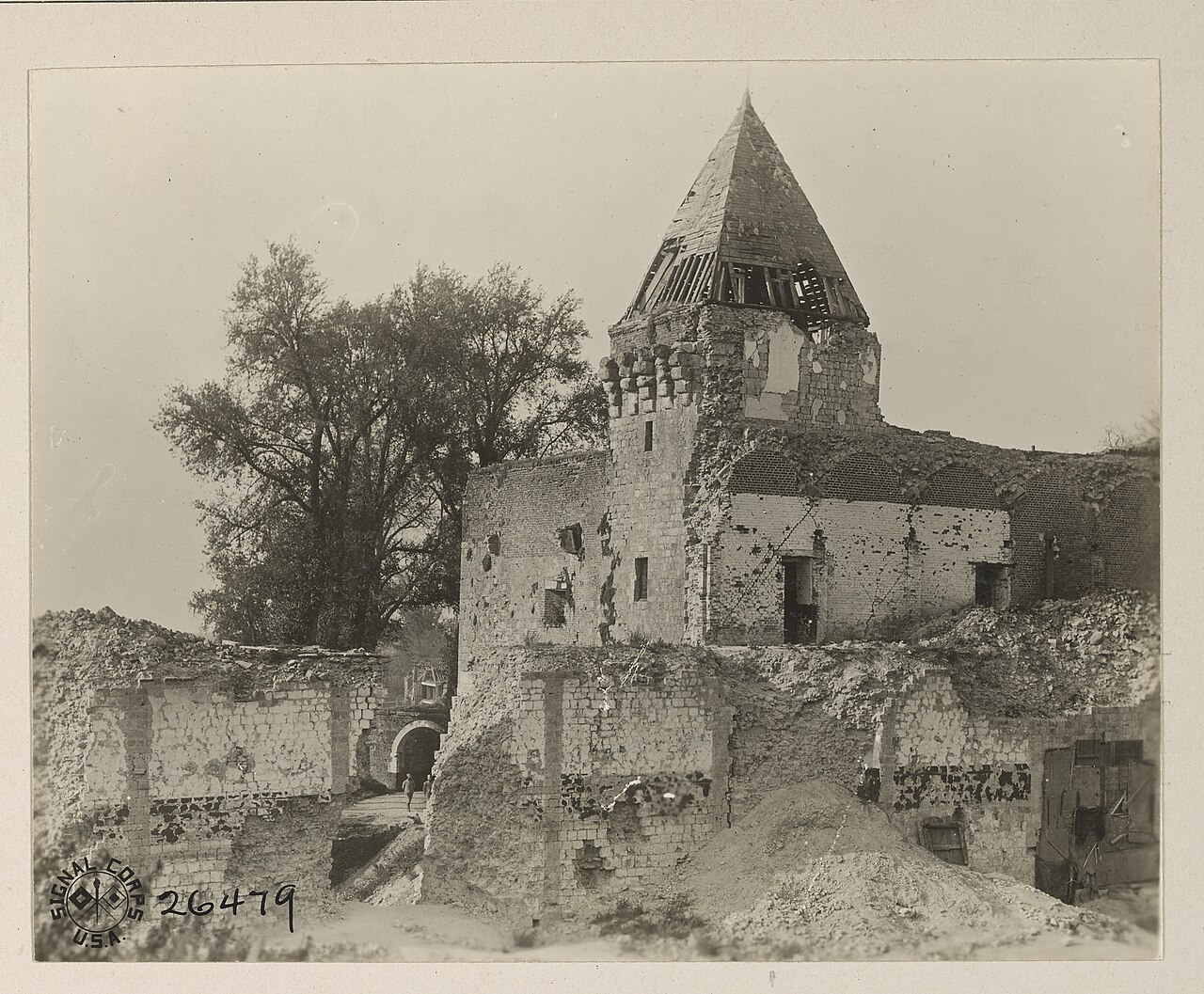
The Château de Ham (also called fort or forteresse de Ham) is a castle in the commune of Ham in the Somme département in Hauts-de-France, France.
The early castle, whose construction date is unknown, is mentioned in a 1052 charter. During the 13th century, it was restored by Odon IV of Ham who gave the fortress its definitive shape, a polygonal enceinte broken up by large cylindrical towers. Enguerrand de Coucy bought the seigneury in 1380 and his daughter sold it in 1400 to Louis d' Orléans, who integrated it into his network of fortresses which included La Ferté-Milon, Pierrefonds and Fère-en-Tardenois. Louis began the reconstruction, perfected after 1418 by John II of Luxembourg, Count of Ligny, who acquired the seigneury following Louis' assassination.
John's nephew, Louis de Luxembourg, Count of Saint-Pol and constable to Louis XI in 1465, constructed a monumental keep in 1441. This massive tower (the tour du connétable - constable's tower) was 33 m (~108 ft) in diameter and 33 m (~108 ft) high and had walls 11 m (~36 ft) thick.
The Château de Ham was besieged several times, notably by Philip II of Spain in 1557.
United with the French crown under the reign of Henri IV, it was transformed at the end of the 17th century by Vauban.
The castle was later turned into a state prison. It 'welcomed' many famous prisoners, the last of whom was Prince Louis-Napoléon Bonaparte (the future Napoléon III) who, after six years, escaped by adopting the identity of a painter, Badinguet. Later, his opponents would often refer to him disparagingly as Badinguet In 1870, during the Franco-Prussian War, the Second Army of the North encircled the town of Ham and forced the occupying Prussians to sign a surrender.
Like the Château de Coucy, the fort was dynamited on 19 March 1917, by the Germans. All that remains today is the square plan entrance tower and parts of its network of enceintes. These picturesque ruins dominate the peaceful course of the Canal de la Somme.
The castle has been listed since 1965 as a monument historique by the French Ministry of Culture.
Text adapted from “Château de Ham” on Wikipedia, CC BY-SA 4.0.
Château de Ham ranks #3,509 of 8,134 worldwide in the atlas's castle fame ranking, and #268 of the 525 mapped in France. Founded 1052, it is older than 89% of the atlas's dated landmarks — one of 325 atlas entries founded in the 11th century. Its Wikipedia articles were opened 1,780 times in the last 60 days, more than 64% of the atlas. The nearest day-trip guide is Compiègne, 41 km away. See how France compares in the castle statistics.
View on the interactive castle map →Frequently asked questions
Where is Château de Ham?
Château de Ham stands in France, at 49.7434°, 3.0731°.
When was Château de Ham built?
The atlas dates its founding to 1052. Earlier structures may have stood on the site; this is the earliest documented founding year.
How famous is Château de Ham?
In this atlas's fame ranking: #3,509 of 8,134 worldwide, and #268 in France. Fame here combines how many Wikipedia language editions cover a landmark with how many people read them.
What is the nearest castle to Château de Ham?
Château de Coucy, about 30 km away.
More castles in France
- Château de Noirmoutier France
- Château de Trécesson France
- Château de Kérouzéré France · 15th century
- Château de Bellocq France · 13th century
More ruins
- Hachinohe Castle Japan · 17th century
- Sydoriv Castle Ukraine · 17th century
- Petit Châtelet France · 9th century
- Zhvantsem Castle Ukraine · 15th century