 France · 15th century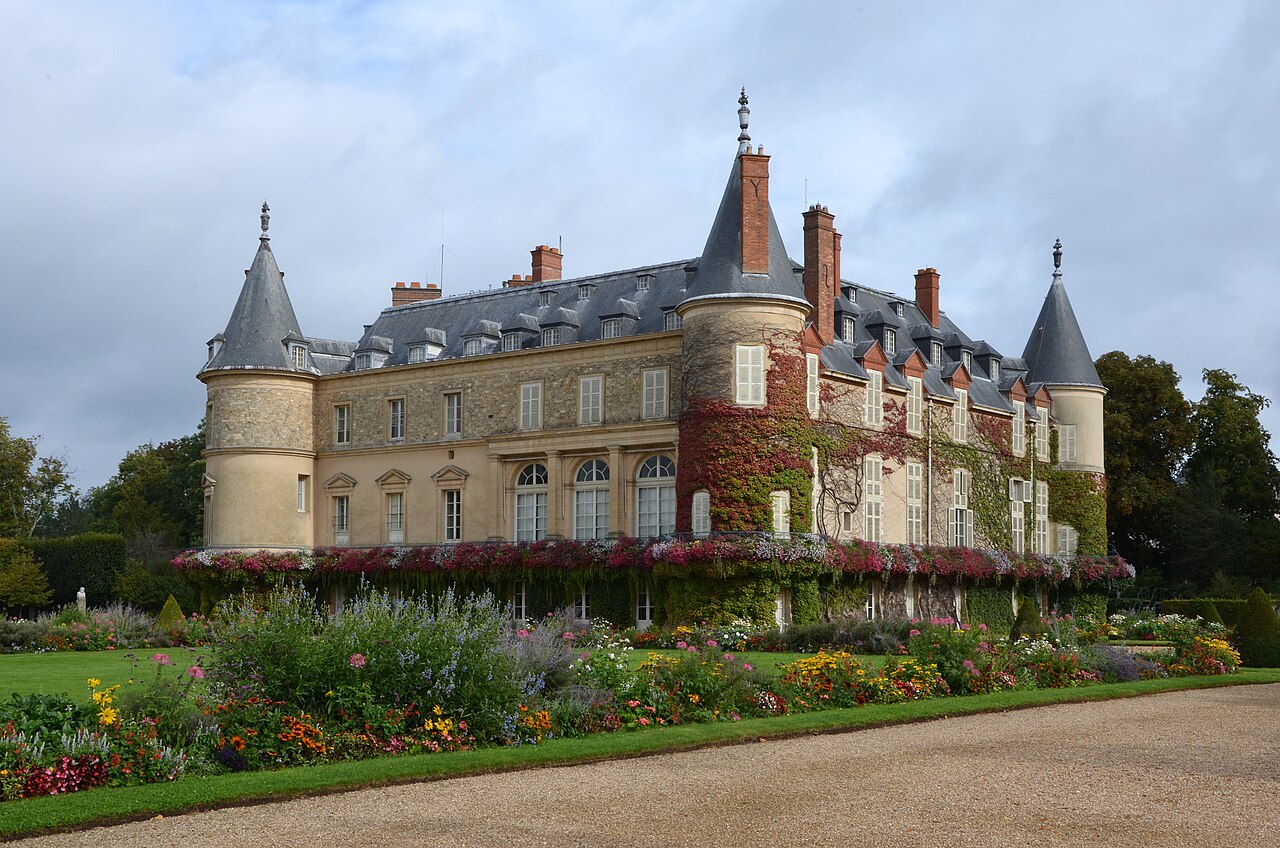
The Château de Rambouillet (pronounced [ʃɑto d(ə) ʁɑ̃bujɛ]), also known in English as the Castle of Rambouillet, is a château in the town of Rambouillet, Yvelines department, in the Île-de-France region in northern France, 50 km (31 mi) southwest of Paris. It was the summer residence of the Presidents of France from 1896 until 2009, and it is now managed by the Centre des monuments nationaux.
The château was originally a fortified manor dating back to 1368 and, although amputated of its eastern wing at the time of Napoleon, it still retains its pentagonal bastioned footprint. King Francis I died there, on 31 March 1547, probably in the imposing medieval tower that bears his name. Like the Hôtel de Rambouillet in Paris, the château was owned by Charles d'Angennes, the marquis de Rambouillet during the reign of Louis XIII. Avenues led directly from the park of the château into the adjacent game-rich forest. More than 200 square kilometres of forest remain, the remnant of the Forest of Rambouillet, also known as Forêt d'Yveline or Forêt de l'Yveline.
In 1783, the château became the private property of King Louis XVI, who bought it from his cousin, Louis Jean Marie de Bourbon, Duke of Penthièvre, as an extension of his hunting grounds. Queen Marie Antoinette, who accompanied her husband on a visit in November 1783, is said to have exclaimed: "Comment pourrais-je vivre dans cette gothique crapaudière !" ("How could I live in such a gothic toadhouse!") However, to induce his wife to like his new acquisition, Louis XVI commissioned in great secret the construction of the renowned Laiterie de la Reine, (the Queen's dairy), where the buckets were of Sèvres porcelain, painted and grained to imitate wood, and the presiding nymph was a marble Amalthea, with the goat that nurtured Jupiter, sculpted by Pierre Julien. A little salon was attached to the dairy itself, with chairs supplied by Georges Jacob in 1787 that had straight, tapering stop-fluted legs.
During the French Revolution, the domain of Rambouillet became a bien national ('national property'), the château being emptied of its furnishings and the gardens and surrounding park falling into neglect.
During the reign of Napoleon I, Rambouillet was included in his liste civile (list of government-owned property at the disposal of the head of state).
Text adapted from “Château de Rambouillet” on Wikipedia, CC BY-SA 4.0.
Château de Rambouillet ranks #528 of 9,079 worldwide in the atlas's castle fame ranking, and #48 of the 793 mapped in France. Founded 1474, it is older than 45% of the atlas's dated landmarks — one of 554 atlas entries founded in the 15th century. Its Wikipedia articles were opened 11,050 times in the last 60 days, more than 94% of the atlas. 13 more atlas landmarks stand within 25 km. The nearest day-trip guide is Paris, 46 km away. See how France compares in the castle statistics.
View on the interactive castle map →