 Germany · 19th century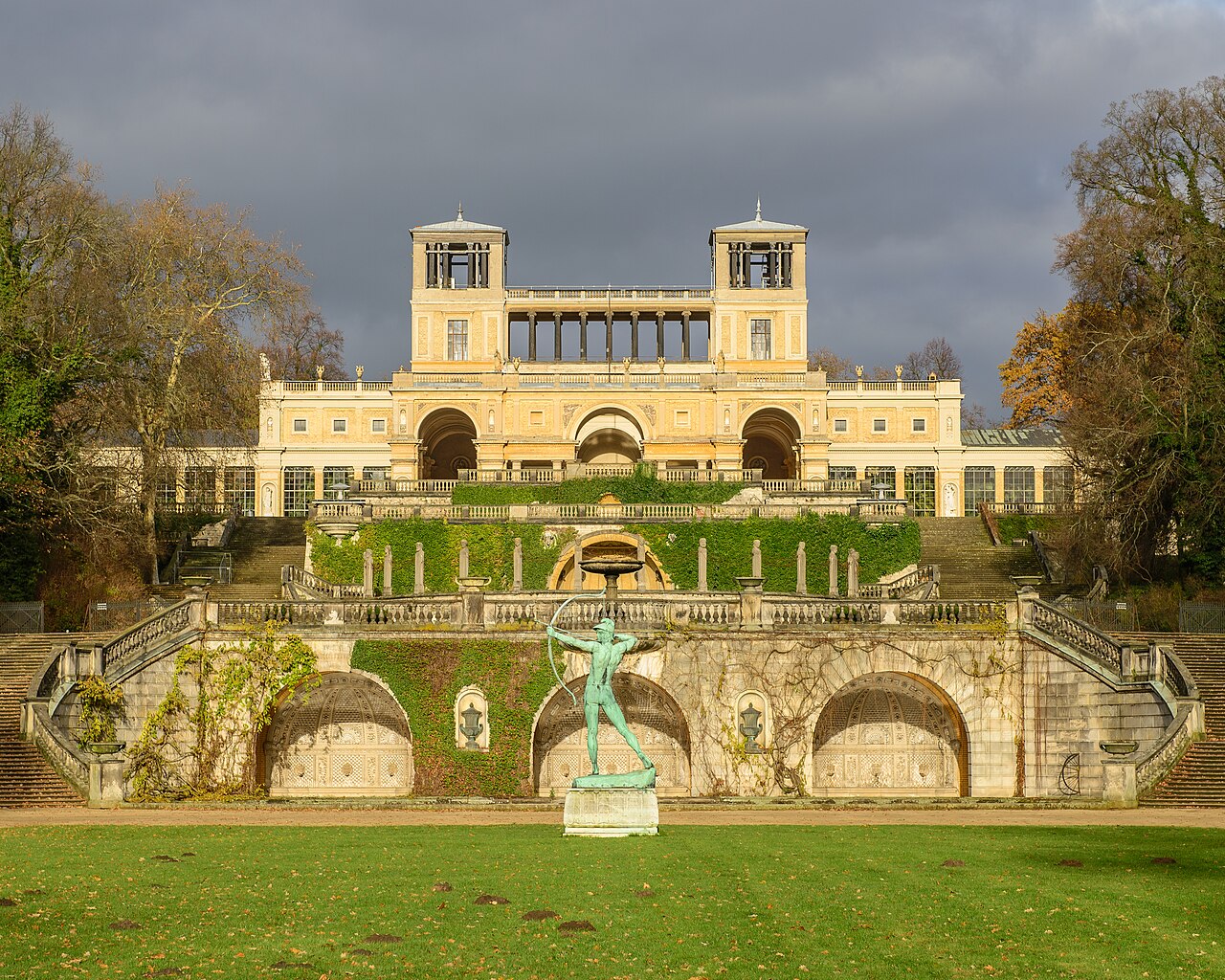
The Orangery Palace (German: Orangerieschloss) is a palace located in the Sanssouci Park of Potsdam, Germany. It is also known as the New Orangery on the Klausberg, or just the Orangery. It was built on behest of the "Romantic on the Throne", King Frederick William IV of Prussia from 1851 to 1864.
The building of the Orangery began with a plan for a high street or triumph street. It was to begin at the triumph arch, east of Sanssouci Park, and end at the Belvedere on the Klausberg. The difference in elevation was to be balanced with viaducts.
With reference to the north side of the Picture Gallery and the New Chambers from the time of Frederick the Great, Frederick William IV sketched out more new buildings, which would decorate his two kilometer long Via Triumphalis.
Because of the political unrest of the period (March Revolution) and lack of funding, the gigantic project never materialized. Only the Orangery Palace and the Triumphtor were ever realized.
The construction of the Orangery Palace began after designs by the architects Friedrich August Stüler, Friedrich Ludwig Persius and Ludwig Ferdinand Hesse.
The building, with its 300-meter-long front, was built in the style of the Italian Renaissance, after the image of the Villa Medici in Rome and the Uffizi in Florence.
The middle building with its twin towers is the actual palace. This building is joined to the 103 meter long and 16 meter wide Plant Hall, with its almost ceiling-to-floor windows on the south side. In the western hall, the original floor duct heating system is still present and functioning. In the alcoves along the garden side of the castle annex, there are allegorical figures of the months and seasons. In the corner building at the end of the Orangery Hall were the royal apartments and the servants' quarters.
In front of the peristyle Elisabeth, Frederick William IV's wife, had a statue of the king erected in Memoriam after his death in 1861.
Behind the portico, in the middle building, lies the over two-story-tall Raffael Hall. It was based on the Sala Regia in the Vatican. Over a large skylight in the high clouded ceiling, light falls into the Museum Hall. On the red silk covered walls, hang over fifty copies of Renaissance paintings and frescoes. Frederick William IV inherited the works from his father, King Frederick William III of Prussia, and assembled them here.
Text adapted from “Orangery Palace” on Wikipedia, CC BY-SA 4.0.
Orangery Palace ranks #882 of 9,079 worldwide in the atlas's castle fame ranking, and #69 of the 711 mapped in Germany. Founded 1851, it is older than 8% of the atlas's dated landmarks — one of 717 atlas entries founded in the 19th century. Its Wikipedia articles were opened 4,740 times in the last 60 days, more than 86% of the atlas. 16 more atlas landmarks stand within 25 km. The nearest day-trip guide is Berlin, 27 km away. See how Germany compares in the castle statistics.
View on the interactive castle map →