 Thailand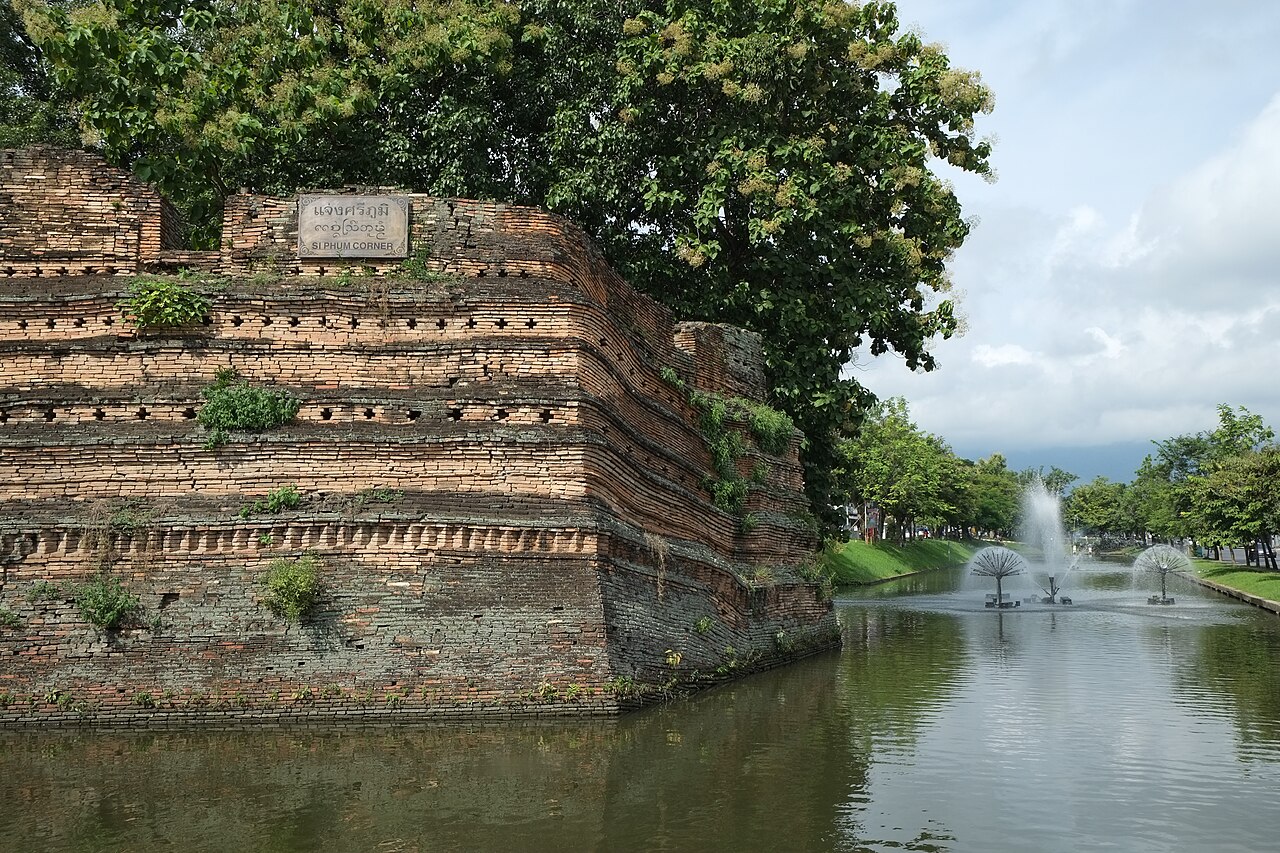
The Chiang Mai city wall, or the wall of Wiang Chiang Mai, today refers to the inner city wall of Wiang Chiang Mai (while the outer city wall is the earthen rampart line), built together with the founding of the Lan Na kingdom, in the reign of King Mangrai, to serve as the capital of Lan Na.
The moat forms a square with sides about 1.63 kilometres long. The earth obtained from digging the moat was piled up to form the line of the city wall. Digging began at the north-eastern corner, at Jaeng Si Phum, an auspicious direction, after which brick was laid on both sides to hold back the earth from collapsing. The top of the wall was bricked all along its length with battlements set on all four walls, and there were also four city gates. Archaeological evidence shows that originally each city gate had only a single storey, with a second storey added and projected outward in a later era. The gate leaves were not aligned with each other, so as to prevent the gate from being battered open by cannon fire.
The northern wall is the longest, measuring about 1.67 kilometres, followed by the southern wall at 1.63 kilometres, while the eastern wall is equal in length to the western wall, at 1.62 kilometres.
After Chiang Mai gained independence from Burma, King Kawila, established as the first ruling lord of Chiang Mai, ordered a major restoration of the city wall so that it became strong and durable, and it was restored again in 1818, in the reign of Chao Luang Thammalangka of Chiang Mai.
In the reign of King Rama V, Prince Damrong Rajanubhab, Minister of the Interior, once gave his opinion on the demolition of the Chiang Mai city wall, saying: "...I feel it is not right to take the example of demolishing the city wall of Bangkok and apply it to demolishing the Chiang Mai city wall.
Machine-translated from “กำแพงเมืองเชียงใหม่” on the Thai Wikipedia, CC BY-SA 4.0.
Chiang Mai city wall ranks #6,829 of 9,079 worldwide in the atlas's castle fame ranking, and #14 of the 21 mapped in Thailand. See how Thailand compares in the castle statistics.
View on the interactive castle map →