Ruin
Citadel of Antwerp
🇧🇪 Belgium · 16th century
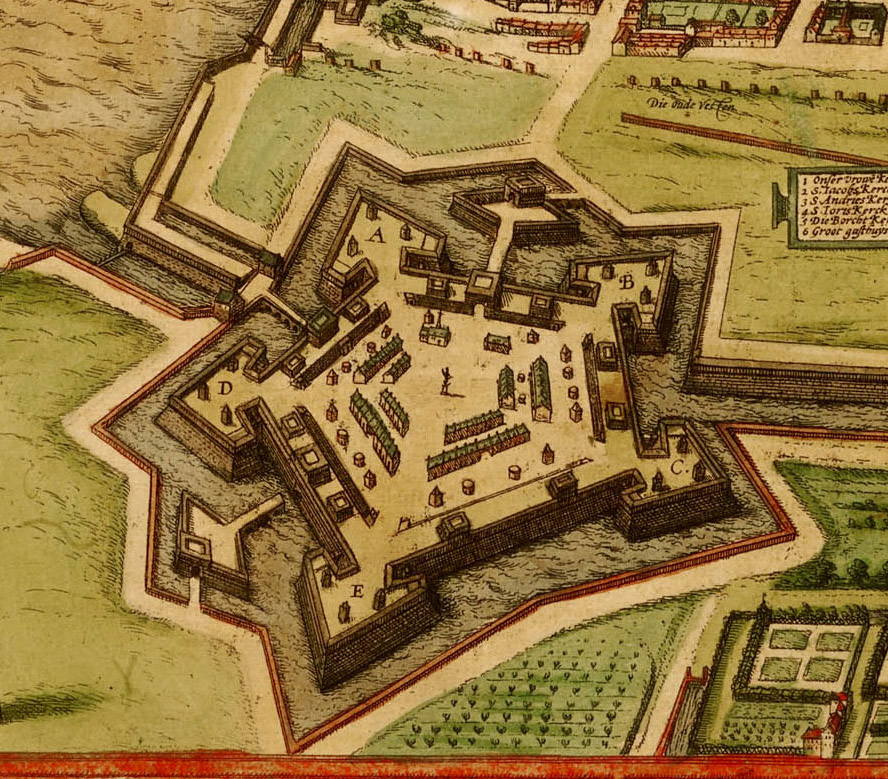
Antwerp Citadel (Spanish: Castillo de Amberes, Dutch: Kasteel van Antwerpen) was a pentagonal bastion fort built to defend and dominate the city of Antwerp in the early stages of the Dutch Revolt. It has been described as "doubtlesse the most matchlesse piece of modern Fortification in the World" and as "one of the most studied urban installations of the sixteenth century".
The citadel was designed by the Italian engineer Francesco Paciotto and built on the orders of the Duke of Alba. Initial construction was completed in 1572. After the Sack of Antwerp (1576) the citizens partially demolished the fortification, but it was reconstructed after the Fall of Antwerp (1585).
The citadel saw action towards the end of the Napoleonic Wars, when it was defended by determined Bonapartists. The Siege of Antwerp (1814) continued for a month after Napoleon's abdication.
After the Belgian Revolution of 1830, Dutch forces remained in control of the citadel until the Siege of Antwerp (1832).
Demolition began in 1874 and was completed in 1881. The site became a new neighbourhood of the city, Zuid, in which the most prominent construction was the new building for the Royal Museum of Fine Arts Antwerp.
In Spanish the title of the governor of the citadel was Castellano de Amberes ("Castellan of Antwerp").
1576: Sancho d'Avila 1577: Philippe III de Croÿ 1587–1596: Don Cristóbal de Mondragón 1606-1622: Don Íñigo de Borja -1674: Don Pedro Sanpayo. 1674-1678: Don Mateo de Villegas.
1679–1693: Don Francisco Marcos de Velasco 1693-1695: Don Diego Gomez, Marques of Espinosa 1695-1700: Don Pedro Alvarez de Vega. 1700-: Don Luis de Borja, Marquess of Caracena.
1830–1832: David Hendrik Chassé Don Fernando de Solís y Vargas de Carvajal, died 1669. Don Geronimo de Cobos, died 1643 Don Diego de Heredia y Arambulo, died 1704 Don Antonio de Castro y Tello, died 1659 Don Julian Martinez de la Parra
In the Sint-Joriskerk there is still a brotherhood called Our Lady of the Citadel (Dutch: Onze-Lieve-Vrouw van het Kasteel).
Text adapted from “Antwerp Citadel” on Wikipedia, CC BY-SA 4.0.
Citadel of Antwerp ranks #4,019 of 8,134 worldwide in the atlas's castle fame ranking, and #54 of the 92 mapped in Belgium. Founded 1567, it is older than 37% of the atlas's dated landmarks — one of 755 atlas entries founded in the 16th century. Its Wikipedia articles were opened 1,735 times in the last 60 days, more than 63% of the atlas. 9 more atlas landmarks stand within 25 km. The nearest day-trip guide is Antwerp, 1 km away. See how Belgium compares in the castle statistics.
View on the interactive castle map →Frequently asked questions
Where is Citadel of Antwerp?
Citadel of Antwerp stands in Belgium, at 51.20843°, 4.39274°.
When was Citadel of Antwerp built?
The atlas dates its founding to 1567. Earlier structures may have stood on the site; this is the earliest documented founding year.
How famous is Citadel of Antwerp?
In this atlas's fame ranking: #4,019 of 8,134 worldwide, and #54 in Belgium. Fame here combines how many Wikipedia language editions cover a landmark with how many people read them.
What is the nearest castle to Citadel of Antwerp?
Het Steen, about 2 km away.
More castles in Belgium
- Ouren Castle Belgium · 11th century
- Fort de Hollogne Belgium · 19th century
- Fort de Boncelles Belgium · 19th century
- Fort d'Andoy Belgium · 19th century
More ruins
- Koknese Castle Latvia · 13th century
- Castleknock Castle Ireland · 12th century
- Vecdole Castle Latvia · 13th century
- Viļaka Castle Latvia · 13th century