Ruin
Cloughoughter Castle
🇮🇪 Ireland · 13th century
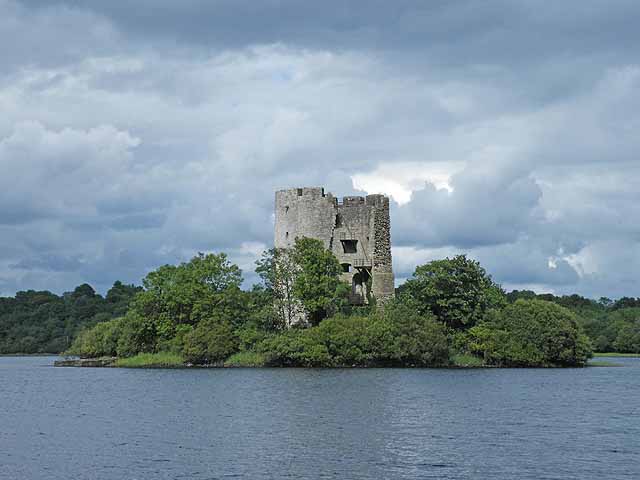
Cloughoughter Castle (Irish: Cloch Locha Uachtair, meaning 'stone castle of Loch Uachtair') is a ruined circular castle on a small island in Lough Oughter, 4 kilometres (2.5 mi) east of the town of Killeshandra in County Cavan, Ireland.
The castle is located in the historic Kingdom of Breifne, specifically in the part that would later be subdivided into East Breifne, roughly corresponding to County Cavan. The spot may have been a crannóg, or an artificially created island, and it is possible there was fortification there as early as the sixth century. In the latter part of the 12th century, it was owned by the O'Rourkes, but early in the 13th century seems to have come into the hands of the Anglo-Norman de Lacy family. Architectural elements from the lower two stories show construction may have started as early as the first quarter of the 13th century.
In 1233, the O'Reilly clan took possession of the area and completed the castle. They retained it for centuries in the midst of their ongoing conflicts with the O'Rourkes, and with members of their own clan. It was there that Philip O'Reilly was imprisoned in the 1360s with "no allowance save a sheaf of oats for day and night and a cup of water, so that he was compelled to drink his own urine."
After the land confiscations that followed the Plantation of Ulster in 1610, Cloughoughter was granted to Captain Hugh Culme. In 1641, Philip O'Reilly, MP for Cavan and a prominent leader of the Irish Rebellion of 1641, seized control of the castle, which he held until 1653. During this phase of its existence, it was used as a jail, with Culme himself being one of the prisoners, along with his son-in-law Henry Jones. Another was William Bedell, Bishop of Kilmore in the Church of Ireland, who died in February 1642, evidently due to inadequate shelter from the cold winter.
In 1649 Owen Roe O'Neill, commander of the Ulster Army died at the castle. In March 1653, it was besieged by Commonwealth forces under Sir Theophilus Jones, brother of Henry and thus related by marriage to the Culme family. It was the last major Confederacy position to surrender on 27 April.
Jones set up his artillery in the nearby townland of Innishconnell and the damage caused by cannon shot remains to this day. Left in ruins, the castle became a frequent subject of art in the 18th and 19th centuries.
Text adapted from “Cloughoughter Castle” on Wikipedia, CC BY-SA 4.0.
Cloughoughter Castle ranks #3,567 of 8,134 worldwide in the atlas's castle fame ranking, and #53 of the 173 mapped in Ireland. Founded 1233, it is older than 74% of the atlas's dated landmarks — one of 861 atlas entries founded in the 13th century. Its Wikipedia articles were opened 1,688 times in the last 60 days, more than 62% of the atlas. 2 more atlas landmarks stand within 25 km. The nearest day-trip guide is Drogheda, 80 km away. See how Ireland compares in the castle statistics.
View on the interactive castle map →Frequently asked questions
Where is Cloughoughter Castle?
Cloughoughter Castle stands in Ireland, at 54.01226°, -7.4665°.
When was Cloughoughter Castle built?
The atlas dates its founding to 1233. Earlier structures may have stood on the site; this is the earliest documented founding year.
How famous is Cloughoughter Castle?
In this atlas's fame ranking: #3,567 of 8,134 worldwide, and #53 in Ireland. Fame here combines how many Wikipedia language editions cover a landmark with how many people read them.
What is the nearest castle to Cloughoughter Castle?
Castle Saunderson, about 15 km away.
More castles in Ireland
- Ardgillan Castle Ireland · 18th century
- Fiddaun Castle Ireland · 16th century
- Thoor Ballylee Ireland · 15th century
- Barberstown Castle Ireland · 13th century
More ruins
- Schalun Castle Liechtenstein · 12th century
- Buchach Castle Ukraine · 15th century
- Obere Burg Liechtenstein · 14th century
- Aizpute Castle Latvia · 13th century