 Morocco · 19th century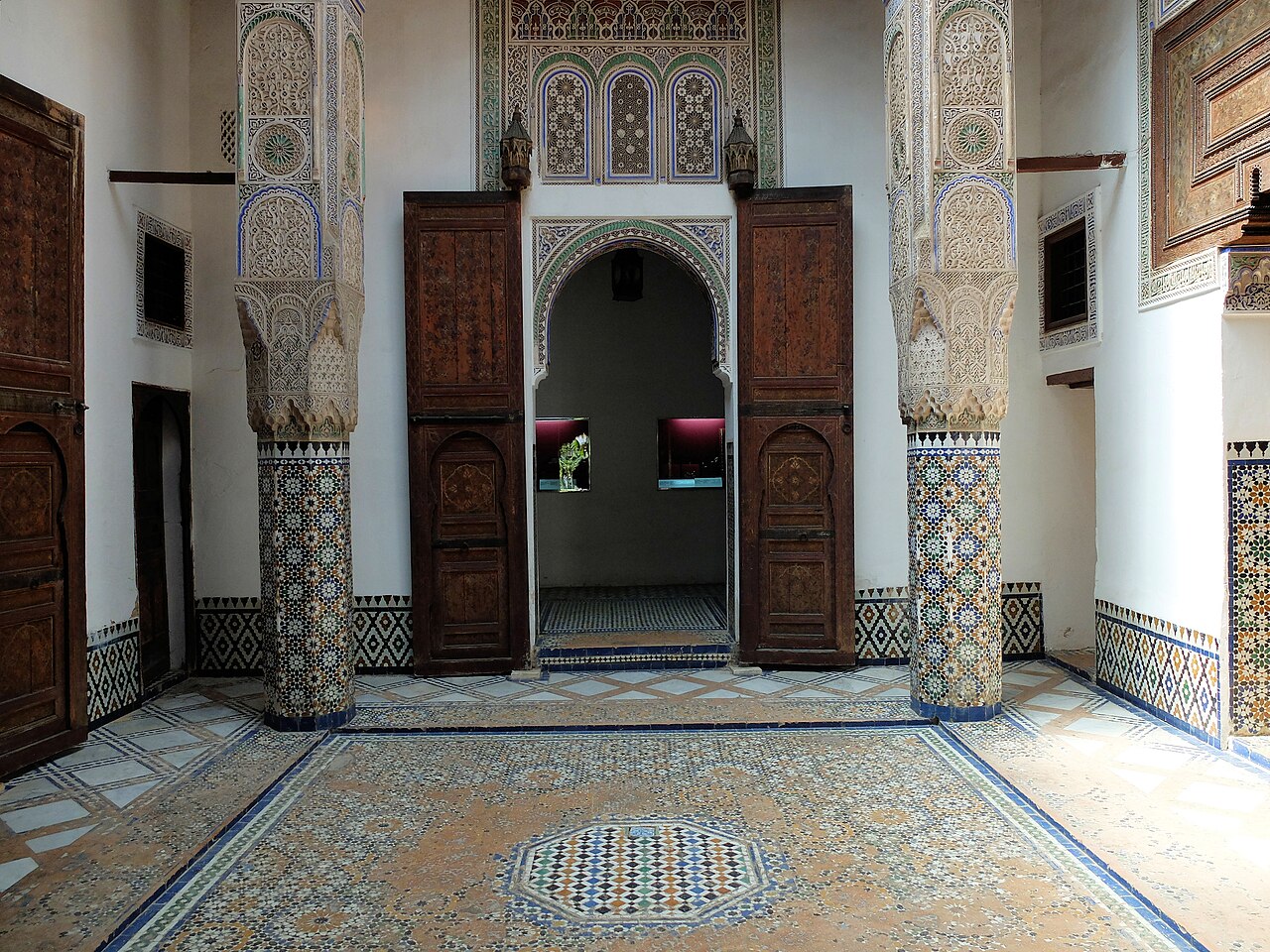
The Dar Jamai Museum (Arabic: قصر دار الجامعي) (also spelled Dar Jamaï or Dar Jama'i) is a museum in Meknes, Morocco. It displays a number of artifacts and art objects from the city and other regions in Morocco. It is housed in a late 19th-century palace built by the Jama'i family who also built the Jamai Palace in Fes.
The palace was built in 1882 by Mokhtar ben Arbi el Jama'i, who, along with his brother, served as Grand Vizier under Sultan Moulay Hassan (ruled 1873–1894). His family also built the Jamai Palace in Fes. When Moulay Hassan died in 1894, his younger son Moulay Abdelaziz was installed on the throne with the help of Ba Ahmed, one of the Jama'i family's rivals. The family thus fell out of favour and saw much of their assets, including the palace, confiscated. The palace was then given to the Glaoui family.
In 1912, upon the advent of French colonial rule over Morocco, it was taken over by the French and turned first into a military hospital, then a military court, and finally, in 1920, into a "Museum of Indigenous Arts" (meaning local Moroccan art objects). In 1913 the municipal services commissioned the construction of a large wall fountain on the outside of the palace, facing Place el-Hedim. It is still present today.
The palace covers a relatively large area at the northern edge of el-Hedim Square in the old city. It is designed according to traditional Moroccan architecture, decorated with sculpted and painted wood, carved stucco, and colourful zellij mosaic tilework. In addition to various rooms on multiple floors, it contains a large courtyard garden (riad) with orange trees and a menzeh (observation pavilion or platform). The palace also had other facilities including kitchens, a mosque, and a small hammam (bathhouse). An old upstairs reception room or salon with rich decoration and a wooden cupola ceiling has also been outfitted with traditional upper-class furnishings and is considered one of the highlights of the museum.
Outside the palace is a large street fountain (mentioned above), covered in elaborate zellij, which is adjoined to the exterior of wall of the palace and faces Place el-Hedim. The current entrance, next to this fountain, was created recently and replaces the original entrance which was off a nearby street.
Text adapted from “Dar Jamai Museum” on Wikipedia, CC BY-SA 4.0.
Dar Jamaï palace ranks #4,017 of 9,035 worldwide in the atlas's castle fame ranking, and #15 of the 41 mapped in Morocco. Founded 1882, one of 705 atlas entries founded in the 19th century. 1 more atlas landmarks stand within 25 km. The nearest day-trip guide is Fez, 55 km away. See how Morocco compares in the castle statistics.
View on the interactive castle map →