 India · 19th century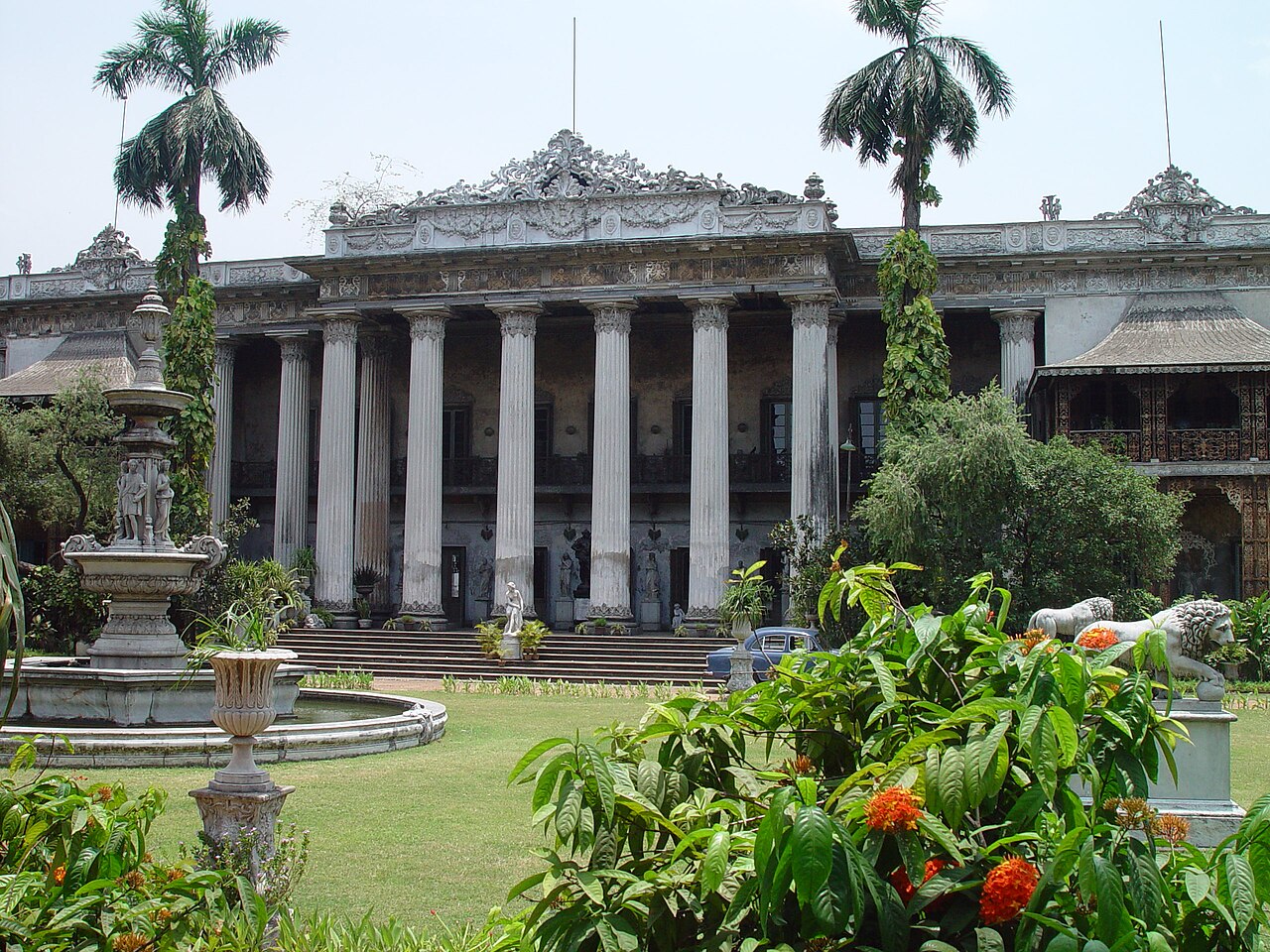
Marble Palace is a palatial nineteenth-century mansion in North Kolkata. It is located at 46, Muktaram Babu Street, Kolkata 700007. It is one of the best-preserved and most elegant houses of nineteenth-century Calcutta. The mansion is famous for its marble walls, floors, and sculptures, from which it derives its name.
The house was built in 1835 by Raja Rajendra Mullick, a wealthy Bengali merchant with a passion for collecting works of art. The house continues to be a residence for his descendants, and the current occupants are the family of Raja Rajendra Mullick Bahadur. Raja Rajendra Mullick was the adopted son of Nilmoni Mullick, who built a Jagannath temple which predates Marble Palace, and still stands within the premises, but is only accessible to members of the family.
The house is Neoclassical in style, while the plan with its open courtyards is largely traditional Bengali. Adjacent to the courtyard, there is a thakur-dalan, or place of worship for members of the family. The three-story building has tall fluted Corinthian pillars and ornamented verandas with fretwork and sloping roofs, built in the style of a Chinese pavilion. The premises also include a garden with lawns, a rock garden, a lake and a small zoo.
Marble Palace houses many Western sculptures, pieces of Victorian furniture, paintings by European and Indian artists, and other artifacts. Decorative objects include large chandeliers, clocks, floor to ceiling mirrors, urns, and royal busts. The house contains two paintings by Peter Paul Rubens, The Marriage of St. Catherine and The Martyrdom of St. Sebastian. There are also said to be two paintings by Sir Joshua Reynolds, The Infant Hercules Strangling the Serpent and Venus and Cupid. Other artists said to figure in the collections include Titian, Bartolomé Esteban Murillo, and John Opie.
The collection of artifacts is lavish but random; genuinely valuable pieces of art share space with a lot of kitschy art objects of little value. This has caused some to feel the collection is superficial and gaudy. Geoffrey Moorhouse in his book Calcutta says it looks "as if they had been scavenged from job lots on the Portobello Road on a series of damp Saturday afternoons."
The final scene of the French novel Le vol des cigognes de Jean-Christophe Grangé takes place in the Marble Palace.
Text adapted from “Marble Palace (Kolkata)” on Wikipedia, CC BY-SA 4.0.
Marble Palace (Kolkata) ranks #1,966 of 9,035 worldwide in the atlas's castle fame ranking, and #72 of the 223 mapped in India. Founded 1835, it is older than 9% of the atlas's dated landmarks, one of 705 atlas entries founded in the 19th century. Its Wikipedia articles were opened 3,182 times in the last 60 days, more than 79% of the atlas. 2 more atlas landmarks stand within 25 km. See how India compares in the castle statistics.
View on the interactive castle map →