Ruin
Drežnik Castle
🇭🇷 Croatia · 12th century
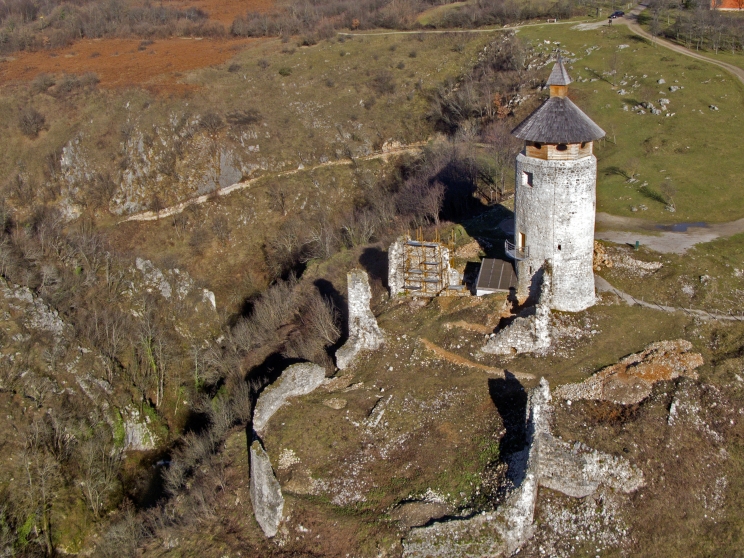
Drežnik Castle (pronounced [ˈdɾeːʒnik]; Croatian: Stari grad Drežnik) is a ruined medieval fortified structure in the village of Drežnik Grad, within the Rakovica municipality, Karlovac County, Republic of Croatia. It is located about ten kilometers northeast of the Plitvice Lakes National Park and 130 km from Zagreb, the capital of Croatia.
According to historical sources, it was first mentioned in 1185. Over the next few centuries, it was owned by several lords, including members of the House of Nelipić (from 1253),, Güssinger and Babonić (from 1278), and finally from 1321 by the princes of Krk (later Frankopans), specifically their Tržac branch. In the 16th century, like many of Croatian castles and fortresses, Drežnik was under constant threat from the invading Ottoman army. Unable to defend itself against a superior enemy, it fell in 1592 and became Otoman stronghold.
The castle was liberated at the end of the 18th century in a military campaign within the Austro-Turkish War (1788–1791). After a two-day siege and heavy cannon fire by Habsburg military forces between 10th and 12th February 1788, the Turkish crew surrendered to Habsburg troops led by colonel Daniel Peharnik-Hotković. After the liberation, the fortress was used for military purposes.
According to a drawing of the castle from 1830, it was in good condition. It housed the command of the Drežnik company. The castle was under military administration until 1866, when it was sold to a merchant who slowly began to demolish it and to sell building materials to local residents. Eventually it became a ruin. On 17 April 1917 the Croatian Parliament entrusted the care of the castle to the Drežnik Municipality.
Drežnik Castle is situated above the steep canyon of the Korana river, at the part where the river, a few kilometers after its spring at the Plitvice Lakes turns eastward to form today's multi-kilometer border between Croatia and Bosnia and Herzegovina. Located on the left, northern bank of the Korana, Drežnik was an integral part of Kordun, a chain of fortifications (a cordon - hence the name Kordun for the area) for defense against the Ottoman Turks, which included, among others, castles and fortresses like Tržac, Cetingrad, Slunj, Furjan etc.
The castle is irregularly rectangular in shape, with stone walls including two rectangular and one round tower situated on the north side.
Text adapted from “Drežnik Castle” on Wikipedia, CC BY-SA 4.0.
Drežnik Castle ranks #5,685 of 8,134 worldwide in the atlas's castle fame ranking, and #50 of the 61 mapped in Croatia. Founded c. 1200, it is older than 77% of the atlas's dated landmarks — one of 564 atlas entries founded in the 12th century. 3 more atlas landmarks stand within 25 km. The nearest day-trip guide is Zagreb, 99 km away. See how Croatia compares in the castle statistics.
View on the interactive castle map →Frequently asked questions
Where is Drežnik Castle?
Drežnik Castle stands in Croatia, at 44.945°, 15.677°.
When was Drežnik Castle built?
The atlas dates its founding to c. 1200. Earlier structures may have stood on the site; this is the earliest documented founding year.
How famous is Drežnik Castle?
In this atlas's fame ranking: #5,685 of 8,134 worldwide, and #50 in Croatia. Fame here combines how many Wikipedia language editions cover a landmark with how many people read them.
What is the nearest castle to Drežnik Castle?
Ostrožac Castle, about 21 km away.
More castles in Croatia
- Fortica Fortress in Otočac Croatia · 17th century
- Oršić Castle in Gornja Stubica Croatia · 18th century
- Kaštel Fortress Croatia
- Brštanik Croatia · 13th century
More ruins
- Leighlinbridge Castle Ireland · 12th century
- Kilcash Castle Ireland
- Citadel of Antwerp Belgium · 16th century
- Koknese Castle Latvia · 13th century