Fortress
Fort Vastenburg
🇮🇩 Indonesia · 18th century
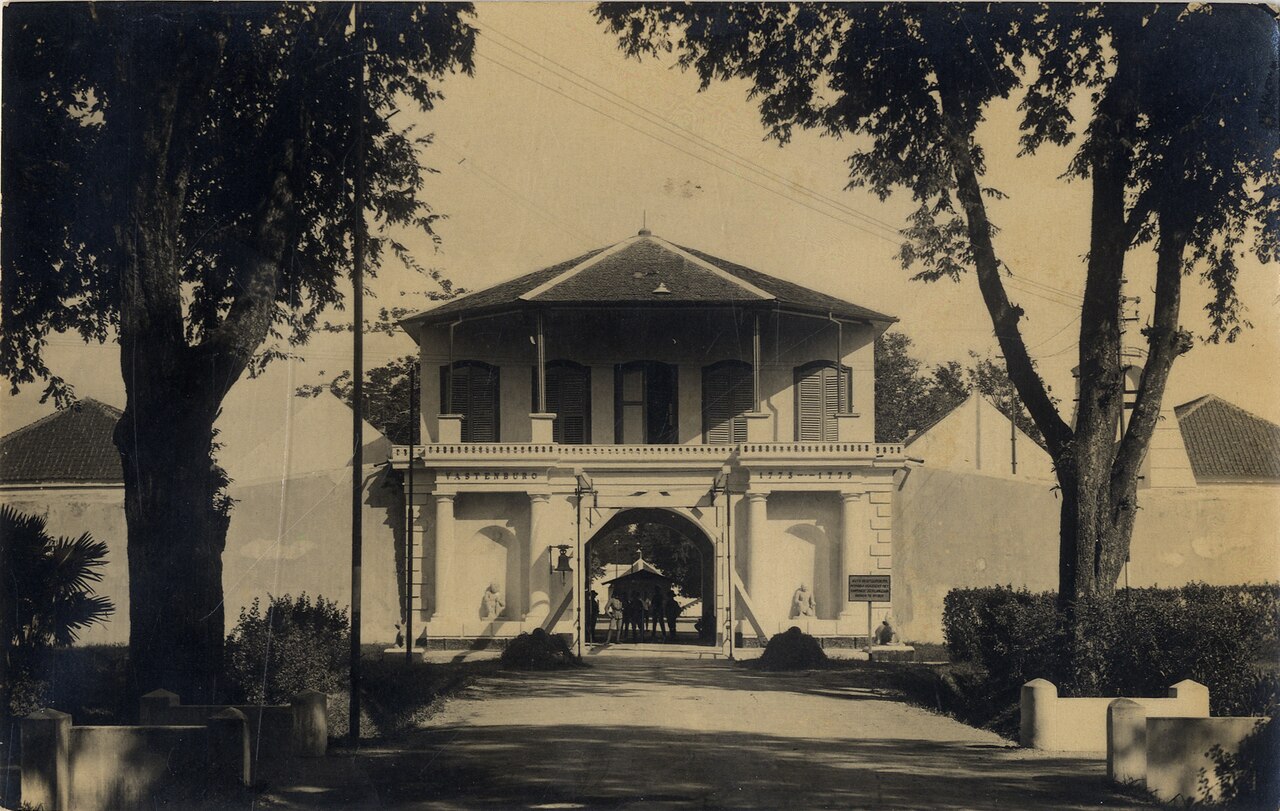
Fort Vastenburg (Dutch "Fort Steadfast"), also Fort Surakarta, is an 18th-century Dutch fort located in Gladak, Surakarta, Central Java, Indonesia. A landmark of Surakarta, the fort faces polemics related with multiple owners claiming different parts of the fort. As a result, the fort remains abandoned and threatened to be demolished by various private parties claiming the fort's ownership.
Fort Vastenburg is a square shaped fort with four bastions. It is surrounded by 6 meter high bearing wall and dry moat. Three portals providing entrance to the fort from the east, west, and north. A Canal style bascule bridge (similar to Jembatan Kota Intan in Batavia) used to provide access point to the fort's western main portal, however this has been demolished.
There are differing opinions about the construction date of Fort Vastenburg. Most agreed that Fort Vastenburg was constructed in 1743 and was completed in 1745, following the order of Governor-General Baron van Imhoff. First named de Grootmoedigheid ("magnanimity"), later the fort name was renamed to Vastenburg ("steadfast") (1750).
There is another claim that the de Grootmoedigheid was different with Fort Vastenburg. In this claim, construction of Fort Vastenburg was started in 1755 and completed in 1779, replacing a trading post de Grootmoedigheid which was constructed in 1743 close to Bandar Beton near Bengawan Solo. De Grootmoedigheid was one of a series of defense network set up by the Dutch East Indies Company (VOC) to maintain security in the Javanese trade network.
The main function of the fort was to house the resident (colonial administrator) and the Dutch East Indies garrison for the region of Central Java. The fort maintained order in Surakarta, especially between the royalties. Unlike the relatively united Yogyakarta royal court, the Sunanate of Surakarta was fractious. By 1757, Pakubuwono II faced a local rebellion from his royal relative Raden Mas Said. Under the Dutch Treaty of Salatiga, Raden Mas Said decided to build his own (smaller) palace — Kraton Mangkunegaran — establishing a second royal court in the city. This weakened the city's sense of integrity, and so Fort Vastenburg have the possible conflict between royalties checked. Fort Vastenburg was further improved between 1772 and 1788.
Text adapted from “Fort Vastenburg” on Wikipedia, CC BY-SA 4.0.
Fort Vastenburg ranks #5,225 of 8,134 worldwide in the atlas's castle fame ranking, and #24 of the 41 mapped in Indonesia. Founded 1743, it is older than 19% of the atlas's dated landmarks — one of 556 atlas entries founded in the 18th century. See how Indonesia compares in the castle statistics.
View on the interactive castle map →Frequently asked questions
Where is Fort Vastenburg?
Fort Vastenburg stands in Indonesia, at -7.57208°, 110.83126°.
When was Fort Vastenburg built?
The atlas dates its founding to 1743. Earlier structures may have stood on the site; this is the earliest documented founding year.
How famous is Fort Vastenburg?
In this atlas's fame ranking: #5,225 of 8,134 worldwide, and #24 in Indonesia. Fame here combines how many Wikipedia language editions cover a landmark with how many people read them.
What is the nearest castle to Fort Vastenburg?
Fort Willem I, about 57 km away.
More castles in Indonesia
- Fort Oranje (Ternate) Indonesia · 16th century
- Fort Nassau (Banda Islands) Indonesia · 17th century
- Otanaha Fortress Indonesia · 16th century
- Fort Duurstede Indonesia · 17th century
More fortresses
- Fort of Coimbra Brazil · 18th century
- Royal Fortress of the Concepcion Spain · 18th century
- Korlai Fort India · 16th century
- Forte de São João Batista do Brum Brazil · 17th century