 Switzerland · 8th century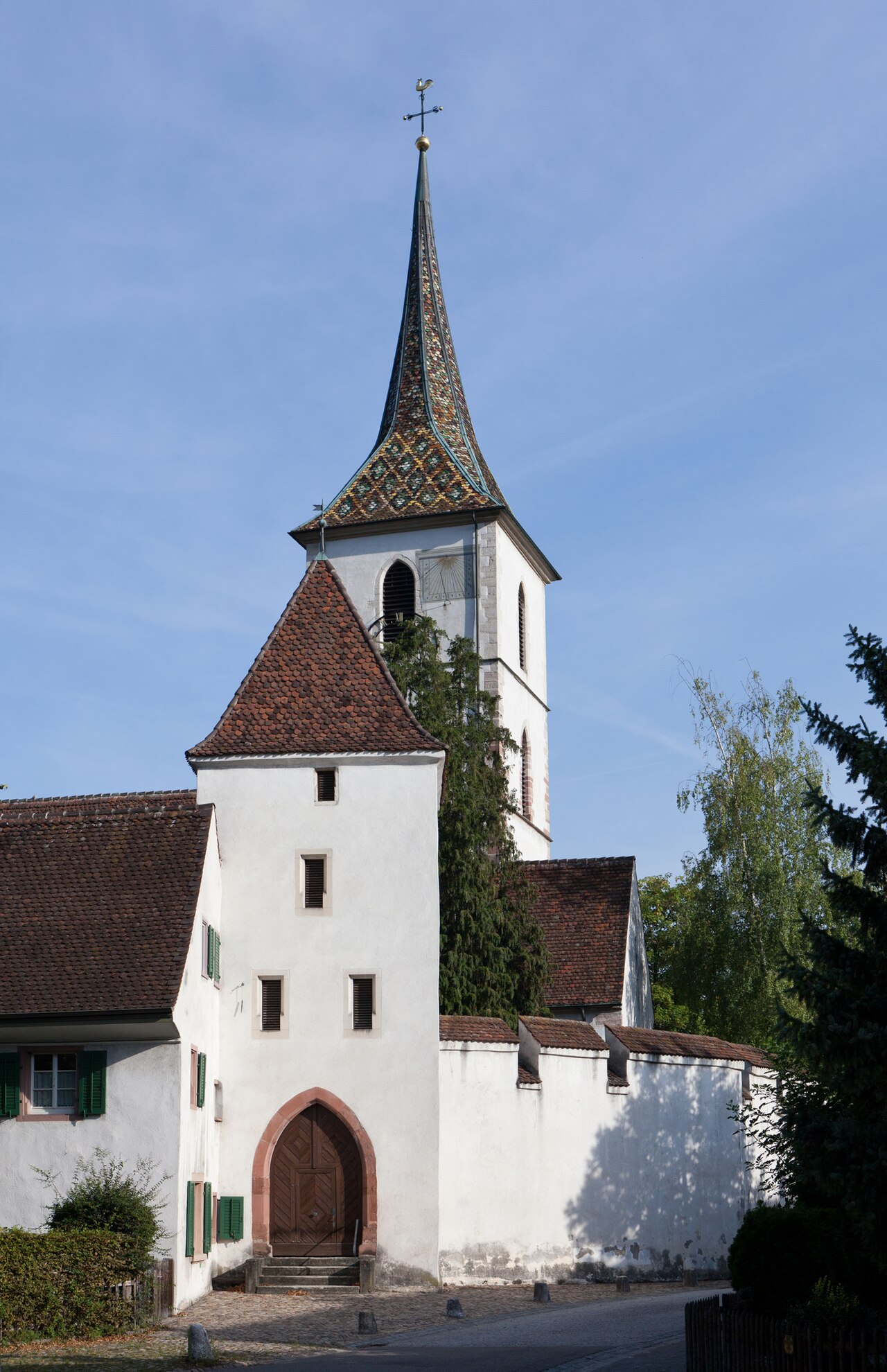
The Fortified Church of St. Arbogast (German: Wehrkirche St. Arbogast) in the municipality of Muttenz in the Swiss canton of Basel-Land is the only church in Switzerland that is surrounded by a defensive wall. It is an example of the fortified church type of construction, and is a Swiss heritage site of national significance. The church is still used as a local village church.
The first church on the site was built in the Early Middle Ages, possibly as early as the 6th century but certainly by the 8th century. It is first mentioned in 793. Around 1000 the nave was extended toward the west. The second church was built around 1100. This new building had a wider and longer nave and the choir was rectangular with massive walls. The second church was replaced in the mid-12th century by the third church, parts of which still stand today. The third church, a Romanesque building, had a round apse, a rectangular choir and a bell tower on the north side which were probably grafted on the earlier nave.
The church was heavily damaged in the 1356 Basel earthquake. Three years later, under Konrad Münch-Löwenberg, the church was rebuilt. The rounded apse was replaced with the current rectangular choir and the nave was raised to a height of about 1.5 m (4.9 ft) below its current height. In 1420 Hans Thüring Münch-Eptingen became the owner of the village and had a new, larger bell tower built. Five years later, his mother gave the church a bell.
Under Hans Thüring Münch-Eptingen the church was fortified with a seven-metre-tall (23 ft) rampart around 1435. The walls had two gatehouses north and south of the church. By fortifying St. Arbogast, the towns people now had defenses to replace the destroyed Hintere Wartenberg, Mittlere Wartenberg and Vordere Wartenberg Castles. The northern gatehouse is decorated with the coat of arms of the Münch or Münch von Münchenstein family. In 1450 Hans Thüring had the interior of the church covered in frescoes. The Münch family had to sell the right to appoint priests and collect money for the church to Peter zum Luft in the late 15th century.
He probably built the charnal house adjoining the church. After Peter's death, Arnold zum Luft took over the church in 1474. Under Arnold, the nave was raised the final 1.5 m (4.9 ft) to its current height and in 1504 given a richly painted wooden ceiling by Ulrich Bruder.
Text adapted from “Fortified Church of St. Arbogast” on Wikipedia, CC BY-SA 4.0.
Fortified Church of St. Arbogast ranks #4,924 of 9,035 worldwide in the atlas's castle fame ranking, and #61 of the 213 mapped in Switzerland. Founded 793, it is older than 95% of the atlas's dated landmarks, one of 48 atlas entries founded in the 8th century. 20 more atlas landmarks stand within 25 km. The nearest day-trip guide is Basel, 6 km away. See how Switzerland compares in the castle statistics.
View on the interactive castle map →