 Malta · 17th century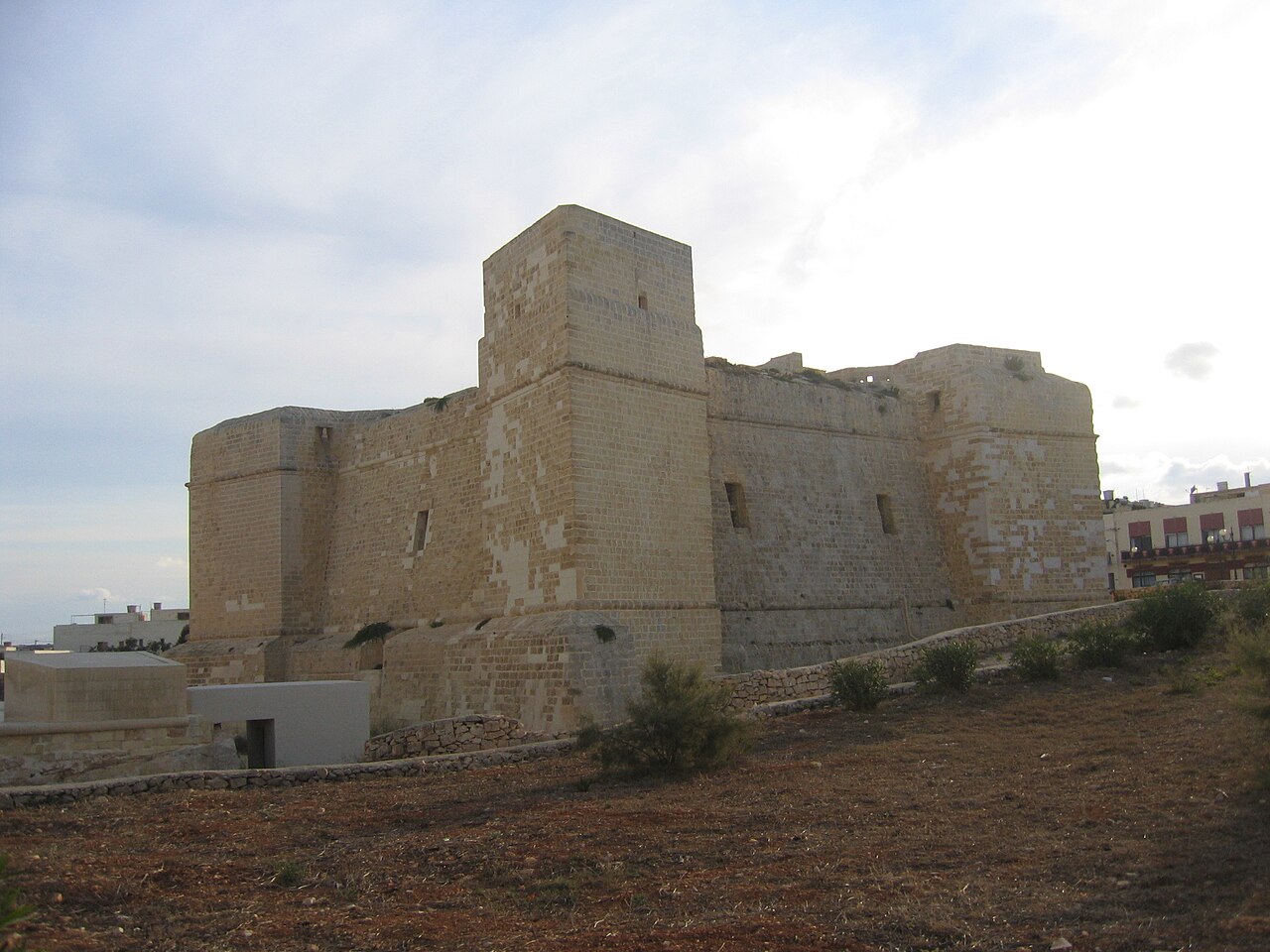
Saint Thomas Tower (Maltese: Torri ta' San Tumas), also known as Fort Saint Thomas (Maltese: Forti San Tumas), is a large bastioned watchtower in Marsaskala, Malta. It was built in 1614, the third of six Wignacourt towers. An artillery battery was added to the tower in the early 18th century. Saint Thomas Tower holds the record as the largest watchtower in Malta.
Saint Thomas Tower was built above the shore on the seaward face of the headland of il-Ħamrija in Marsaskala. It is a substantial fortification intended to prevent the landing of troops in the sheltered anchorages of Marsaskala Creek and St Thomas' Bay. Construction of the tower was approved in July 1614, at the time of the Raid on Żejtun, in which an Ottoman fleet managed to land at St Thomas' Bay. The tower was named after a chapel dedicated to St Thomas, which stood close to where the tower now lies. It cost 13,450 scudi, 6 tarì and 4 grani to build, making it the second most expensive Wignacourt tower, after Saint Mary's Tower.
The tower's architect is unknown. The claims that it was designed by Vittorio Cassar are disputed, since Cassar was probably dead when work on the tower began.
The tower has very thick walls and has four pentagonal bastioned turrets projecting outwards on each corner. Its entrance was through a vaulted doorway with a wooden drawbridge. The drawbridge is still partially intact and it is the only original one to have survived in Malta. The tower is surrounded by a rock-hewn ditch.
After the De Redin towers were built, St Thomas had Żonqor and Xrobb l-Għaġin Towers in its line of sight. Currently, these are now either in ruins or completely demolished.
In 1715, St Thomas Tower was reinforced by the addition of a battery on the seaward face. Construction of the battery cost a total of 382 scudi, 8 tarì, 11 grani and 1 piccolo, which was less than the cost of construction of other batteries around the coast.
During the French blockade of 1798–1800, the tower was stormed and captured by Maltese insurgents.
The tower was used by the British until the 19th century. They did not make any major alterations to the tower (like they did in Saint Lucian Tower), other than some minor changes to the structure. At some point, the tower was also used as a prison.
Today, the town of Marsaskala has expanded, surrounding the tower with modern buildings.
Text adapted from “Saint Thomas Tower” on Wikipedia, CC BY-SA 4.0.
St Thomas Tower ranks #4,558 of 9,035 worldwide in the atlas's castle fame ranking, and #23 of the 39 mapped in Malta. Founded 1614, it is older than 29% of the atlas's dated landmarks, one of 708 atlas entries founded in the 17th century. 33 more atlas landmarks stand within 25 km. See how Malta compares in the castle statistics.
View on the interactive castle map →