 Germany · 12th century
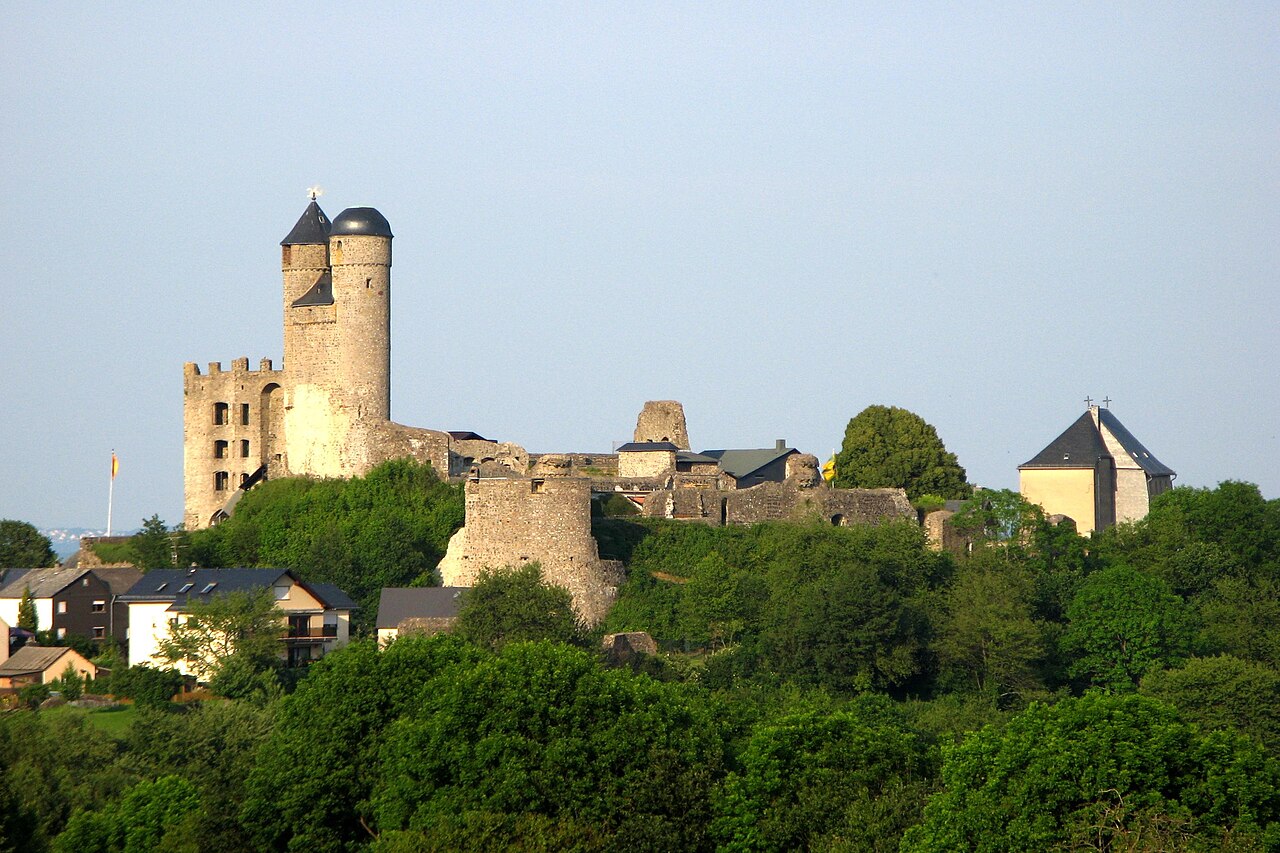
Greifenstein Castle (Hesse) ranks #4,493 of 9,040 worldwide in the atlas's castle fame ranking, and #367 of the 714 mapped in Germany. Founded 1160, it is older than 79% of the atlas's dated landmarks, one of 763 atlas entries founded in the 12th century. Its Wikipedia articles were opened 2,232 times in the last 60 days, more than 72% of the atlas. 3 more atlas landmarks stand within 25 km. The nearest day-trip guide is Koblenz, 57 km away. See how Germany compares in the castle statistics.
Greifenstein Castle (German: Burg Greifenstein) lies in the eponymous village of Greifenstein in the county of Lahn-Dill-Kreis in Middle Hesse, Germany. It is a geo point in the national geopark of Westerwald-Lahn-Taunus.
The hill castle stands on a hill in the Dill Westerwald and has a good view over the Dill valley. At 441 m (1,447 ft) above sea level (NN) it is the highest castle in the county of Lahn-Dill. The castle is a highly visible landmark. It is signed from the A 45 motorway.
The hill castle was first recorded in 1160. In 1298 it was destroyed by the counts of Nassau and Solms, as was Lichtenstein, which was not rebuilt. In 1315 it was enfeoffed by the House of Habsburg (Albert I had purchased the castle from Kraft of Greifenstein) to the Counts of Nassau. After having several owners, it had become dilapidated by 1676 and was then converted into a Baroque schloss by William Maurice of Solms-Greifenstein. After the counts moved to Braunfels in 1693 the site fell into ruins.
In 1969 the castle ruins were gifted to the Greifenstein Society, who have since looked after the preservation of the site, which is open to the public and incorporates a restaurant. The castle is a heritage site in the meaning of the Hessian Monument Conservation Act. Since 1995, its restoration has also been supported by the Federal Republic of Germany because it has been classified as a Monument of National Significances (Denkmal von nationaler Bedeutung).
The circular walk across the castle terrain leads to a gaol with torture implements, weapons and a wine cellar, living rooms and a twin-towered bergfried accessible on a spiral staircase. On the pointed roof of the Brother Tower (Bruderturm) there is a gryphon (German: Greif, a reference to the name of the castle) as a weather vane. In the tower itself is a peal of three bells with strike tones of F#1, A1 and C2.
Attractions include the Village and Castle Museum (Dorf- und Burgmuseum), one of the few double chapels in Germany. The Chapel of St. Catherine was built in 1462 as a fortified church in the Gothic style. When the castle was converted into the Baroque style the castle courtyard was filled with earth with the result that, today, the chapel is below ground level. It contains frescoes and arrow slits as well as casemates with vaulted ceilings and fighting rooms.
Text adapted from “Greifenstein Castle (Hesse)” on Wikipedia, CC BY-SA 4.0.
View on the interactive castle map →