Castle
Willibaldsburg
🇩🇪 Germany · 11th century
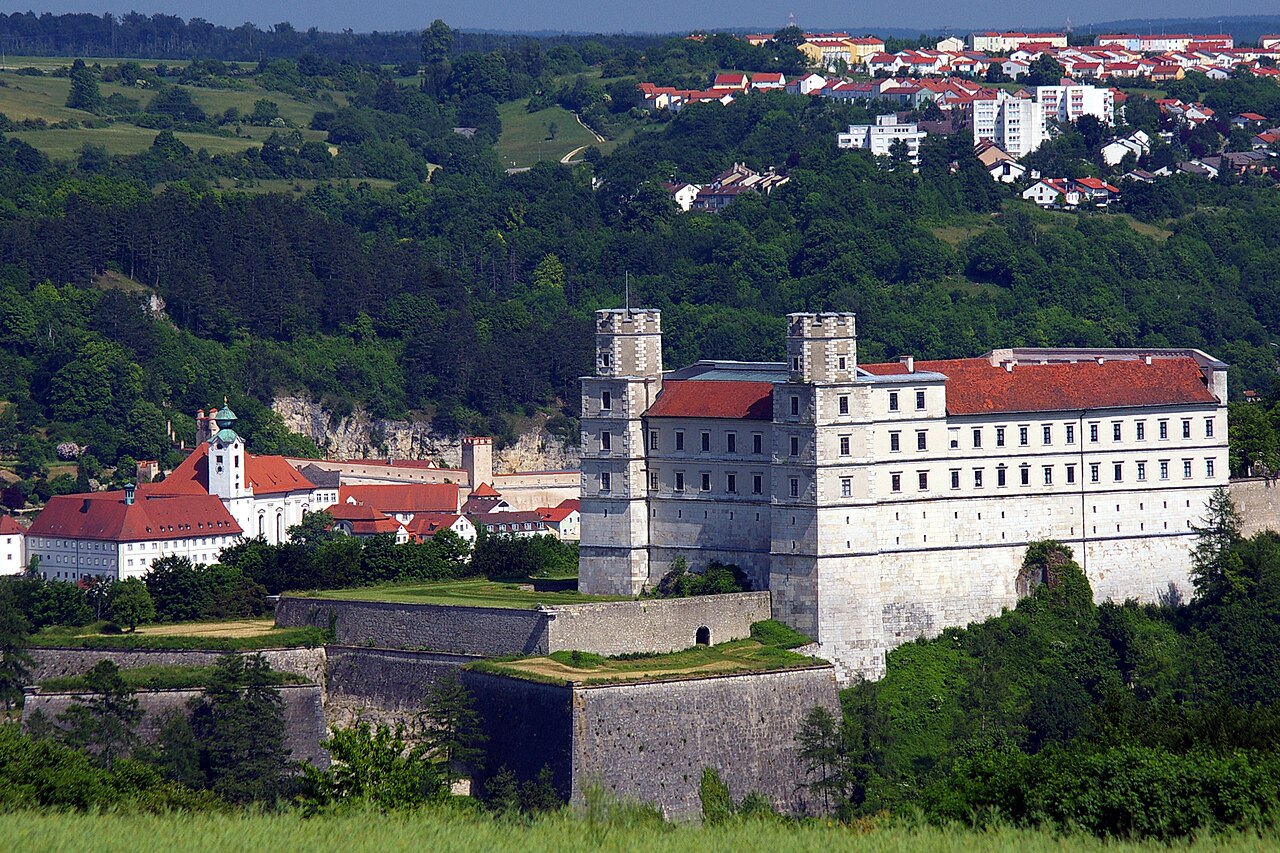
The Willibaldsburg is a spur castle, built around the year 1353, in Eichstätt in Upper Bavaria. Until the middle of the 18th century, it was the representative castle and seat of Eichstätt's prince-bishops.
This fortified palace lies west of the Old Town on an elongated hill ridge, the Willibaldsberg at an elevation of 464 m above sea level, overlooking the Altmühl valley, the eastern portion being referred to as the Frauenberg. To the east across the valley lies the cathedral city of Eichstätt, and on the western side of the valley loop, Marienstein. Its total length is about 420 metres and it is naturally well protected thanks to this location. The Altmühl river here forms a sharp bend which, due to the resulting ridge was an ideal spot for the medieval castle and later fortress. It derives its name from the first bishop Willibald von Eichstätt (c. 700 – c.787). The castle and city lie within the Altmühl Valley Nature Park in the cultural region of Franconia.
The first fortifications on the castle hill are mentioned as early as 1070. Under Bishop Berthold von Nürnburg, also known as Berthold von Zollern (1355-1365), expansion into a fortified residence for the bishops of Eichstätt began around 1355, the old bishopric being in the city next to the cathedral. This High Medieval edifice, which lay on the western spur of the hill was probably a large stone house, a tower and a chapel, protected by surrounding curtain walls and moats. After the Counts of Hirschberg died out in 1305, the bishops had to organize the military security of the diocese themselves. The cathedral chapter initially opposed the expansion plans because of the high costs, but the bishop was able to prevail.
Bishop Frederick IV of Oettingen (1383-1415) strengthened the fortifications by building a Zwinger kennel and had an "aestuarium magnum aestivale" built. This is likely to have been a hall building, a summer house, as seen in other castles of this time.
Under the bishops Albrecht II von Hohenrechberg (1429-1445) and Martin von Schaumberg (1560-1590), the castle vestment was expanded and strengthened. Within 50 years, the Willibaldsburg underwent a major transformation from a late mediaeval castle through a stately fortified Counter-Reformation edifice under Schaumberg, to a late Renaissance summer palace under Bishop Johann Konrad von Gemmingen (1595–1612).
Text adapted from “Willibaldsburg” on Wikipedia, CC BY-SA 4.0.
Willibaldsburg ranks #4,488 of 8,134 worldwide in the atlas's castle fame ranking, and #343 of the 505 mapped in Germany. Founded 1070, it is older than 89% of the atlas's dated landmarks — one of 325 atlas entries founded in the 11th century. Its Wikipedia articles were opened 1,947 times in the last 60 days, more than 66% of the atlas. 4 more atlas landmarks stand within 25 km. The nearest day-trip guide is Munich, 89 km away. See how Germany compares in the castle statistics.
View on the interactive castle map →Frequently asked questions
Where is Willibaldsburg?
Willibaldsburg stands in Germany, at 48.89458°, 11.16951°.
When was Willibaldsburg built?
The atlas dates its founding to 1070. Earlier structures may have stood on the site; this is the earliest documented founding year.
How famous is Willibaldsburg?
In this atlas's fame ranking: #4,488 of 8,134 worldwide, and #343 in Germany. Fame here combines how many Wikipedia language editions cover a landmark with how many people read them.
What is the nearest castle to Willibaldsburg?
Nassenfels Castle, about 12 km away.
More castles in Germany
- Schloss Hämelschenburg Germany · 16th century
- Burgruine Hohenstein Germany
- Hohlenfels Castle Germany · 14th century
- Idstein Castle Germany · 12th century
More castles
- Burg Lauenstein Germany
- Wachsenburg Castle Germany · 10th century
- Haus Bodelschwingh Germany
- Castle Oliver Ireland