 Hungary · 19th century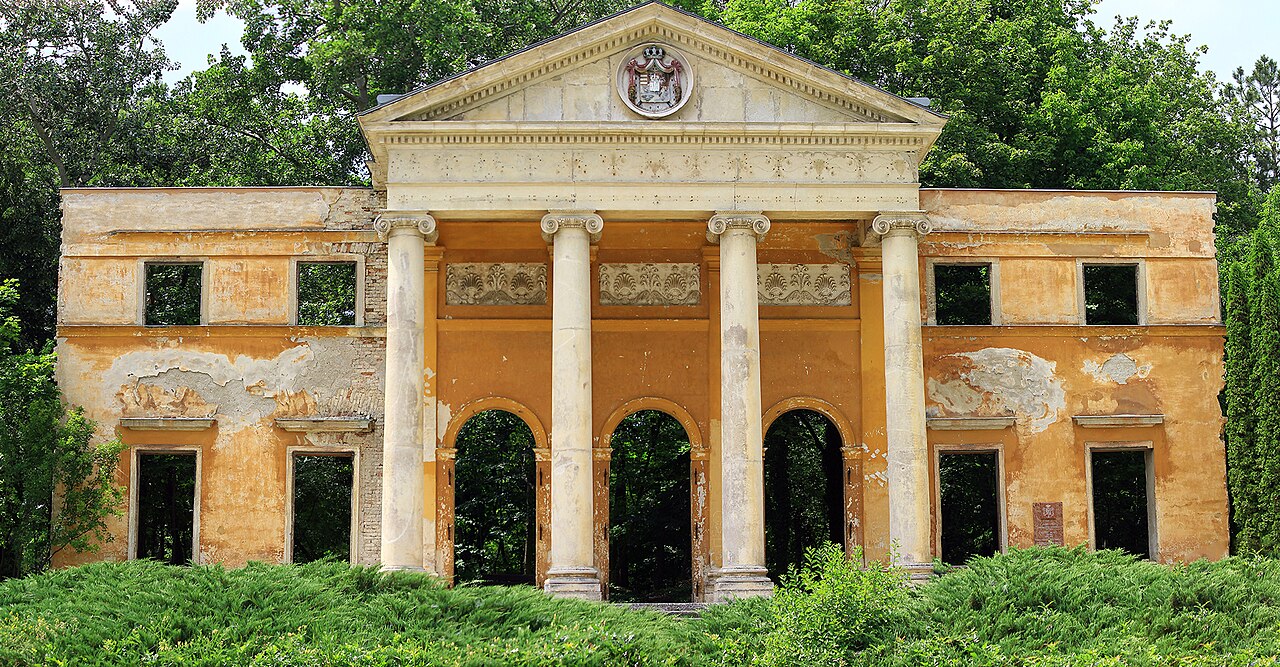
Alcsút Palace (Hungarian: Alcsúti kastély, German: Schloss Altschutt) a former country house located in Alcsút, Hungary. It was the country estate of the Hungarian branch of the House of Habsburg-Lorraine.
On 20 September 1795, Holy Roman Emperor Francis II appointed his younger brother Archduke Joseph of Austria as governor of Hungary. A year later, the Diet of Hungary elected him as Palatine of Hungary in Pressburg (Bratislava). As a result, he became the first member of the Hungarian or Palatinal branch of the House of Habsburg-Lorraine.
Between 1819 and 1827, Palatine Joseph built a summer residence in Alcsút according to the plans of the well-known architect Mihály Pollack (1773–1855) in a neoclassical style. The foundation stone for this building was laid on 13 June 1820. Construction work was completed in 1826. However, as it took a full year to furnish the palace, the family was only able to move into their country home in 1827. Archduke Joseph also had the adjoining farm buildings built and set up a model farm here.
Palatine Joseph's son, Archduke Joseph Karl, carried out further extensive conversion and expansion work in the 1870s. He had new wings added, created a courtyard and rebuilt the rear facade of the palace in an eclectic style.
At the end of the Palace’s right-wing, stables were constructed in the neoclassical style. When János Simor, the Hungarian prelate and Archbishop of Esztergom, paid a visit to the palace, he liked these stables so much that he suggested that these stables would also be suitable for a chapel. inspired by these words, Archduke Joseph Karl converted them into a chapel. Architect Ferenc Storno was involved for the reconstruction. The construction took place in 1879 and 1880. Cardinal János Simor consecrated the new chapel in neo-Romanesque style on 27 November 1880. After that, the archive of the Hungarian Habsburgs and a library were realized in the last two large rooms at the end of the right wing.
The last renovation work took place at the start of the 20th century. At that time, the farm was completed as a closed unit.
The house was regularly used by the family as a summer residence between 1827 and 1944. Each of the residents, starting with Palatine Joseph, as well as his successors, left their mark on the house.
Text adapted from “Alcsút Palace” on Wikipedia, CC BY-SA 4.0.
Habsburg Mansion, Alcsút ranks #5,376 of 9,035 worldwide in the atlas's castle fame ranking, and #33 of the 135 mapped in Hungary. Founded 1819, it is older than 10% of the atlas's dated landmarks, one of 705 atlas entries founded in the 19th century. Its Wikipedia articles were opened 1,150 times in the last 60 days, more than 54% of the atlas. 9 more atlas landmarks stand within 25 km. The nearest day-trip guide is Székesfehérvár, 29 km away. See how Hungary compares in the castle statistics.
View on the interactive castle map →