 Austria · 13th century
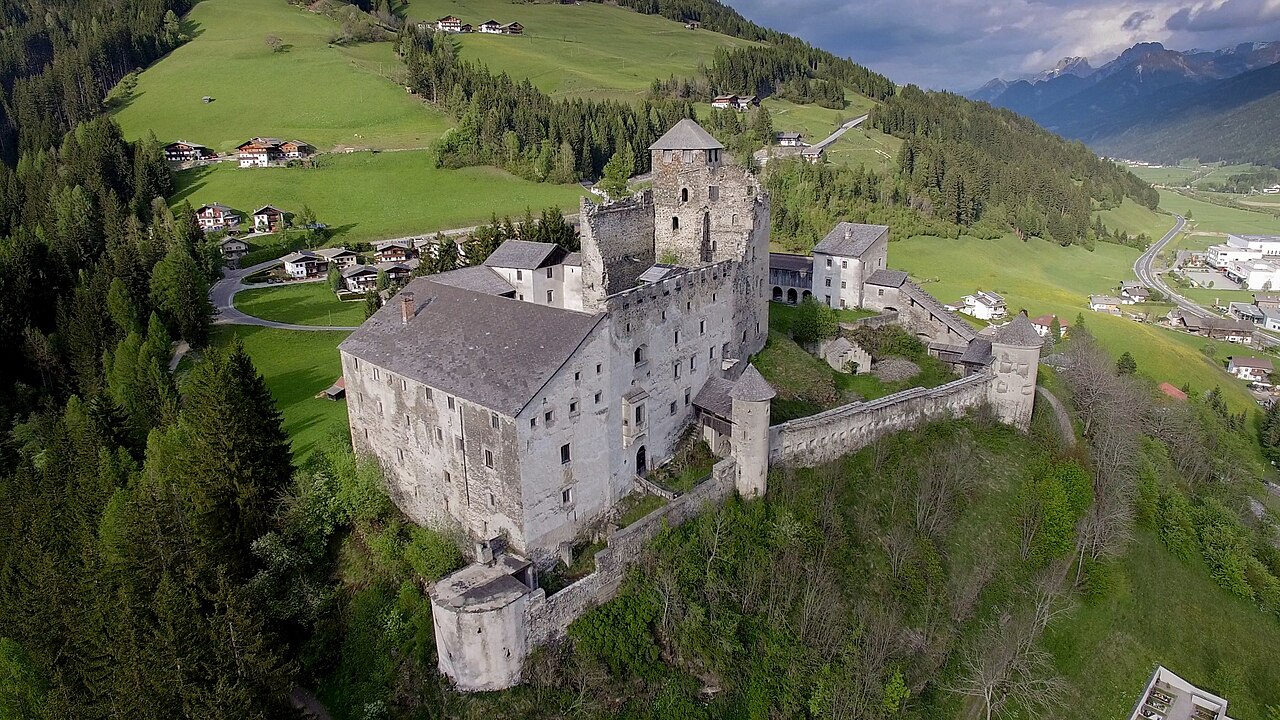
Heinfels Castle is an extensive hilltop castle complex above Heinfels in East Tyrol. The strategically well-situated fortification at 1130 metres above sea level is a striking landmark of the eastern Puster Valley. From the castle you have a wide view up and down the Drau as well as into the Tyrolean Gailtal valley opposite.
The legendary foundation by the Huns dates back to the 5th century. Until the 16th century, the castle was therefore referred to as ‘Huonenfels’, ‘Huonifels’, ‘Huenfels’ or ‘Heunfels’. For a long time, it was assumed in historical research that the castle was founded by the Avars. However, in the course of restoration work between 2016 and 2020, building research was able to prove that the oldest part of the castle, the keep, dates back to 1210.
In 1239, Otto Welf de Hunenvelse, who belonged to the older lords of Welsperg, is mentioned for the first time as a ministerial who named himself after the castle. The castle was first mentioned in documents in 1243 and was owned by Freising ministerials.
In the 13th century, the Counts of Gorizia acquired Heinfels Castle by inheritance and, from 1275 onwards, developed it into an important base, which was also the seat of a court. It is not known when the castle came into the possession of the Counts of Gorizia, but in a contract of the same year between the two Counts of Gorizia Meinhard II and Albert I, it was handed over to the latter. This means that the castle must have been in the possession of Gorizia before then.
In 1307, the castle, including the associated property and court, passed to Albert through an inheritance contract between Albert II and Heinrich III. The latter divided his inheritance among his sons during his lifetime.
In 1460, Count John II of Gorizia lost the dispute over the inheritance of the Counts of Cilli against Emperor Frederick III. He also lost his Carinthian possessions and the residence of Bruck as a result of the Peace of Pusarnitz. He then moved to Heinfels and chose it as his future residence. He subsequently expanded the castle into a residential fortress and built equally strong defences.
Due to the ongoing Venetian conflicts and the threat from the Turks, the castle was constantly being repaired and modernised. The population usually had to pay for this. This led to peasant uprisings. In 1525, the castle was temporarily occupied by the peasants.
Text adapted from “Heinfels Castle” on Wikipedia, CC BY-SA 4.0.
Heinfels Castle ranks #4,166 of 9,035 worldwide in the atlas's castle fame ranking, and #108 of the 239 mapped in Austria. Founded 1210, it is older than 74% of the atlas's dated landmarks, one of 1090 atlas entries founded in the 13th century. Its Wikipedia articles were opened 1,032 times in the last 60 days, more than 51% of the atlas. 1 more atlas landmarks stand within 25 km. The nearest day-trip guide is Udine, 97 km away. See how Austria compares in the castle statistics.
View on the interactive castle map →