 Germany · 6th century BC
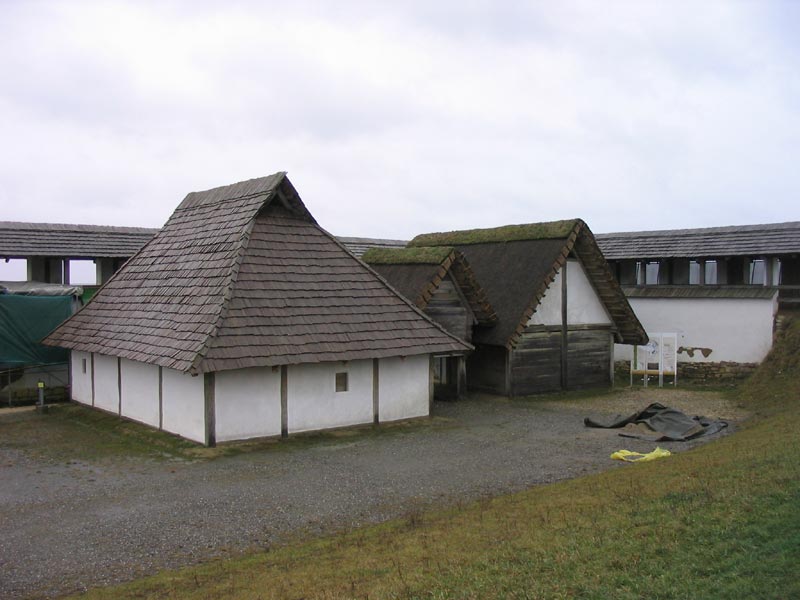
The Heuneburg is a prehistoric Celtic hillfort by the river Danube in Hundersingen near Herbertingen, between Ulm and Sigmaringen, Baden-Württemberg, in the south of Germany, close to the modern borders with Switzerland and Austria. It is considered to be one of the most important early Celtic centres in Central Europe, particularly during the Iron Age Hallstatt culture period. Apart from the fortified citadel, there are extensive remains of settlements and burial areas spanning several centuries.
The fortified citadel measures about 300 by 150 m (980 by 490 ft). It stood on a strategically positioned mountain spur that rises steeply 40 m (130 ft) above the Danube. It is at the centre of a fertile river plain, surrounded by rolling hill country. During the Iron Age the Heuneburg is thought to have controlled a surrounding area of over 1,000 km2 (390 sq mi) including other hilltop settlements, hamlets, villages, roads, cemeteries and cult or gathering places.
The settlement has been called "oldest city north of the alps", and has been identified with the Celtic city of Pyrene mentioned by Herodotus.
..."The Istros river arises among the Celts and the polis of Pyrene, cutting Europe across the middle" — Herodotus (c.484–c.425 BC).
Text adapted from “Heuneburg” on Wikipedia, CC BY-SA 4.0.
Heuneburg ranks #906 of 9,035 worldwide in the atlas's castle fame ranking, and #72 of the 709 mapped in Germany. Founded c. 600 BC, it is older than 99% of the atlas's dated landmarks, one of 10 atlas entries founded in the 6th century BC. Its Wikipedia articles were opened 7,318 times in the last 60 days, more than 91% of the atlas. 2 more atlas landmarks stand within 25 km. The nearest day-trip guide is Stuttgart, 78 km away. See how Germany compares in the castle statistics.
View on the interactive castle map →