Ruin
Hinoe Castle
🇯🇵 Japan · 13th century
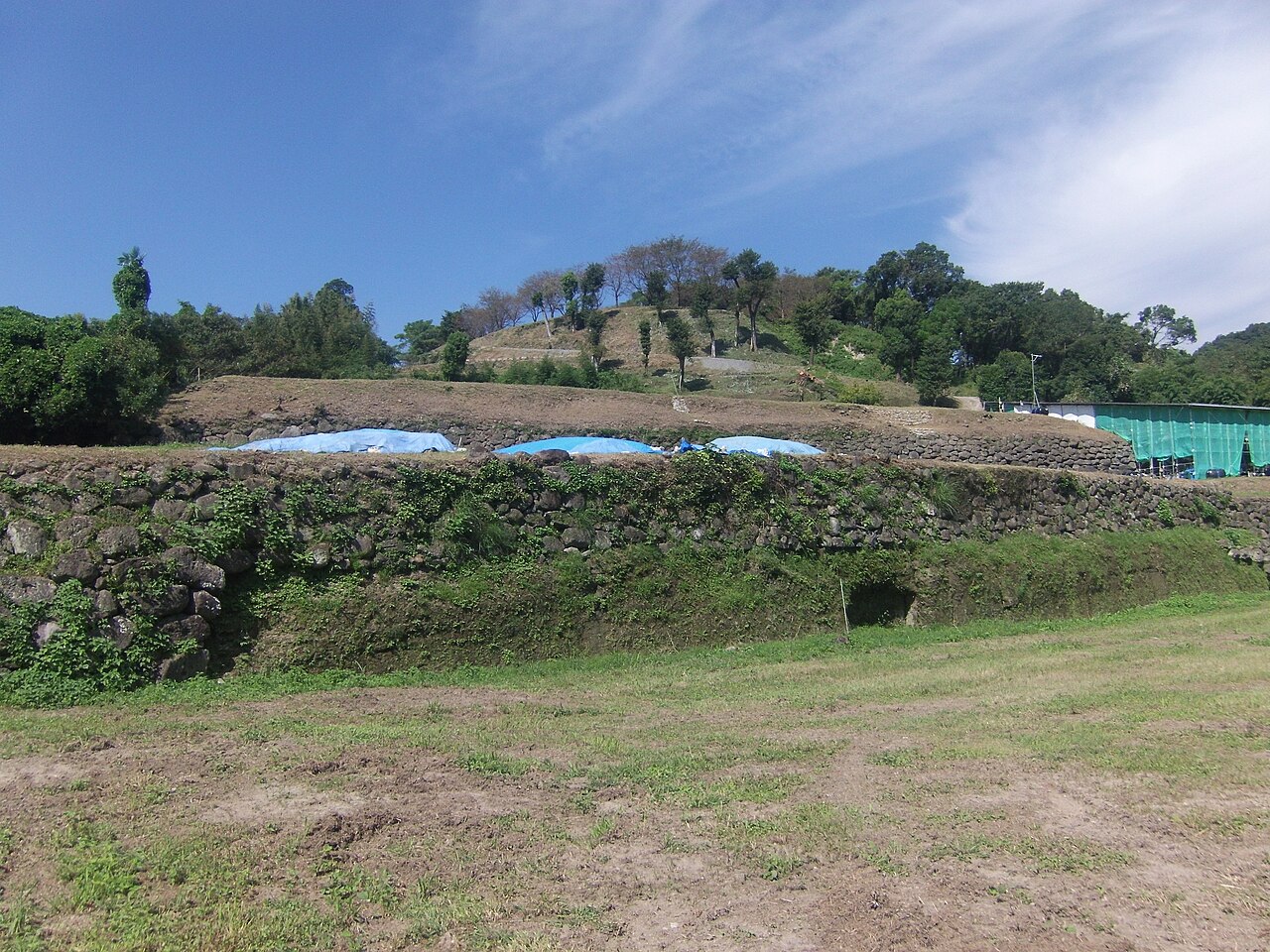
The Hinoe Castle (日野江城, Hinoe-jō) was a Sengoku period Japanese castle cemetery located in the Kita-Arima neighbourhood of city of Minamishimabara, Nagasaki Prefecture Japan. Its ruins were designated a National Historic Site of Japan in 1972.
Hinoe Castle is located on a hill near the mouth of the Arima River, almost in the urban center of Minamishimabara. The site is at the tip of long ridge continued southward from Mount Unzen, at the south coast of the Shimabara Peninsula. The Arima River flows to the south, and the Ote River flows to the east. The existing castle is a mountain castle from the Sengoku period, with many enclosures arranged in a stepped pattern around the main citadel. The main body of Hinoe Castle extended over an area 400 by 200 meters, separated from connecting ridge by valley. The core area of the castle was the eastern half, and consisted of the central enclosure at highest point on the hill, the secondary enclosure to southeast and the third enclosure to the west.
Another peak at western half of the hill was used as a frontal fortification protecting the castle from the castle town, and numerous terraces were also built surrounding these areas. The main gate is presumed to be on the east side, and the remains of a staircase stretching over 100 meters that reaches all the way to the bottom of the main enclosure.
A castle was built on this site by Fujiwara Tsunezumi, who ruled parts of the Shimabara Peninsula during the early Kamakura period. Tsunezumi claimed descendant from Fujiwara no Sumitomo (although he also claimed descent from the Taira clan or the Northern Fujiwara clan as circumstances warranted), and at the time of the castle's construction, he took the surname Arima. By the Sengoku period, the Arima clan had conquered the various powers within Shimabara Peninsula. Arima Takazumi built Hara Castle as a subsidiary castle to Hinoe Castle and during his rule, the Arima clan's territory reached its largest, growing to 210,000 koku and controlling most of Hizen Province. The Arima earned enormous profit from marine transportation, and in 1550 the Portuguese began to trade at Kuchinotsu port next to Hinoe Castle. However, when the Ōuchi clan, which had been their backer, was destroyed, the Arima came under pressure from the Ryūzōji clan.
Text adapted from “Hinoe Castle” on Wikipedia, CC BY-SA 4.0.
Hinoe Castle ranks #4,050 of 8,134 worldwide in the atlas's castle fame ranking, and #203 of the 297 mapped in Japan. Founded c. 1210, it is older than 76% of the atlas's dated landmarks — one of 861 atlas entries founded in the 13th century. Its Wikipedia articles were opened 1,133 times in the last 60 days, more than 52% of the atlas. 2 more atlas landmarks stand within 25 km. The nearest day-trip guide is Kumamoto, 45 km away. It is one of the 37 landmarks on the atlas's regional map of Kyushu. See how Japan compares in the castle statistics.
View on the interactive castle map →Frequently asked questions
Where is Hinoe Castle?
Hinoe Castle stands in Japan, at 32.65995°, 130.2528°.
When was Hinoe Castle built?
The atlas dates its founding to c. 1210. Earlier structures may have stood on the site; this is the earliest documented founding year.
How famous is Hinoe Castle?
In this atlas's fame ranking: #4,050 of 8,134 worldwide, and #203 in Japan. Fame here combines how many Wikipedia language editions cover a landmark with how many people read them.
What is the nearest castle to Hinoe Castle?
Hara Castle, about 3 km away.
More castles in Japan
- Takayama Castle Japan · 16th century
- Shōryūji Castle Japan · 14th century
- Tateyama Castle Japan · 16th century
- Miki Castle Japan · 15th century
More ruins
- Château Moncade France · 13th century
- Walled town of Vidoški Bosnia and Herzegovina · 15th century
- Château de Ham France · 11th century
- Château de Bellocq France · 13th century