 Japan · 15th century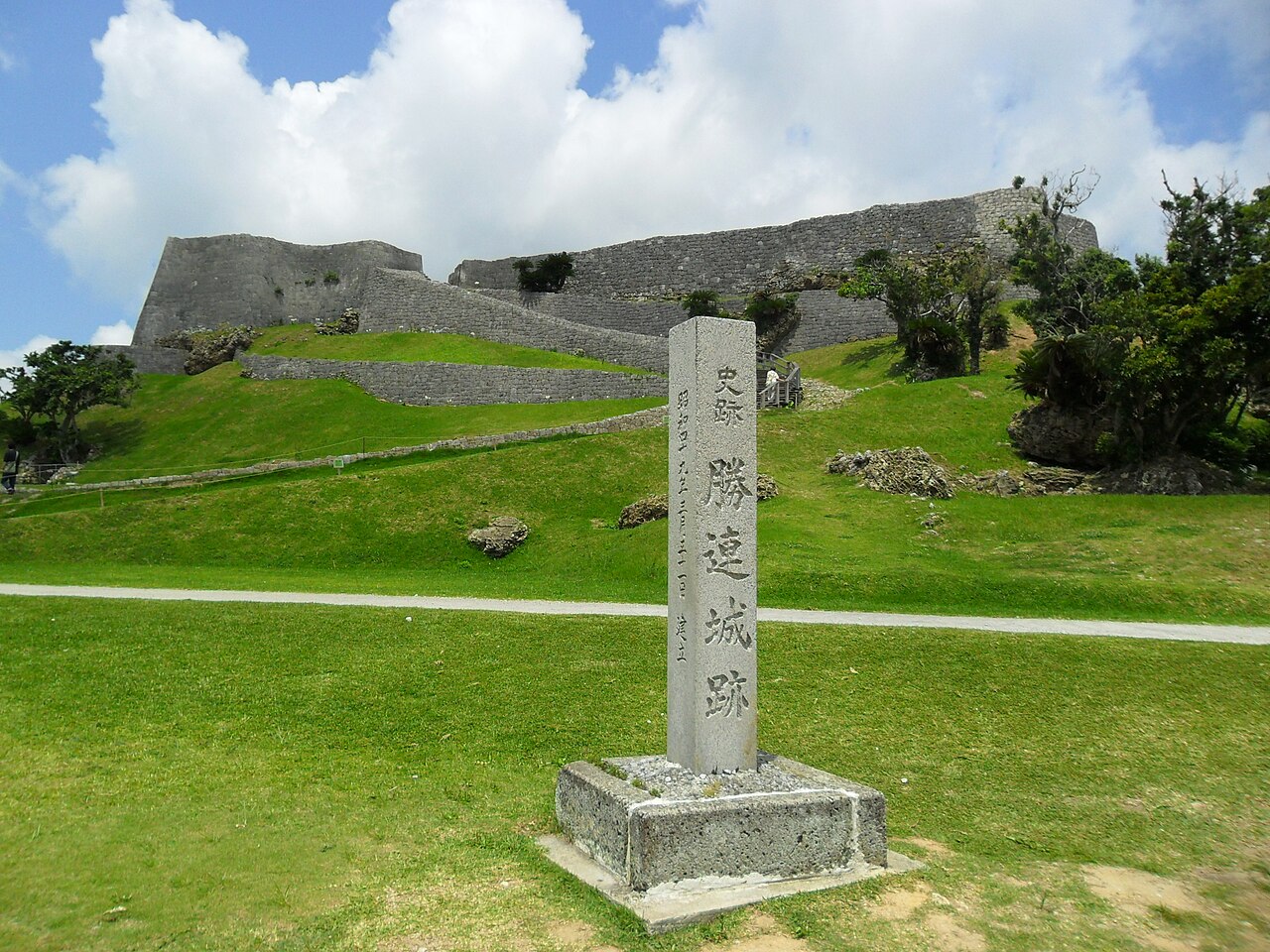
Katsuren Castle (勝連城, Katsuren jō; Okinawan: Kacchin Gusuku) is a Ryūkyūan gusuku fortification located in the city of Uruma, Okinawa Prefecture, Japan. It has been protected by the central government as a National Historic Site since 1972. In 2000, Katsuren Castle was designated as a UNESCO World Heritage Site, as a part of the Gusuku Sites and Related Properties of the Kingdom of Ryukyu.
Katsuren Castle was built on a large hill of Ryūkyūan limestone, at an elevation of 60 to 100 meters above sea level at the southern base of the Katsuren Peninsula. With the Pacific Ocean on two sides, it is also called the "Ocean Gusuku". It consists of the southern castle (Hegusuku), the middle castle (Uchi), and the northern castle (Nishigusuku). The northern castle has three baileys (the first, second, and third baileys) separated by stone walls (baileys are also called kuruwa). The first, second, and third baileys are connected in a stepped pattern, with the first bailey being the highest. In the second bailey, the remains of a relatively large building, approximately 17 meters in front and 14.5 meters in depth, were discovered.
It is believed to have been a shrine building with evenly spaced pillars and foundation stones. While roofs were primarily made of shingles when the castle was built, Japanese-style roof tiles have also been discovered nearby. The Haebaru settlement (Haebaru Furushima ruins) stretched to the south of the castle, serving as a port for trade.
Katsuren Castle was built in the early 14th century by Katsuren Aji, the fifth son of Taisei, the second king of the Eiso dynasty. Its "golden age" was in the mid-15th century, under Amawari, (the 10th Katsuren Aji). Amawari staged a coup against the 9th Katsuren Aji, Mochitsuke Aji, who was oppressive and an alcoholic. He then took over as Aji and promoted international trade, becoming increasingly powerful. After defeating Gosamaru in the Gosamaru-Amawari Rebellion, Amawari attempted to unify the Ryūkyū Islands, even overthrowing King Shō Taikyū, but was defeated by the royal court in 1458. The castle fell into ruins after that.
Chinese Yuan Dynasty ceramics (blue and white porcelain) have been excavated within the castle, and the prosperity of the time can be seen in the "Omoro Sōshi.
Text adapted from “Katsuren Castle” on Wikipedia, CC BY-SA 4.0.
Katsuren Castle ranks #1,418 of 9,079 worldwide in the atlas's castle fame ranking, and #72 of the 296 mapped in Japan. Founded c. 1450, it is older than 47% of the atlas's dated landmarks — one of 554 atlas entries founded in the 15th century. Its Wikipedia articles were opened 2,877 times in the last 60 days, more than 77% of the atlas. 5 more atlas landmarks stand within 25 km. See how Japan compares in the castle statistics.
View on the interactive castle map →