 Japan · 17th century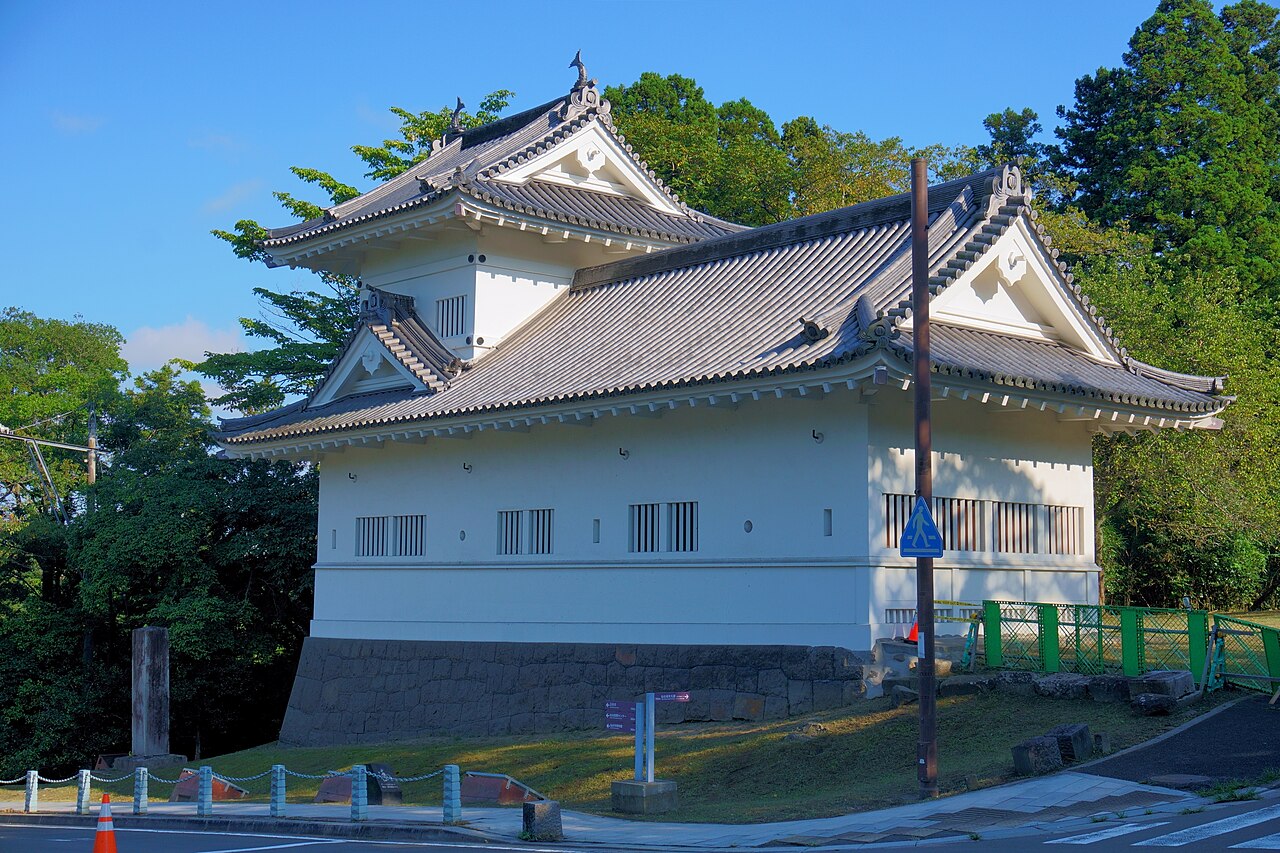
Aoba Castle (青葉城, Aoba-jō) is a Japanese castle located in Sendai, Miyagi Prefecture. Throughout the Edo period, Aoba Castle was home to the Date clan, daimyō of Sendai Domain. The castle was also known as Sendai-jō (仙台城) or as Gojō-rō (五城楼). In 2003, the castle ruins were designated a National Historic Site.
Aoba Castle is located on a plateau overlooking the city of Sendai, on the opposing bank of the Hirose river. The site is protected by cliffs to the south and east and by a forest to the west. This forest was strictly guarded in the Edo period and is a rare survivor of the original virgin forests of Honshū. The area is now managed as a botanical garden by Tohoku University.
The castle hill is partially surrounded by the Hirose river to the north and east, and a steep slope protects the south. The honmaru (inner bailey) is about 115 meters high and is a roughly square-shaped area 250 meters long surrounded by stone walls, in some places 15 meters high. It contained the foundation for the tenshu, (equivalent to the main keep of European castles); however, only the foundation base was ever built. Instead, the honmaru was protected by four three-story yagura. The daimyō residence within the honmaru was built in the flamboyant Momoyama style, and contemporaries compared it with Toyotomi Hideyoshi's legendary Jurakudai Palace in Kyoto.
North of the honmaru was the ni-no-maru (second bailey) and the san-no-maru (third bailey), followed by an area containing the residences of the highest samurai officials of the domain. The ni-no-maru was used for both governmental functions and was the location of the main residence of the daimyō. The honmaru was reserved only for certain ceremonial functions. A bridge across the Hirose river led to the higashi-no-maru (east bailey), which also had the ōte-mon (main gate) of the castle.
The location of Aoba Castle, a small hill called Mount Aoba, was the site of a fortified residence of a branch of the Shimazu clan, the nominal kokushi of Mutsu Province from the early Kamakura period. In the Muromachi period, it was controlled by the jizamurai Kokubun clan, which was in turn destroyed by the Date clan.
Following the Battle of Sekigahara in 1601, the area was visited by Tokugawa Ieyasu, who renamed Mount Aoba "Sendai".
Text adapted from “Aoba Castle” on Wikipedia, CC BY-SA 4.0.
Sendai Castle ranks #792 of 9,079 worldwide in the atlas's castle fame ranking, and #36 of the 296 mapped in Japan. Founded 1601, it is older than 31% of the atlas's dated landmarks — one of 721 atlas entries founded in the 17th century. Its Wikipedia articles were opened 10,110 times in the last 60 days, more than 94% of the atlas. 1 more atlas landmarks stand within 25 km. See how Japan compares in the castle statistics.
View on the interactive castle map →