 Lithuania · 14th century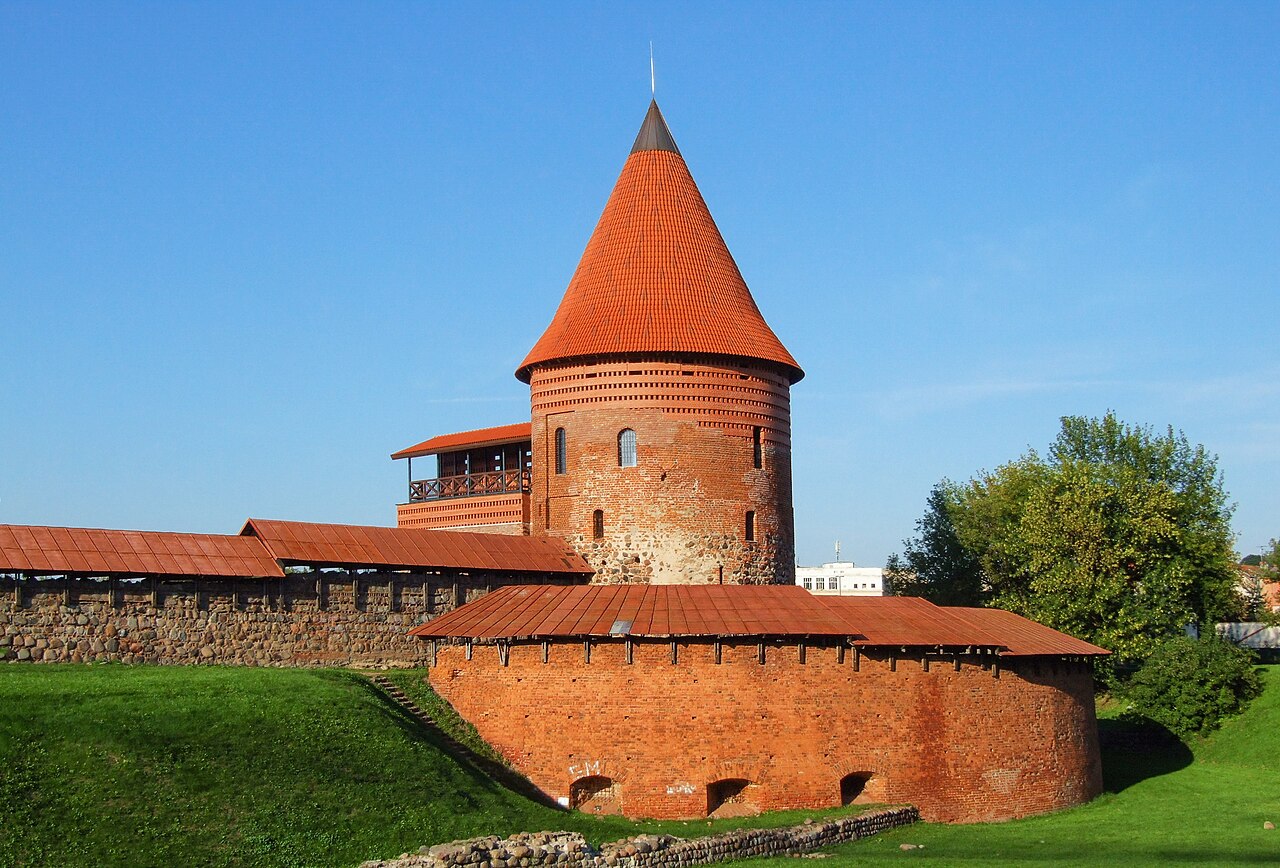
Kaunas Castle (Lithuanian: Kauno pilis) is a medieval castle in Kaunas, the second-largest city in Lithuania. Archeological evidence suggests that it was built during the mid-14th century in the Gothic style. Its site is strategic—a rise on the banks of the Nemunas River near its confluence with the Neris River. As of the 21st century, roughly one-third of the original castle remains.
The precise construction date of the first Kaunas Castle is unknown. Archaeological data suggests that a stone castle was built on the site during the middle of the 14th century. Situated on an elevated bank near the river junction about 100 kilometers (62 mi) from the capital city of Vilnius, it served as a strategic outpost. It guarded nearby cities as well as trade routes. The castle was the property of the Ruler of Lithuania.
A written account states that in 1361, the Grand Master of the Teutonic Knights Winrich von Kniprode issued an order to gather information about the castle, specifically the thickness of its walls, as preparation for an assault on the castle. In March–April 1362, the castle was besieged by the Teutonic Order. During this attack, the Knights constructed a siege tower and erected wall-penetration machinery; primitive firearms might have been used since gunpowder technology was emerging in Europe. At that time, the castle walls were over 11 meters (36 feet) high when its firing galleries were factored in. According to Wigand of Marburg, the castle's garrison consisted of about 400 Lithuanian soldiers, commanded by Prince Vaidotas, son of Grand Duke Kęstutis.
After three weeks, the Knights breached the castle's walls and soon took the castle. On Easter Sunday in 1362, the Knights conducted a Mass at the castle to commemorate their victory.
Apparently, of the castle's defense force of 400, only 36 survived. Questions remain about the castle's defenders' lack of support from outside during the siege. In any event, Kęstutis soon regained and rebuilt Kaunas Castle, but it remained a point of contention between Lithuanians and Teutonic Knights for many years. In 1384, Kaunas Castle was re-captured by the Teutonic Knights. At this time, Grand Master Konrad Zöllner von Rotenstein began the reconstruction of Kaunas Castle and renamed it Marienwerder. The Knights' presence in Kaunas threatened the entire defensive system of castles along the Nemunas.
Text adapted from “Kaunas Castle” on Wikipedia, CC BY-SA 4.0.
Kaunas Castle ranks #872 of 9,079 worldwide in the atlas's castle fame ranking, and #5 of the 32 mapped in Lithuania. Founded c. 1350, it is older than 55% of the atlas's dated landmarks — one of 755 atlas entries founded in the 14th century. Its Wikipedia articles were opened 4,530 times in the last 60 days, more than 85% of the atlas. 3 more atlas landmarks stand within 25 km. The nearest day-trip guide is Kaunas, 3 km away. See how Lithuania compares in the castle statistics.
View on the interactive castle map →