 Croatia · 9th century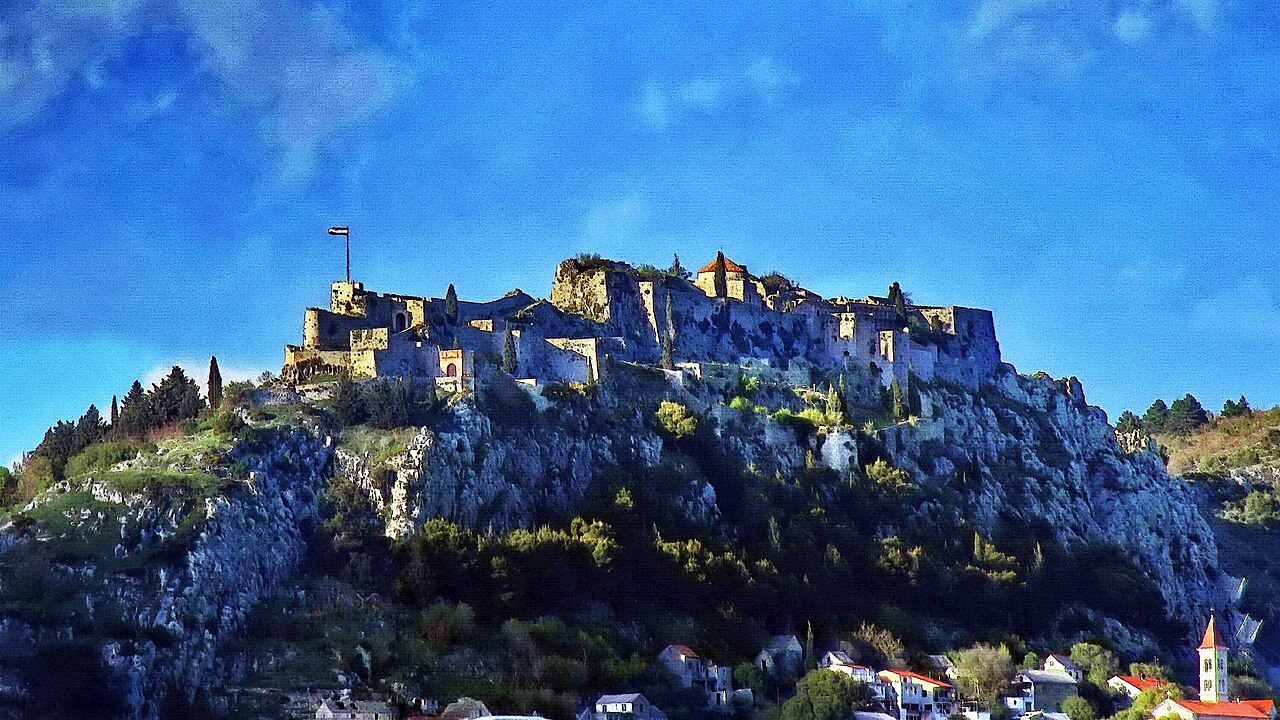
The Klis Fortress (Croatian: Tvrđava Klis; Italian: Fortezza di Clissa) is a medieval fortress situated above the village of Klis, near Split, Croatia. From its origin as a small stronghold built by the ancient Illyrian tribe Dalmatae, to a role as royal castle and seat of many Croatian kings, to its final development as a large fortress during the Ottoman wars in Europe, Klis Fortress has guarded the frontier, being lost and re-conquered several times throughout its 2,000-year history. Due to its location on a pass that separates the mountains Mosor and Kozjak, the fortress served as a major source of defense in Dalmatia, especially against the Ottoman Empire. It has been a crossroad between the Mediterranean Sea and the Balkans.
Since Duke Mislav of the Duchy of Croatia made Klis Fortress the seat of his throne in the middle of the 9th century, the fortress served as the seat of many Croatia's rulers. His successor, Duke Trpimir I, is significant for spreading Christianity in the Duchy of Croatia. He expanded the Klis Fortress, and in Rižinice, in the valley under the fortress, he built a church and the first Benedictine monastery in Croatia. During the reign of the first Croatian king, Tomislav, Klis and Biograd na Moru were his chief residences.
In March 1242 at Klis Fortress, Tatars serving in the Mongol army suffered a major defeat while in pursuit of the Hungarian army led by King Béla IV. During the Late Middle Ages, the fortress was governed by Croatian nobility, amongst whom Paul I Šubić of Bribir was the most significant. During his reign, the House of Šubić controlled most of modern-day Croatia and Bosnia. Excluding the brief possession by the forces of Bosnian King, Tvrtko I, the fortress remained in Hungaro-Croatian hands for the next several hundred years, until the 16th century.
Text adapted from “Fortress of Klis” on Wikipedia, CC BY-SA 4.0.
Klis Fortress ranks #525 of 9,079 worldwide in the atlas's castle fame ranking, and #3 of the 79 mapped in Croatia. Founded c. 850, it is older than 94% of the atlas's dated landmarks — one of 88 atlas entries founded in the 9th century. Its Wikipedia articles were opened 7,585 times in the last 60 days, more than 91% of the atlas. 10 more atlas landmarks stand within 25 km. The nearest day-trip guide is Split, 9 km away. It is one of the 32 landmarks on the atlas's regional map of Dalmatia. It is stop 10 of 21 on the Dalmatian fortress coast, Zadar to Dubrovnik. See how Croatia compares in the castle statistics.
View on the interactive castle map →