 Poland · 18th century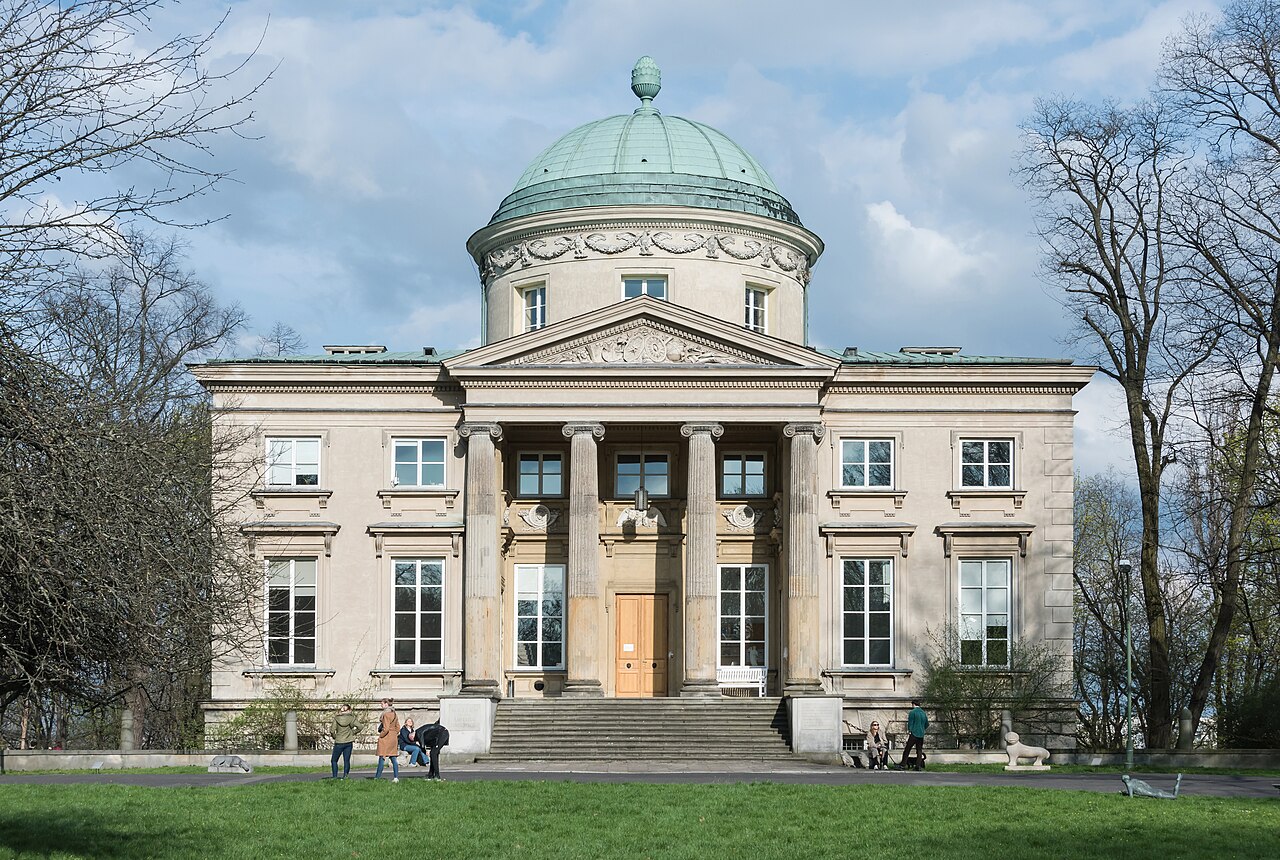
Królikarnia (in English, "The Rabbit House") is a historic classicist palace in Warsaw, Poland; and a neighborhood in the Mokotów district of Warsaw.
Since 1965, the palace has housed a museum dedicated to Polish sculptor Xawery Dunikowski.
The palace is named for its former function as a rabbit warren for Poland's King Augustus II the Strong (reigned 1697–1706 and 1709–33).
The Królikarnia was erected on the picturesque Wisła River escarpment between 1782 and 1786 for King Stanisław August Poniatowski's Theatre Entrepreneur and Chamberlain, Charles Thomatis, Count de Valéry, by royal architect Domenico Merlini. It was modeled after the famous Renaissance-era Villa Rotonda outside Vicenza, Italy, designed by Andrea Palladio.
On his estate, the Count established a brewery, brickyard, inn, mill, barn, and garden with vineyard. Thomatis has also been described as a pimp for King Stanisław August Poniatowski (reigned 1764–95); and the Count's "villa at Królikarnia [as] little more than a high-class brothel".
In 1794, during the Kościuszko Uprising, the insurrection's leader Tadeusz Kosciuszko resided in the palace.
In 1816, the estate was purchased by Michał Hieronim Radziwiłł, and in 1849 by Ksawery Pusłowski, a passionate art collector. In 1879, the palace was partly destroyed by fire, and shortly afterward was rebuilt for the Pusłowski family by Józef Huss.
During World War II, in 1939 and 1945, the Królikarnia was completely destroyed by German bombardments.
In 1964, it was rebuilt to house a collection of sculptures by Xawery Dunikowski, and now houses the Xawery Dunikowski Museum of Sculpture, opened in 1965. The Museum is a branch of the National Museum in Warsaw.
Text adapted from “Królikarnia” on Wikipedia, CC BY-SA 4.0.
Królikarnia ranks #1,725 of 9,079 worldwide in the atlas's castle fame ranking, and #58 of the 398 mapped in Poland. Founded 1786, it is older than 13% of the atlas's dated landmarks — one of 696 atlas entries founded in the 18th century. Its Wikipedia articles were opened 3,007 times in the last 60 days, more than 78% of the atlas. 44 more atlas landmarks stand within 25 km. The nearest day-trip guide is Warsaw, 5 km away. See how Poland compares in the castle statistics.
View on the interactive castle map →